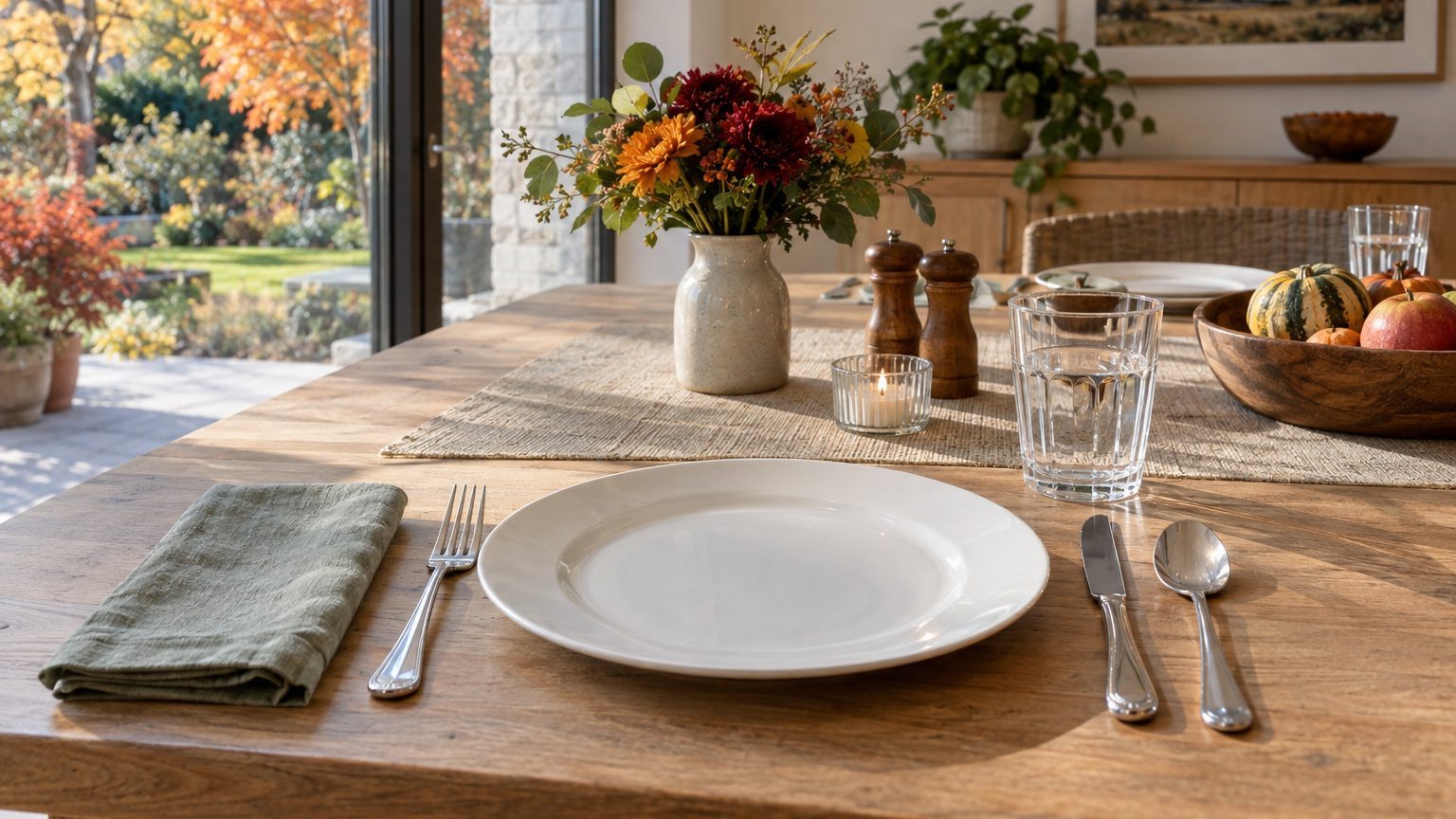
To set a basic table, put the dinner plate in the center of each place. Forks go on the left. The knife goes on the right with its blade facing the plate, and the spoon sits to the right of the knife. The water glass goes above the knife, and the napkin goes to the left of the forks or on the plate. Arrange utensils in the order you’ll use them, from the outside in. For a casual meal, set only what the menu needs. For a formal one, add a salad fork, soup spoon, bread plate, extra glasses and dessert utensils.
Basic table setting
What goes at each place: plate, fork, knife, spoon, glass, napkin
Six pieces cover most weeknight dinners: a dinner plate, a dinner fork, a dinner knife, a spoon (if the menu calls for one), a water glass and a napkin. The plate is the “hub of the wheel,” in Emily Post’s phrase, and it’s the first thing to go down. Everything else is positioned around it.
Step-by-step order for setting one place
Work in the same sequence at every seat and the table builds itself. Repeat this checklist for each guest:
- Set the dinner plate in the center of the place, about an inch or two from the table edge.
- Lay the fork to the left of the plate.
- Place the knife immediately right of the plate, blade turned toward it.
- Add the spoon to the right of the knife, only if a spoon course is coming.
- Put the water glass above the knife, at the tip or angled slightly to the right of it.
- Finish with the napkin, either to the left of the fork or centered on the plate.
The “forks left, knives and spoons right” rule and the blade-in rule
Emily Post’s memory aid is the word FORKS. Read left to right, F is for fork, the O is the plate (note its shape), K is for knives and S is for spoons. Forget the R. A second trick uses your hands: touch thumb to forefinger on each to form a lowercase “b” on the left and a “d” on the right. Bread goes left, drinks go right.
Emily Post’s memory aid is the word FORKS. Read left to right, F is for fork, the O is the plate (note its shape), K is for knives and S is for spoons. Forget the R. A second trick uses your hands: touch thumb to forefinger on each to form a lowercase “b” on the left and a “d” on the right. Bread goes left, drinks go right (Where Does the Bread Plate Go explains the placement in more detail).
Casual table setting
What to include and what to skip for an everyday or relaxed holiday meal
The governing rule, straight from Emily Post: set the table only with utensils you will use. Not serving soup? No soup spoon. No salad course? Leave the salad fork in the drawer. A pot-luck with close friends doesn’t need more than the most basic setting, and plenty of families (and restaurants) simply stack the fork, knife and spoon on a napkin to the left of the plate. For more ideas on keeping things relaxed, see this guide to a Casual Table Setting.
When placemats, paper napkins, or a table without a cloth work
Placemats suit everyday meals and protect a wood table from hot dishes. Paper napkins are fine when the food is hands-on or the crowd is big. A bare table works too, and a tablecloth isn’t mandatory even for a nice dinner; Emily Post notes that placemats, and colored or patterned linens, can be just as elegant as white tablecloths. Placemats, if used, sit centered in front of each chair, roughly one to two inches from the table edge.
Formal table setting
Extra pieces added for a multi-course dinner
A formal setting is for a meal of more than three courses, such as a dinner party or a big holiday spread. It’s the informal setting taken further. A charger sits under the dinner plate, and the dinner fork stays on the left, flanked by a salad fork. The salad fork sits outside the dinner fork if the salad comes first, and inside it if the salad follows the main course. A soup spoon joins the knife on the right, and a small bread plate sits above the forks at the upper left, with its butter knife angled so the handle points right.
Glassware multiplies as well. In a formal setting you may have several glasses, such as for different wines, to the right of the water glass. A cap exists too: no more than three of any implement goes on the table at once (the oyster fork is the exception). Anything else arrives with its course.
How a formal place setting differs from a basic one
Dessert utensils bring a visible shift. They can be brought out with dessert or set above the plate from the start, and in the most traditional arrangement the dessert spoon sits above the dessert fork. The napkin may stay to the left or move to the center of the charger. The most formal tables also run on symmetry: place settings evenly spaced, silverware lined up at the same distance from the edge.
| Item | Basic | Casual | Formal |
|---|---|---|---|
| Dinner plate | Center of the place | Center; everyday or paper plates are fine | Center, on top of the charger |
| Salad plate | Skip | Only if salad is served separately | Arrives with the salad course |
| Bread plate | Optional | Skip | Above the forks, upper left |
| Charger | No | No | Yes, under the dinner plate |
| Dinner fork | Left of the plate | Left of the plate, or stacked on the napkin | Left of the plate; the largest fork |
| Salad fork | Only if there’s a salad course | Skip unless needed | Left; outside the dinner fork if salad comes first |
| Dinner knife | Right of the plate, blade in | Right, blade in (or on the napkin) | Right of the plate, blade in |
| Soup spoon | Only if soup is served | Only if soup is served | Right of the knives |
| Dessert utensils | Skip | Bring out with dessert | Above the plate, or brought with the course |
| Water glass | Above the knife | Above the knife | Above the knife, upper right |
| Wine glass | Skip | Optional | Right of the water glass |
| Napkin | Left of the forks or on the plate | Left, or under the utensils | Left, or centered on the charger |
| Placemat or tablecloth | Either | Placemat or bare table | Tablecloth traditional; placemats also work |
| When to use | Everyday dinners | Pot-lucks, relaxed holidays | More than three courses |
How much space does each guest need at the table?
Spacing between place settings and distance from the table edge
Plan on about 24 inches of table edge per person. Furniture planners often stretch that to 26 to 30 inches for armchairs or formal service, and some accept as little as 18 to 24 for a snug fit. A 72-inch table, then, seats three per long side with no room to spare. Keep the plate and utensils about one to two inches from the edge. Emily Post gives that range for placemats, and for the most formal tables, silverware should line up at the same distance all the way around.
Adjusting the layout when the table is crowded
When guests outnumber seats, trim the setting, not the elbow room. Drop the bread plate, skip the salad fork, and pass the bread in a basket. Hold wine glasses for the table instead of at each place, and move shared dishes to a sideboard. Emily Post also warns against overcrowding, and advises arranging decor so diners seated opposite can still see each other. Behind the chairs, leave at least 36 inches between the table edge and the nearest wall so people can pull out a chair and sit down; allow 42 to 48 inches if guests need to walk behind seated diners.
How far ahead can you set the table?
What to set the day before and what to add at the last minute
Setting the table the night before works well for many hosts, and the reasoning holds up: you discover the missing fork or the short stack of napkins while there’s still time to fix it. A workable timeline looks like this. The day before, lay the tablecloth or placemats, plates and chargers, flatware, empty glasses and folded napkins. On the day, fill the water glasses, light any candles, and put out bread plates’ butter. For a holiday spread, our thanksgiving table setting guide builds on this same timeline with seasonal touches.
Keeping the table clean and dust-free until guests arrive
An early table needs protection. Drape a clean sheet or lightweight cloth over the settings, or turn glasses upside down and rest the napkins on the plates. Remove the cover just before guests arrive. Do a quick wipe of the rims with a dry cloth, and keep food, pets and pass-through foot traffic away from the table.
What are common table setting mistakes?
Reversed or misplaced utensils
The classic slip is flipping the knife so the blade faces away from the plate. Others include forks on the right, a water glass on the left, and the bread plate drifting to the right side (the “b” and “d” trick catches that). Another: setting the salad fork in the wrong spot. If the salad comes first, it goes outside the dinner fork. If it follows the main course, it goes inside.
Too many pieces for the meal being served
A place setting is a menu in miniature. Every piece promises something to the guest, so an unused soup spoon or a dessert fork with no dessert ever served creates confusion. Match the pieces to the menu. If the dinner knife can handle every course, as it often does at an informal meal, give guests one and keep the table calm.
A quick final check before guests sit down
Walk the table once, in this order:
- Forks left, knives and spoons right, blades facing the plate.
- Utensils ordered by use, outside to inside.
- Water glass above the knife, wine glasses to its right.
- Napkins placed, plates the same distance from the edge at every seat.
- Nothing on the table that the menu won’t use.
Frequently Asked Questions
Which way should the knife blade face on a table setting?
The blade faces the plate. The knife sits immediately to the right of the plate, cutting edge turned inward. This keeps the sharp side away from the neighboring guest and follows the traditional layout.
How many forks should be at a place setting?
Basic and casual settings usually need one fork, or two if there’s a separate salad or appetizer course. Formal settings add forks for each course, but no more than three of any implement go on the table at once. Anything beyond that is brought out with its course.
Do you need a tablecloth to set a table?
No. A bare table or placemats work well for everyday and casual meals. Even a formal meal can look beautiful without a cloth, and colored or patterned linens can be just as elegant as white ones.
Where do you put the dessert fork and spoon?
Either above the plate before the meal or brought out with the dessert course. The traditional arrangement puts the dessert spoon above the dessert fork, though you’ll see both configurations. If you set them early, keep them horizontal and centered above the plate.
Can you use placemats instead of a tablecloth for a nice dinner?
Yes. Placemats are fine for everyday and most nice dinners; a white tablecloth is still considered the most formal choice. Center one in front of each chair, about one to two inches from the table edge.
Sources: ablissfulnest.com | belfurniture.com | bydesignandviz.com