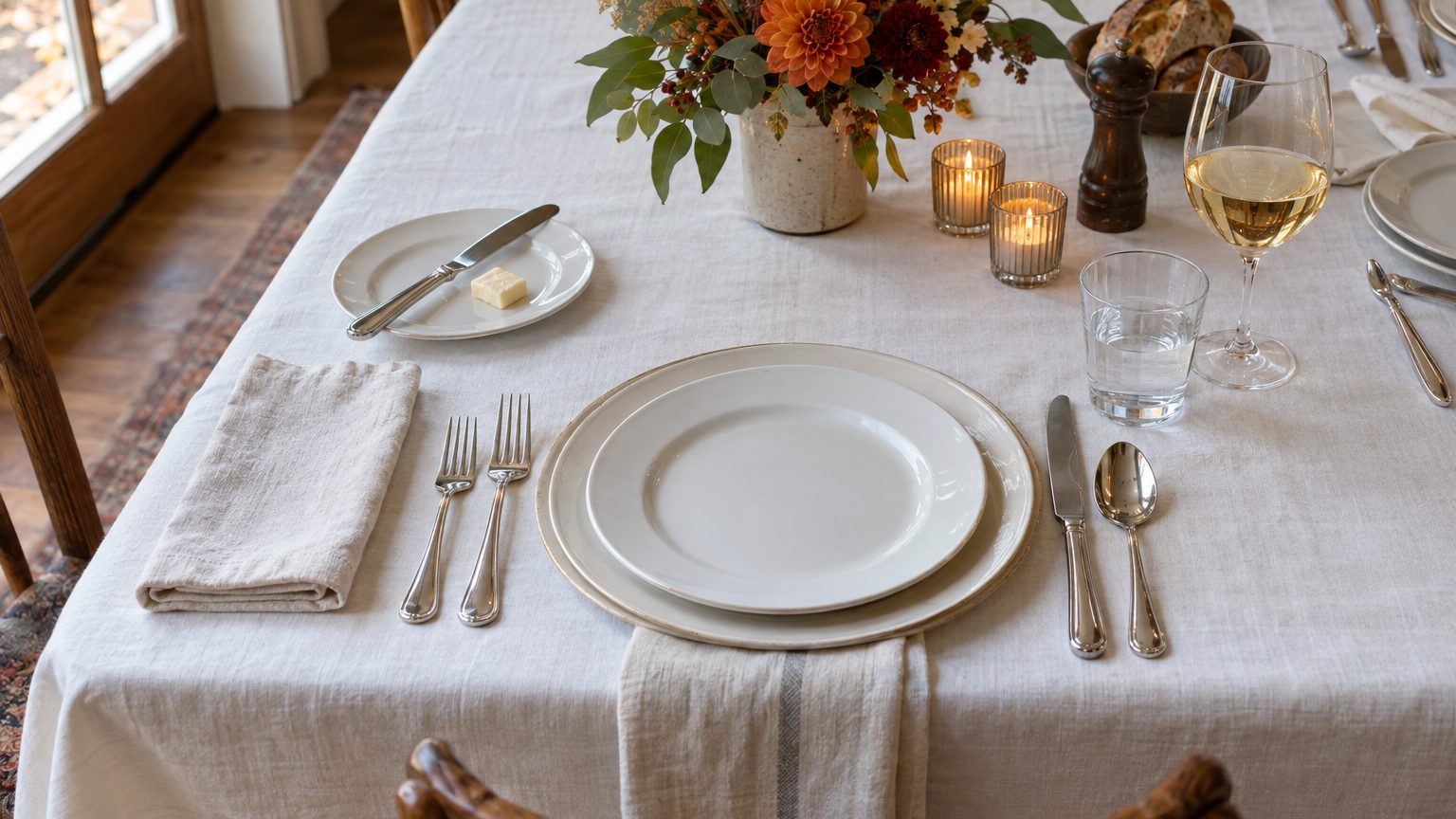
The bread plate sits above the forks, at the upper left of the place setting
. That puts it on the left of the water glass and just above the forks.
The butter knife rests on the plate with its blade facing inward toward the diner and its handle pointing right
, laid on a diagonal. A memory aid covers the rest of the layout: BMW. Bread on the left, Meal in the middle, Water on the right.
Keep this table open while you set the table. The diameters are typical ranges, so your own dishes may differ by half an inch.
| Item | Position | Typical diameter | Distance from table edge | Use it when | Skip it when |
|---|---|---|---|---|---|
| Bread plate | Upper left, above the forks, roughly in line with the glasses | About 6 in. | No fixed gap; sits above the forks, not at the edge | Rolls and butter are on the table | The table is crowded or the meal is casual |
| Butter knife | Diagonally across the bread plate, blade in, handle right | Not applicable | Follows the bread plate | Butter is passed at the table | There is no bread plate |
| Salad plate | Left of the forks, or on top of the dinner plate | 7 to 8 in. | Follows the dinner plate when stacked | A separate salad course is served | Salad shares the dinner plate, or space is tight |
| Charger plate | Center of the setting, under the dinner plate | 12 to 14 in. | About 1 in. | A formal, multi-course dinner | Only one course is served |
| Dinner plate | Center of the setting, on the charger if you use one | 10 to 11 in. | About 1 in. | Any plated, sit-down meal | Bowl-only, buffet or finger-food meals |
Bread plate and butter knife placement
The short answer: upper left, above the forks
Most people ask which side, because the plate is small and easy to lose among the glasses. It goes on the left, with the forks, napkin and bread. Drinks live on the right. For a Thanksgiving table,
the plate sits above the forks and napkin and roughly in line with the glasses, with room to adjust to fit your table
.
How to angle the butter knife on the bread plate
Lay the knife across the plate on a diagonal, about 45 degrees.
The older formal wording runs from upper left to lower right
. The handle ends up pointing right, so a right-handed guest can grab it without moving the plate. Parallel to the table edge also works. Either way, the sharp edge faces you.
The BMW trick: bread, meal, water
Read the setting left to right and you get the acronym. Bread plate on the left, the meal (dinner plate and flatware) in the center, water glass on the right. If you blank on a detail halfway through setting eight places, BMW tells you which side of the plate you’re on. The forks-left, knives-right rule handles the rest.
Where does the salad plate go
Salad plate on top of the dinner plate vs. to the left
It depends on timing. When salad comes first, the plate sits on top of the dinner plate or the charger and is cleared before the entrée. When salad is served with the meal,
the salad plate goes to the left of the forks
. At a Thanksgiving dinner, where everything lands at once, the left-of-forks spot is the realistic choice.
What to do when you have both a salad plate and a bread plate
Two small plates on the left side create a traffic jam. Step them: bread plate above the forks, salad plate beside the forks, a little lower. Keep the bread plate’s spot and let the salad plate adapt. If the table can’t take both, apply a simple rule. Serve the salad first and clear it, or put salad on the dinner plate and keep the bread plate. A salad plate in the wrong place hurts less than a crowded left side.
Charger plate placement
How far from the table edge to set a charger
About 1 inch.
Placing it at least an inch in keeps it from hanging over the edge
. Some guides allow up to 2 inches, which is fine if the dinner plate follows the same line. Pick one distance and use the first setting as a template for the rest. Chargers typically run 12 to 14 inches across, so check that the flatware still fits on either side. The formal table setting guide covers where each fork and knife goes.
Stacking order: charger, then the first-course plate
From the bottom: charger, then the first-course plate (a salad plate or soup bowl).
The service plate stays in place during earlier courses, until the entrée plate arrives and the two are exchanged
. In practice, the first course sits on the charger, the empty first-course dish is cleared, and the host swaps the charger for the hot dinner plate. Many hosts instead leave the charger under the dinner plate and clear it after the main course. Either way, no food is served directly on it.
It is decorative and not meant to touch food
.
Do you need a bread plate at a Thanksgiving dinner?
When you can skip it and use the dinner plate
Often, no. Rolls go on the edge of the dinner plate at a casual dinner, buffet or paper-plate game day. Skip the bread plate when you serve only one course and a basket of rolls is going around the table. Keep it when guests will butter several rolls, or when you want a formal look.
Etiquette holds that even at a formal dinner, a butter plate is correct
, because bread shouldn’t land directly on the tablecloth.
Space-saving options for crowded tables
Plate centers about two feet apart is the classic target.
The older formal guidance puts the ideal at about two feet from plate center to plate center
. A crowded holiday table rarely allows that. Decide in this order: drop the charger, then fold salad onto the dinner plate, then drop the bread plate. Pass shared butter instead.
Setting a butter dish within easy reach of every few guests
keeps butter moving. For the full layout see how to set a table.
How do you set a bread plate for a left-handed guest?
You leave the bread plate where it is. The standard layout is built for right-handers, and
the butter knife’s handle points right for that reason
. Moving plates around for one guest confuses everyone else at the table. The easy courtesy is small. Turn that guest’s butter knife so the handle points left, and set the water glass where their left hand won’t knock it. No etiquette rule requires a mirror-image setting. A left-hander can also simply pick up the knife with the right hand or move the plate, and nobody will notice.
What are common bread plate mistakes?
Placing it on the right side with the glasses
Guests then pick up a glass of water or the butter knife by mistake, and the symmetry goes. The fix is the BMW check: bread left, water right. If you’ve set the plate on the wrong side, slide it above the forks before guests sit down.
Setting the butter knife handle-down or crosswise
A knife placed the wrong way around, or flat across the table, looks like a dinner knife. A butter knife is not for cutting turkey.
Even at a casual meal, a used knife should never go back on the tablecloth
, so lay it back on the bread plate. Put it back to a diagonal with the handle right and the blade in. If you’re setting with a full silverware set, see how to set a table with silverware for the knife-and-fork order.
Crowding the bread plate against the water glass
A bread plate wedged next to a glass leaves no room to reach. Leave a gap wide enough that a hand can lift the glass without brushing the plate. If the glass keeps winning, pull the plate in toward the forks.
At dessert, clear the bread plate and butter knife with the other unused items
, which frees up room for coffee cups.
Frequently Asked Questions
Which side does the bread plate go on?
The left. It sits above the forks, at the upper left of the place setting, while glasses go on the right. The BMW rule (bread, meal, water) is the quickest way to remember it.
Does the butter knife go on the bread plate or on the table?
On the bread plate. It rests diagonally, blade facing in and handle to the right.
The Emily Post Institute describes it as placed diagonally on top of the butter plate
. Without a bread plate, use the shared butter dish’s knife instead of placing one on the cloth.
Can I use a salad plate as a bread plate?
Yes, if you don’t have a true bread plate. A 7-inch salad plate is a comfortable stand-in. An 8-inch plate gets large and may crowd the glasses, so choose the smaller one and keep it above the forks.
Do you eat off a charger plate?
No. It is a decorative base and protects the table, and food is never served directly on it. Plates and bowls sit on top of it. It is cleared before dessert at the latest.
What if my table is too small for a bread plate?
Skip it. Put rolls on the edge of the dinner plate and pass butter in a shared dish with its own knife. You keep the left side clear for the napkin and forks, and no one is worse off.
Sources: ampriomilano.com | anzhucraft.com | blog.innstyle.com