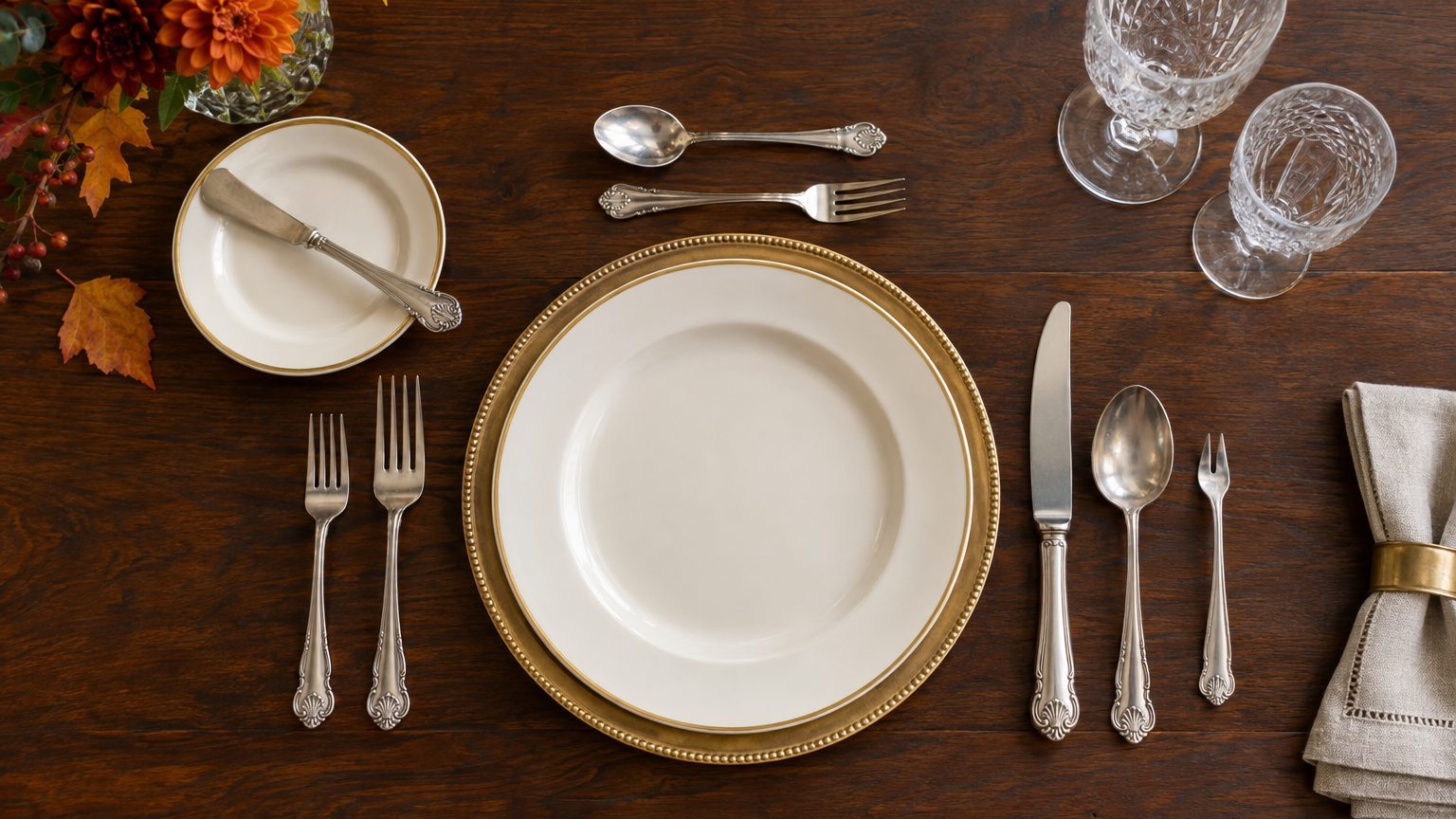
A formal table setting centers a charger and dinner plate at each seat. Forks go on the left. The knife and spoons go on the right, in the order they’ll be used, from the outside in, with the knife blade facing the plate. The dessert spoon and fork lie above the plate. The bread plate and its butter knife sit at the upper left, and the glasses at the upper right.
The napkin may sit to the left of the setting or on the charger.
The rule that keeps this manageable:
no more than three of any one implement are placed on the table at once (the oyster fork is the one exception)
, and anything extra arrives with its course.
Formal table setting diagram
Treat the dinner plate as the origin of a map. If you’re turning this into an annotated graphic, these are the labels, viewed from above. The charger sits under the dinner plate, centered about an inch or so in from the table edge.
A charger may be used or skipped
, but it’s the visual anchor of most formal tables.
To the left of the plate, the dinner fork sits closest and any other forks sit outside it. To the right, the dinner knife sits closest, with its blade toward the plate. The soup spoon sits outside the knife.
If shellfish is on the menu, the oyster fork goes to the right of the spoons.
Above the plate, centered, lie the dessert utensils.
The spoon sits on top with its handle pointing right, and the fork sits just below with its handle pointing left.
At the upper left, above the forks, sits the bread plate. The butter knife rests across it. At the upper right,
the water goblet goes directly above the knives
, with the wine glasses just to its right. If you use a place card, it goes at the top center, above the dessert utensils. For where the bread plate and napkin go in simpler settings, see how to set a table.
Formal dinner place setting diagram
A five-course dinner changes shape as it goes. Take a sample menu: shellfish appetizer, soup, salad, entrée, dessert. Before guests sit, the setting holds an oyster fork, a soup spoon, a dinner knife, a salad fork, a dinner fork, and the dessert pair above the plate. The salad is served before the entrée here, so the salad fork sits outermost on the left.
If the salad followed the entrée,
the small salad fork would sit to the right of the dinner fork, next to the plate.
| Course | Plate or bowl | Utensil(s) set or added | Glass served | Position relative to dinner plate |
|---|---|---|---|---|
| Appetizer (shellfish) | Shellfish plate on the charger | Oyster fork; every other piece is already laid | Champagne flute | Oyster fork right of the spoons; flute at the far right of the glass group |
| Soup | Soup bowl on the charger | Soup spoon, now the outermost piece on the right | Water goblet | Spoon right of the knife; goblet above the knife |
| Salad | Salad plate on the charger | Salad fork, outermost on the left | White wine glass | Fork left; glass to the right of the goblet |
| Entrée | Dinner plate, exchanged for the charger or set on it (see below) | Dinner fork and dinner knife | Red wine glass | Fork left, knife right; glass to the right of the goblet |
| Dessert | Dessert plate | Dessert spoon and fork, already set | Water goblet stays | Both above the plate, spoon handle right, fork handle left |
| Utensils on the table | 7 at the appetizer, 6 at the soup, 5 at the salad, 4 at the entrée, 2 at dessert | |||
Used utensils leave with each plate.
The service plate stays put through the courses before the entrée, then gets exchanged for the entrée plate.
Etiquette sources differ on the next step. Some keep the charger under the entrée, while others pull it as the entrée arrives. Pick one approach and tell whoever is serving.
How many utensils in a formal place setting
Three of any one type, with a single exception.
The exception is the oyster fork, which may join three other forks.
That’s why a formal setting can show four forks without breaking the rule.
The oyster fork is the only fork traditionally placed on the right.
Count by type, not by total.
Read the left side from the outside in. A fish fork,
placed farthest left because it’s the first fork used
, comes before the salad fork or dinner fork, depending on the menu. On the right, the knife closest to the plate is the dinner knife, the soup spoon sits outside it, and the oyster fork sits outside that. Only the dessert pair breaks the left-right pattern, because it sits above the plate. Set it ahead of time, or bring it with the dessert.
Set only what the menu uses. A soup spoon at a soupless dinner is just clutter. When a fourth utensil won’t fit,
the utensil for the fourth course is brought in with the food.
What makes a table setting formal?
Course count is the main dividing line.
The formal place setting is used for a meal of more than three courses, such as a dinner party or a holiday meal.
An informal setting covers three courses. The formal one adds glassware, plates and utensils for the extra courses.
Linens come next.
White linens are still considered the most formal, but colored or patterned cloths and napkins can be just as elegant.
A tablecloth should hang
12 to 18 inches
below the tabletop. Cloth napkins replace paper ones, and the charger replaces the placemat. Then comes stemware.
Glasses can number up to five and are placed in the order they’ll be used.
With more than three, smaller glasses can sit in front.
The water goblet comes first, and a champagne flute or sherry glass,
for a first course or an opening toast, goes to the right of the wine glasses.
Last is symmetry.
The most formal table is strictly symmetrical, with the centerpiece in the exact center, place settings spaced evenly, and silverware lined up at the same distance from the table edge.
How much space does each guest need at a formal table?
Plan on at least 24 inches of table width per guest.
If you have room, 30 inches per guest feels spacious.
A 72-inch rectangular table seats three guests per long side at the 24-inch minimum, and you’d gain breathing room by dropping to two per side. Align flatware about 1 inch from the table edge, and keep it level across every seat.
Placemats, if used, sit one to two inches from the edge.
The centerpiece needs its own clearance. The usual rule for a seated dinner is
under about 12 inches tall
, so guests can see across the table. The other safe option is above 24 inches on a slim stem, which clears the sightline entirely. Anything between the two ends up right at face level. Leave a clear strip of table between the arrangement and the nearest plate so servers and elbows have room.
How do you set a formal table step by step?
Order of setup
Work from the largest pieces to the smallest. Lay the tablecloth first and check the drop on all sides. Position chargers next, using a ruler or a folded napkin to set each one an equal distance from the edge. Add flatware, starting with the dinner fork and knife, then working outward by course. Place the dessert utensils above the plate. Set the bread plate and butter knife at the upper left. Glassware goes in last, so nobody knocks a goblet while reaching across, starting with the water goblet above the knife. Finish with the napkins,
on the charger or to the left of the setting
. For formal settings,
the napkin is not placed under the fork.
A final 60-second check
Walk the table once, seat to seat. Every knife blade faces its plate. The forks count three or fewer, plus an oyster fork if needed. Utensils run in menu order from the outside. Glasses sit in order of use, with the water goblet above the knife. Then stand at one end and check that the rows of chargers, forks and glasses look straight.
What are the most common formal table setting mistakes?
Many errors come from overthinking. These are common ones:
- Knife blade facing out. Blades always face the plate. Rotate any that don’t.
- Utensils out of order. Rebuild from the menu, with the first-used piece farthest from the plate.
- Too many utensils at once. Hold the fourth-course piece back and bring it with the food.
- Mismatched glass order. Put the water goblet above the knife, then the wine glasses by course.
- Uneven spacing. Measure the edge setback and the width per seat, and move anything that drifts.
Frequently Asked Questions
Does the charger stay on the table during the entire formal meal?
No. It holds the appetizer, soup and salad plates, and it’s removed by dessert at the latest.
The entrée plate is traditionally exchanged for it.
Some hosts keep it under the entrée, so check the convention you want to follow.
Do you need a tablecloth for a formal table setting?
Traditionally yes.
White linen is traditionally considered the most formal choice, though colored or patterned cloths can also work.
A cloth also quiets the clink of china and glass.
Where do you put utensils for dessert at a formal dinner?
Place them above the dinner plate, horizontally.
The spoon goes on top with its handle pointing right, and the fork sits below with its handle pointing left.
If the menu needs only one of the two, leave the other off.
What do you do if the menu needs more than three utensils?
Set up to three of any one type, and bring the rest with the course. The oyster fork is the lone exception to the three-piece limit.
Should a formal table setting include place cards?
They’re optional, but they help at larger dinners and holiday meals, since you decide where everyone sits. Center each card above the dessert utensils, or rest it on the charger.
Sources: cbhoreca.com | colorcaravan.com | cvlinens.com