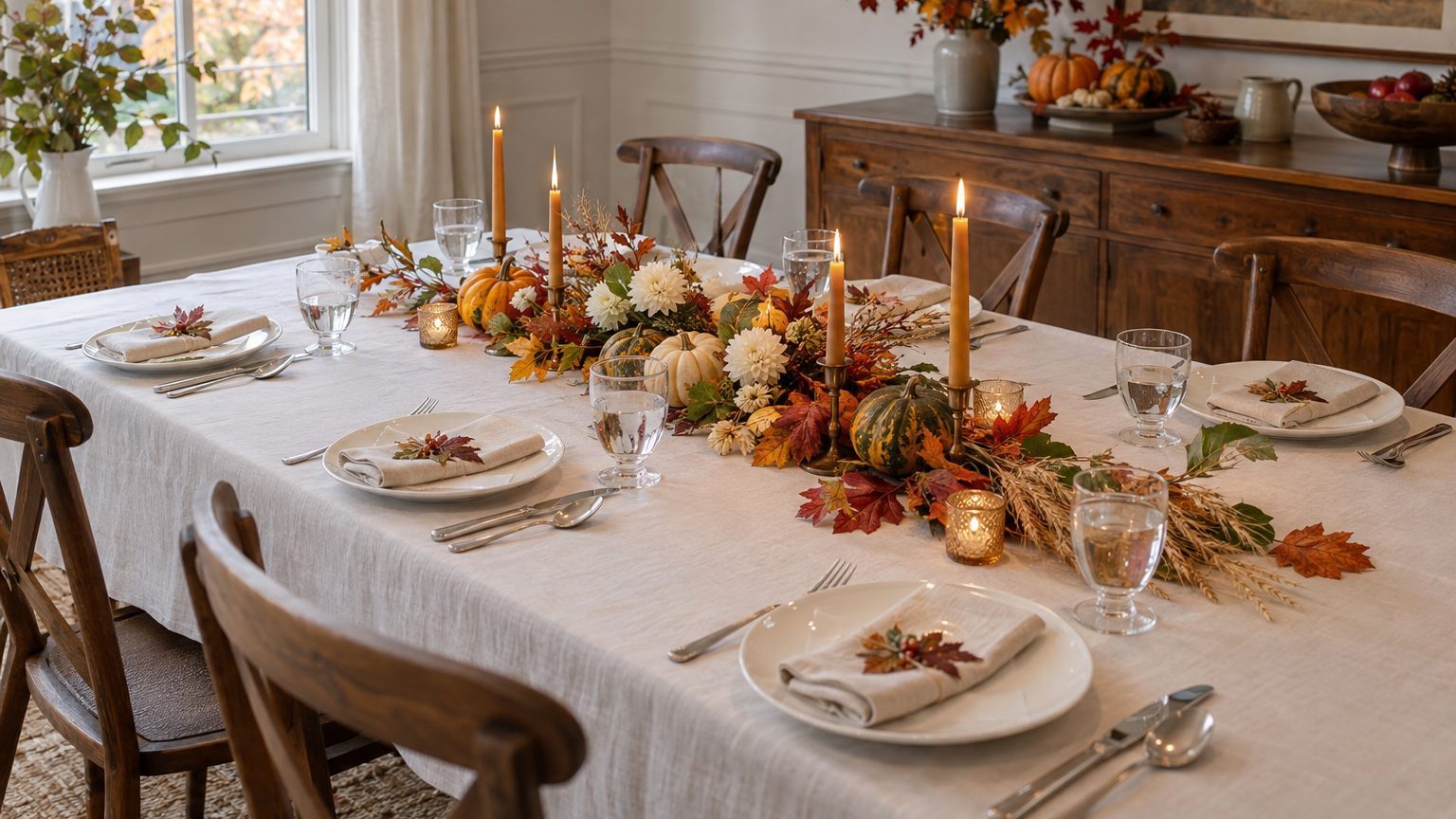
A Thanksgiving table setting starts with a tablecloth or runner. Each guest then gets a dinner plate in the center, forks on the left, a knife and spoon on the right with the
knife blade facing inward toward the plate
, a water glass above the knife, and a napkin on or beside the plate. Add a centerpiece that stays
under about 12 inches tall so seated guests can see each other across the table
. Keep decor minimal so serving dishes fit, and allow
24 inches of table edge per person as the minimum, with 30 inches more comfortable
. Set most of the table the day before. Food, candles, and fresh flowers wait for the day itself.
How to set a table
The basic Thanksgiving place setting, piece by piece
Start in the middle. The dinner plate goes down first, about an inch from the table edge. Then the rule that covers nearly everything:
forks go to the left of the plate, and knives and spoons go to the right
. The only common exception is the oyster fork, which sits to the right of the spoons and rarely shows up at a turkey dinner.
Etiquette guides offer a memory aid: the word FORKS gives you fork, plate, knife, spoon from left to right. The dinner fork sits closest to the plate. The knife sits directly to the right of the plate, and the spoon, if the menu needs one, goes to the right of the knife. The
water glass goes above the knife, or at a 45-degree angle to the right of it
. A cloth napkin goes either to the left of the forks or on the plate.
Choosing a level of formality for your dinner
Formality should follow the menu and the guest list, not a magazine photo. The guiding principle from etiquette authorities is that
any setting is appropriate if it matches the formality of your celebration
. A casual dinner for six might put the fork, knife, and spoon in a neat stack on the napkin. A seated dinner for twelve with grandparents in attendance might call for chargers, a bread plate, and two glasses per person.
Cloth napkins suit any level, since
they can be used in any table setting, regardless of formality
. In a formal setup,
no more than three of any implement are placed in a single setting
. And a formal Thanksgiving can be surprisingly spare:
just one fork and knife if only the main course is served
. Add only the pieces your courses require.
Adding extra pieces for soup, salad, and dessert
Extra courses mean extra tools, set in the order they will be used, working from the outside in. If salad comes first,
the forks run left to right: salad fork, then dinner fork
. A soup spoon goes to the right of the knife. A bread plate sits above the forks,
on the left side of the setting
, with a butter knife laid across it.
Dessert pieces can go above the plate,
a dessert fork handle pointing left and a dessert spoon handle pointing right
. Many hosts skip that row and bring out dessert forks with the pie, which frees up space. A wine glass goes
slightly to the right of, and often a little lower than, the water glass
. Add or drop pieces to match the courses on your menu.
Thanksgiving centerpiece ideas
Height and width rules so guests can see and pass dishes
Twelve inches. That is a common guideline for a seated dinner. Anything between roughly 12 and 24 inches sits at seated eye level, which is why a tall arrangement ends up on the sideboard halfway through the meal. If you want height,
go 24 inches or higher
on a slim stem or stand so guests can look under it.
Width matters as much as height, and it gets less attention. On a 60-inch round table,
keep the centerpiece within about 14 inches wide
. On a 6-foot rectangular table seating six to eight,
two or three small arrangements about 12 inches wide
beat one long one. Several small pieces can be lifted off to make space for the gravy boat. A tray base helps too, because
it lets you move or shorten the display
when the dishes arrive.
Natural, candle-based, and low-cost centerpiece styles compared
Natural centerpieces (mini pumpkins, gourds, pears, branches, dried grasses) cost little, hold up for days, and can be built on a runner a day ahead. Fresh flowers look best when added the morning of dinner. Candle-based centerpieces add a lot of atmosphere for little money, but flame height needs planning. Keep arrangements
under 12 inches, or lift flames well above eye level
. And choose unscented.
Scented candles near a roast or spiced cider often turn muddy
.
Low-cost styles lean on what you already own: a bowl of apples, a few candlesticks in mixed heights, or jar bud vases. A runner with five or six small objects often looks richer than one large arrangement and leaves the center free for platters.
Thanksgiving table decor
Building a color palette and layering textures
Pick two or three colors and one neutral. A fall color palette of burgundy, burnt orange, and deep green against cream is the classic. Gold or brass touches or warm browns work as accents. Then layer texture rather than adding color: a linen tablecloth, a woven or wooden runner, ceramic plates, glass candle holders. Four textures in a narrow palette read as designed. Six colors read as a craft fair.
Table linens carry most of the work, and they can be done early. Etiquette guidance notes that
linens are an easy step to complete the day before Thanksgiving
, and that
cloth napkins are ironed and folded into a rectangle or a triangle
. A tablecloth gives you a full-coverage base. A runner alone suits a handsome wood table you would rather show off. Let the cloth hang evenly over the edge on all sides.
What to skip when the table is already crowded
Decor should support the meal, not compete with serving dishes for space. Skip scattered confetti and loose acorns that end up in the mashed potatoes. Skip tall tapers in every holder, extra chargers if the table is narrow, and anything that needs a second pass to clear before the platters arrive. Leave room for the accessories of the meal:
salt and pepper shakers, bread baskets, and gravy boats
all need a home.
Thanksgiving buffet setup
Deciding between a buffet and a family-style table
Choose a buffet when the guest count exceeds what the table can hold with serving dishes. A short decision guide:
- Seated, plated or passed: six to eight guests at a table with a narrow center strip. Dishes are carried to the table or passed from a sideboard.
- Family-style: a table with a wide center strip, or a guest count comfortably under the table’s capacity. Dishes sit on the table and travel hand to hand.
- Buffet: more guests than seats at the main table, or a table whose center can’t hold the dishes. Food lives on a counter or sideboard, and the table keeps its place settings.
Capacity math decides it. Table length divided by 24 to 30 inches gives seats per side, with
one extra seat at each end on tables 36 inches wide or more
. A hybrid works well: keep the table set for a seated meal and serve from a kitchen island. One tradition does exactly this by
serving buffet style off the kitchen island while the table stays set
.
Traffic flow and the order of dishes
People walk the line left to right, so start with plates.
Begin with dinner plates, then the turkey or main dish, then sides, gravy, and condiments, with rolls, napkins, and flatware at the end
. Putting utensils last means nobody balances a fork while trying to scoop stuffing. Set the buffet where the line can form away from the dining table’s traffic, and put desserts and drinks on a separate surface if you have one.
The USDA’s guidance applies here:
never leave perishable food out at room temperature over two hours, or one hour if the temperature is above 90°F
. For a long buffet, keep hot dishes hot in slow cookers or warming trays, and
nest cold dishes in bowls of ice, or use small platters and replace them often
. Give every dish its own serving utensil.
How far in advance can you set the Thanksgiving table?
What can be done days ahead and what should wait until the day of
Yes, set the table the night before. Everything non-perishable can be done a day or more ahead: linens, plates, silverware, glasses, napkins, place cards, and the base of the centerpiece. Food, fresh flowers, and lit candles wait. The table below shows the full sequence.
| Timeframe | Tasks to complete | Notes |
|---|---|---|
| 1 week before | Check linens and serveware. Count plates, glasses, flatware, serving dishes, and serving utensils against the guest list. Choose the formality level. | Borrow or buy missing pieces now. Nothing perishable is involved yet. |
| 2 to 3 days before | Wash and polish glassware and silverware. Write place cards. Test the centerpiece for height and fit. Decide which dish goes in which serving piece. | Keep candles unlit and in their boxes. Store linens flat or hung until ironing. |
| The day before | Iron the tablecloth and napkins. Spread the cloth, then set plates, silverware, glasses, napkins, and place cards. Arrange the centerpiece base. | Leave off food, fresh flowers, and lit candles. A light cover keeps dust off. |
| The morning of | Add fresh flowers or greenery. Set out empty serving dishes and clear the sideboard or buffet surface. | Flowers go in last so they look their best at dinner. |
| 30 minutes before guests arrive | Light candles. Put out serving utensils. Fill water glasses. Walk the table once, seated, to check sightlines. | Food arrives last. Perishable dishes have a two-hour limit at room temperature. |
How do you fit all the dishes and guests on one Thanksgiving table?
Allowing for elbow room, serving dishes, and decor
Think of the tabletop as a budget with three accounts: place settings, serving dishes, and decor. Place settings get paid first. Allow
24 to 30 inches per person
along the edge, and aim for the higher end of that range for formal settings, armchairs, or a long, lingering meal. Depth matters too:
about 18 inches from the table edge for plates and glassware, leaving a slim band in the center
.
Run the arithmetic. A 42-inch-wide table with 18-inch settings on both sides leaves a 6-inch strip down the middle. That strip is the whole budget for centerpiece and shared dishes, which explains why so many Thanksgiving tables feel crowded. For length, a 6-foot table seats about eight at 24 inches per person (three per side plus one at each end) but only six at 30 inches. Round tables work from circumference:
diameter times 3.14, divided by 24 to 30 inches per person
. Leave about
36 inches between the table edge and the wall
so someone can walk behind seated guests.
When to add a side table, a second table, or a kids’ table
Add a side table or sideboard first. It takes pressure off the center strip by holding the second helping of potatoes, the gravy, and the rolls. Add a second table when the guest count passes what the main table seats at 24 inches each. Push two smaller tables together at the same height, or run a folding table off the end and cover both with one cloth.
A kids’ table makes sense when you can’t fit everyone, and it works better within sight of the adults. Use the same linens so it feels like part of the dinner.
What are common Thanksgiving table setting mistakes?
Run through this list before the first guest rings the bell:
- A tall centerpiece. Sit in a chair and check. If you can’t see across, it’s too tall.
- Scented candles near food. Choose unscented, and keep flames above or below seated eye level.
- Missing serving utensils. Every dish needs its own spoon, fork, or server, placed beside it.
- Utensils on the wrong side or out of order. Forks left, knife and spoon right, outside-in by course.
- No room for dishes. If the center strip can’t hold the platters, move food to a sideboard or switch to a buffet.
Frequently Asked Questions
What colors are traditional for a Thanksgiving table?
Burnt orange, burgundy, gold, deep green, and warm brown are the classics, usually balanced with cream or white. Pick two or three and let texture do the rest. Candles and napkins in one accent color tie the table together.
Do you need a tablecloth for Thanksgiving dinner?
No. A runner with placemats suits a good wood table, and a cloth adds protection and a more formal look. A cloth also hides scratches and mismatched leaves, and it works well on a table made from two pieces pushed together.
Should the turkey be on the table or carved in the kitchen?
Carve in the kitchen if the table is tight. A whole bird takes up the space of several side dishes, and carving is easier with room to work. Bring the sliced turkey to the table on a platter, or serve it from the buffet. Either way, mind the USDA’s two-hour limit for perishable food at room temperature.
How do you decorate a Thanksgiving table on a budget?
Use what you have: candlesticks, bowls of apples or pears, branches from the yard, and linens you already own. A runner with a few small objects looks richer than one large arrangement. Keep the palette narrow so mismatched pieces still look intentional.
Can you use paper plates and still have a nice Thanksgiving table?
Yes. Choose sturdy, plain plates in a solid color, add cloth napkins and real glasses, and put a tablecloth or runner underneath. A simple centerpiece with candles lifts the whole look. Disposable plates also make a buffet easier, since you can stack extras at the start of the line.
Sources: fsis.usda.gov | fsis.usda.gov | babyboomer.org