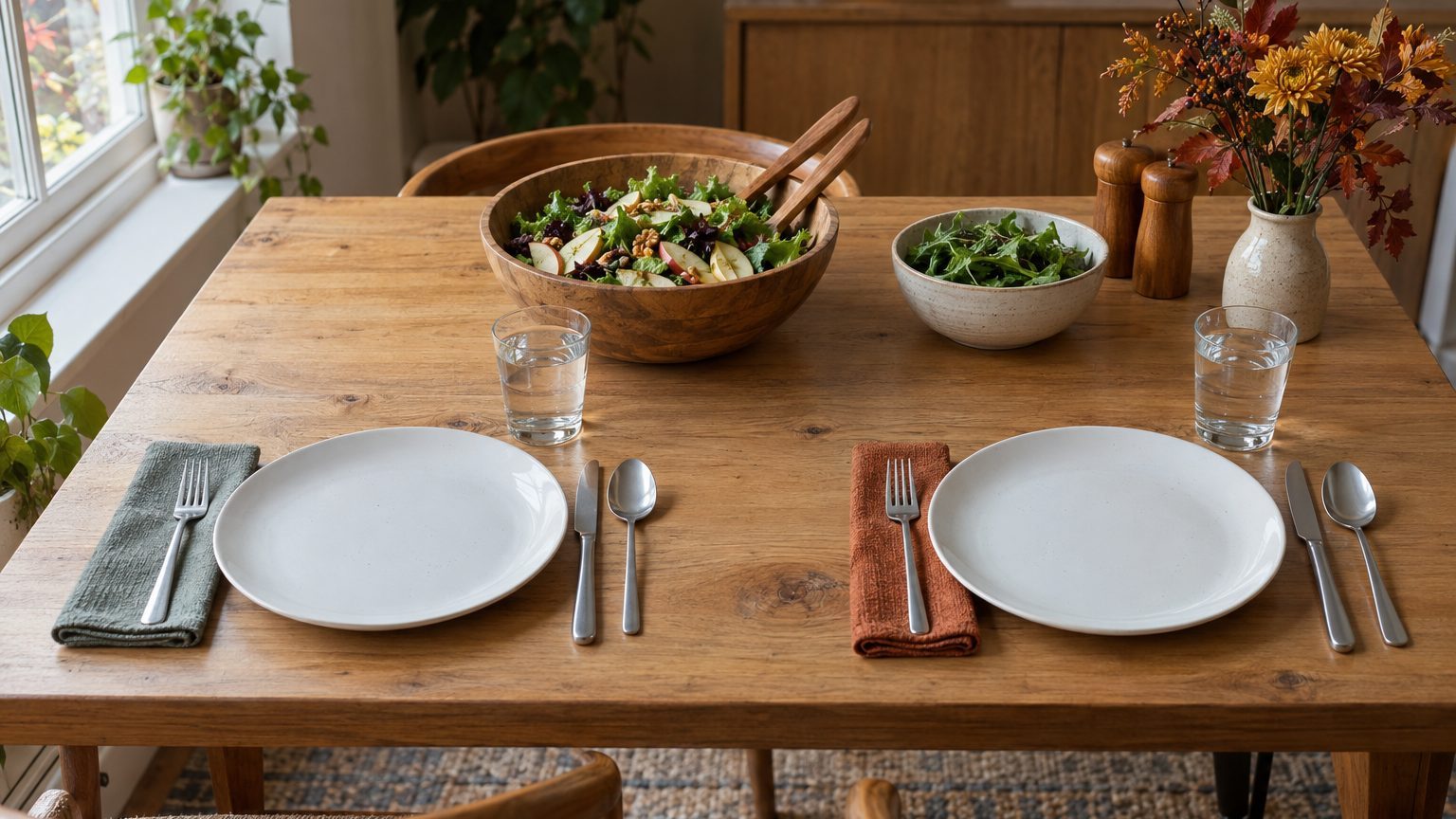
A casual table setting needs up to six things per person: a dinner plate in the center, a fork on the left, a knife on the right (blade facing the plate) plus a spoon if the meal calls for one, a drinking glass above the knife, and a napkin under the fork or on the plate. Leave off the extra forks, the bread plate and the specialty glasses. For family style meals, keep the middle of the table open for serving dishes, each with its own utensil.
Simple place setting
Start with the plate, the hub of the whole setup. Everything else is arranged around it, and a one-word memory trick handles the rest: FORKS. Reading left to right, you get fork, plate (the “O”), knife, spoon. Forks live on the left. Knife and spoon live on the right, with the knife sitting closest to the plate and its blade turned toward it.
The glass goes above the knife, or at a 45-degree angle off to its right. The napkin has three acceptable homes: to the left of the fork, under the fork, or on the plate. Pick one and repeat it at every seat. For a deeper look at utensil order, see how to set a table with silverware.
The guiding rule is to set only what the meal needs. Pasta night? Fork and spoon. Chicken and potatoes? Fork and knife. No soup, no spoon. Dessert utensils can arrive with dessert.
Do you need a salad fork? Not if the salad shares the plate with the main course, since one fork does everything. If the salad comes first as its own course, add a second fork on the outside and work inward, the outside-in rule. Skip the bread plate, charger and specialty glassware unless the menu truly calls for them.
Family style table setting
Family style flips the logic. Plates are empty at the start, and food travels down the table in bowls and platters. The center belongs to the food, so everything decorative has to step aside.
Give every dish its own serving spoon, fork or tongs, and set a trivet or heat-safe pad beneath anything hot. A casserole on a bare wood table leaves a ring. Platters work best in a staggered line down the middle, with the heaviest dish closest to whoever will serve it. A runner is fine if it’s narrow, and flowers or candles should stay low enough to see across.
Space matters more than people expect. The traditional etiquette guideline is about two feet from plate center to plate center, which gives each diner elbow room without forcing a shouted conversation. Beyond the room for the person, leave a clear strip down the middle roughly the width of your largest platter.
Pick one direction for passing, say to the right, and stick with it. Also watch the clock: the USDA says perishable food shouldn’t sit out longer than two hours at room temperature, or one hour above 90°F. A long, lingering Sunday dinner should send leftovers to the fridge before the second pot of coffee.
How to set a table for family dinner
The full routine takes about five minutes once it’s habit. This is the version that works for weeknights (the broader basics are in how to set a table):
- Clear the surface and wipe it, then lay placemats if you use them.
- Put a plate at each seat, centered.
- Add the fork on the left, with the napkin beneath it or on the plate.
- Set the knife (blade toward the plate) and spoon on the right.
- Place glasses above the knives, then bring out serving dishes, trivets and utensils.
Kids can take over most of this. A simple memory aid: touch each thumb to its forefinger and the left hand forms a lowercase “b” (bread, left side) while the right forms a “d” (drinks, right side). Young children can handle napkins and forks, since those sit on the left, while older ones can manage glasses. Let them check the table against the FORKS rule at the end.
Adjusting by meal is just subtraction and addition. Soup dinner: add a spoon. Steak: swap in a steak knife. Meal with a sit-down dessert: carry the dessert spoon or fork in with the plates instead of crowding the table beforehand.
What is the difference between casual and formal table settings?
Casual settings strip a place down to what you will actually use, while formal ones add a utensil, plate or glass for each course. Formal setups are generally reserved for meals of more than three courses, and the formal table setting guide covers that layout in full.
| Element | Casual | Formal |
|---|---|---|
| Plates | One dinner plate; simplify to what the meal needs | Dinner plate plus extra plates for additional courses |
| Forks | One fork, or two if salad is a separate course | A fork for each course, set outside-in |
| Knives and spoons | One knife, one spoon only if needed | Knives and spoons matched to each course |
| Glassware | One water glass; skip specialty glasses | Water glass plus glasses for each beverage served |
| Bread plate | Skip | Include, above the forks |
| Napkin | Paper or cloth, under the fork or on the plate | Cloth napkin, placed to the left of the forks or on the plate |
| Serving style | Plated or family style, with dishes on the table | Courses served in sequence |
| Decor | Placemats or bare table; a low, simple centerpiece | Tablecloth and a more elaborate arrangement |
| Typical occasion | Weeknight dinners, casual entertaining, relaxed holiday meals | Dinners with more than three courses |
What dishes and flatware can you use for a casual table setting?
Whatever you eat from every day. Informal dining has no matching-set requirement, so your everyday dinnerware and flatware are the right tools. Mixing patterns works when something quietly ties them together: plates in a shared color family, or one consistent flatware style across a varied dish collection.
Paper napkins are fine, folded neatly and placed in the same spot at every seat. Placemats protect the table and give each diner a defined zone. A good rule is condition: chipped plates and bent forks tend to look more careless than mismatched patterns do.
How do you dress up a casual table setting without making it formal?
Three upgrades do most of the work, and none adds a single extra utensil. First, swap paper napkins for cloth ones. Second, run a narrow table runner down the center, leaving the edges clear for plates. Third, add a small centerpiece, such as a short bowl of seasonal fruit, a few stems in a low vase or a single candle cluster.
The test is height and footprint. If guests can see each other over the arrangement and the platters still fit beside it, you’re still casual. Add a tall candelabra and a place card at each seat, and you’ve drifted somewhere else entirely.
What are common casual table setting mistakes?
Most errors come from doing too much, or from not planning for the food itself. Five show up again and again:
- Knife blade facing out. Turn it toward the plate.
- Too many items. Remove anything the menu won’t use, including extra forks and unused glasses.
- No room for serving dishes. Clear the center and shrink the centerpiece.
- Uneven spacing. Line up plates and utensils so each setting matches its neighbor.
- Hot dishes on bare wood. Slide a trivet under each one.
Consistency does the quiet work here. A table with six matching, evenly spaced settings looks planned even if every plate comes from a different set.
Frequently Asked Questions
Can you use paper napkins for a casual table setting?
Yes. Paper napkins suit weeknight dinners and relaxed gatherings. Place them where you’d place cloth ones, under the fork or on the plate.
Do you need a tablecloth for a casual dinner?
No. A clean bare table, placemats or a narrow runner all work. A tablecloth is optional and tends to push the look toward dressier, so save it for when you want that effect.
Do placemats count as a casual table setting?
Placemats are a base layer, not a complete setting. You still need the plate, fork, knife, spoon, glass and napkin on top. They do mark each person’s space clearly and protect the table.
Should serving utensils be placed on the table for family style meals?
Yes. Every serving dish should have its own spoon, fork or tongs, resting in or beside the dish. That keeps diners from using their own silverware to serve, and it keeps the food moving smoothly around the table.
Where does the napkin go if there are no extra forks?
With a single fork, the napkin can sit to the left of it, lie under it, or rest on the plate. Under the fork saves space at a crowded table. Whichever you choose, repeat it at every place.
Sources: fsis.usda.gov | ucanr.edu | isd423.org