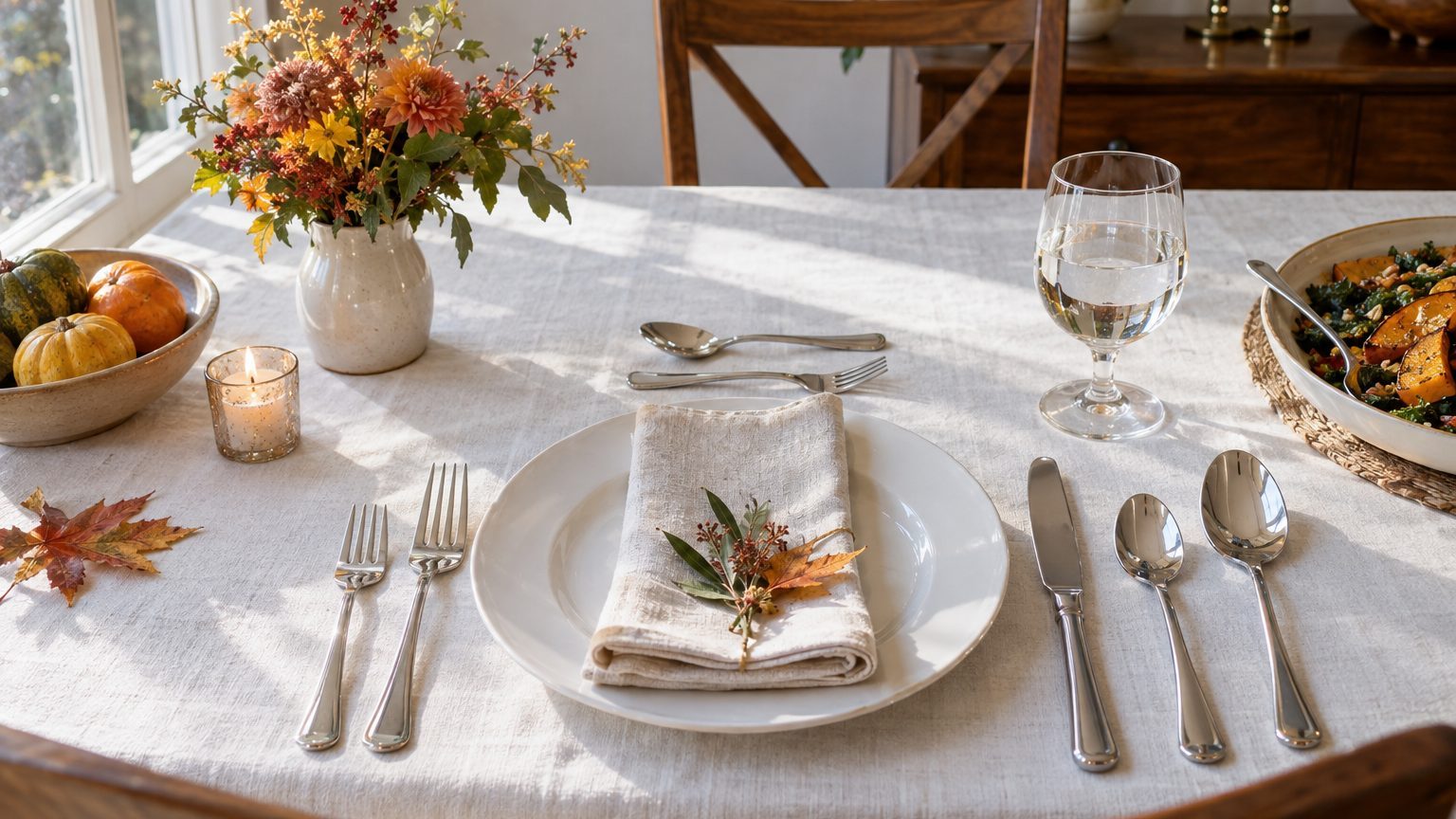
Forks go on the left of the plate, tines up, with the salad fork outside the dinner fork. Knives go on the right with the blade turned in toward the plate, and spoons sit to the right of the knives. Dessert silverware goes above the plate. The spoon sits on top with its handle pointing right, and the fork sits below it with its handle pointing left. Everything is laid in the order of use, working from the outside in, and no side carries more than three pieces.
Read left to right, a full American setting runs like this: salad fork, dinner fork, dinner plate, dinner knife, teaspoon, soup spoon. The dessert pair stays above the plate, out of the row.
Which side does the fork go on
The left. Emily Post’s etiquette guidance offers a memory trick: forks spells the layout. The F is the fork, the O is the plate, the K is the knife and the S is the spoon, all in left-to-right order. Most diners are right-handed, so the knife and spoon sit where the right hand falls and the fork waits on the left.
Two forks mean a decision. When a salad or appetizer opens the meal, the small fork goes on the outside because it gets used first, and the dinner fork stays closest to the plate. Some traditional hosts serve salad after the main course, and in that case the small fork moves inside, next to the plate. Tines point up in the standard American style (European settings often turn them down). Dessert forks leave the left side entirely and go above the plate, covered below.
For a left-handed guest, some hosts simply swap the sides. That is a courtesy, not a requirement.
Which way does the knife blade face
Toward the plate. The dinner knife sits immediately to the right of the plate with its cutting edge turned in. When the main course is steak or another cut that needs it, a steak knife takes the dinner knife’s place, same spot, same direction.
The usual explanation for the rule is historical: a blade pointing at a neighbor once read as a threat, while a blade turned toward your own plate signals the opposite. Whatever the origin, it also works in practice. A guest reaching right is unlikely to grab a cutting edge.
The butter knife is the exception to the “knife on the right” habit. It belongs on the bread plate, laid diagonally with the handle toward the diner, and the bread plate has its own page. One related etiquette point: at an informal meal, one dinner knife can serve every course, but a used knife should never be set back on the tablecloth or placemat.
Where does the dessert spoon go
Above the dinner plate, lying horizontally. The dessert spoon takes the upper position with its handle pointing right. The dessert fork sits beneath it, closer to the plate, with its handle pointing left (so the tines face right). Both are positioned to be picked up by the hand that matches the handle.
The alternative is to hold dessert silverware back. Many hosts bring the fork and spoon out on the dessert plate, or set them down with the course. Both approaches are accepted. Setting them upfront gives guests a road map of the meal. Holding them back gives you a cleaner table and more elbow room during dinner. The second option matters most when the table is small or already crowded with serving dishes.
Either way, only set dessert pieces guests will use. If the plan is pie alone, a fork is enough, and the spoon can stay in the drawer.
Where do the soup spoon and teaspoon go
Both sit on the right. The soup spoon goes on the far right, outside the knife, and only appears when soup is on the menu. The teaspoon sits between the knife and the soup spoon. Because the soup spoon is outermost, it is also the first one a guest reaches for. A coffee spoon, if you use one, usually arrives on the saucer when the coffee does.
| Utensil | Position | Orientation | When it is used |
|---|---|---|---|
| Salad fork | Left of the plate, outside the dinner fork | Tines up | Salad course, before the main |
| Dinner fork | Left of the plate, closest to it | Tines up | Main course |
| Dinner knife | Right, immediately beside the plate | Blade turned in | Main course |
| Soup spoon | Far right, outside the knife | Bowl up | Soup course |
| Teaspoon | Right, between the knife and soup spoon | Bowl up | Tea or coffee |
| Dessert fork | Above the plate, below the dessert spoon | Horizontal, handle left | Dessert |
| Dessert spoon | Above the plate, top position | Horizontal, handle right | Dessert |
| Butter knife | On the bread plate | Diagonal, handle toward the diner | Bread, throughout the meal |
How many pieces of silverware should be on the table
Three per side is the ceiling. Past that, the setting turns into a puzzle, and guests start guessing. The one classic exception is the oyster fork, which rides on the right of the last spoon even when it is the fourth piece there. For a home dinner, you will almost never need it.
The outside-in rule does the sorting. Each course gets one piece, set in the order the courses arrive, and the main course’s piece lands closest to the plate. A quick rule of thumb:
- One course: dinner fork on the left, dinner knife on the right.
- Two courses: add one piece outside for the opener, a salad fork or a soup spoon.
- Three courses: add both, so the left row is salad fork then dinner fork, and the right row is dinner knife, teaspoon (if needed), soup spoon.
Dessert never counts against the three, since it lives above the plate.
For Thanksgiving, the baseline is a dinner fork, a dinner knife and a spoon, plus the dessert fork and spoon above the plate. That makes five pieces per guest. The spoon only earns its spot if soup opens the meal. Without soup, drop it and you are at four. A starter salad adds one more piece, the salad fork, on the outside left. The full-table picture, including how to set a table around these pieces, has its own guide, and a multi-course feast leans on the formal table setting conventions.
How far should silverware be from the edge of the table
About an inch. The bottom ends of the handles line up evenly along a single invisible baseline, roughly an inch up from the table edge, which is also where the bottom rim of the plate sits. Large plates, dinner and luncheon sizes, are typically laid about an inch in from the edge too.
Side to side, leave about an inch between the plate and the nearest utensil. That gap keeps a fork from hiding under a rim and gives a guest room to grab it without tilting the plate. The dessert pair floats just above the plate, parallel to the table edge.
A tablecloth hides imperfections. A bare wood table does not, so glance down the row of settings from one end. Staggered handles stand out immediately.
What are the most common silverware placement mistakes
Most errors come from habit or from setting too much. A fast walk-through before guests sit down catches nearly all of them:
- Blade facing out. Rotate every knife so the cutting edge points at the plate.
- Forks on the right. Forks go left, even when the table feels lopsided.
- More than three utensils on a side. Pull the extras, or move dessert pieces above the plate.
- Reversed courses. The first-used piece should be outermost, never tucked beside the plate.
- Uneven bottoms or crooked spacing. Realign handles to the same line, about an inch from the edge.
One more trap is setting every piece the flatware set contains. A drawer full of forks is not a guest list. Set what the menu requires, and the table explains itself.
Frequently Asked Questions
Do you put the fork on the left or right?
Left. Forks sit to the left of the plate, with the dinner fork closest to it and any salad fork outside. The only forks that stray from the left are the dessert fork, which sits above the plate, and the oyster fork, which goes on the right.
Should forks be placed tines up or tines down?
In the standard American style, tines face up. European settings often turn them down, so you will see both depending on the host’s background. For a typical US family dinner, tines up is the safe choice.
Does the spoon go on the right or left of the knife?
Right. Spoons sit to the right of the knife, with the soup spoon farthest out and the teaspoon between the two. Dessert spoons are the exception, resting above the plate.
How many utensils should you put on a table setting?
No more than three on either side of the plate, plus the dessert pieces above it. Set only what the menu needs. A simple dinner may call for just a fork and a knife.
Do you set the dessert silverware before the meal or bring it out later?
Either works. The traditional American approach sets the dessert fork and spoon above the plate from the start. Many hosts bring them out with the dessert course instead, which keeps the table clear during a big meal like Thanksgiving.
Sources: emilypost.com | etiquettescholar.com | foodnetwork.com