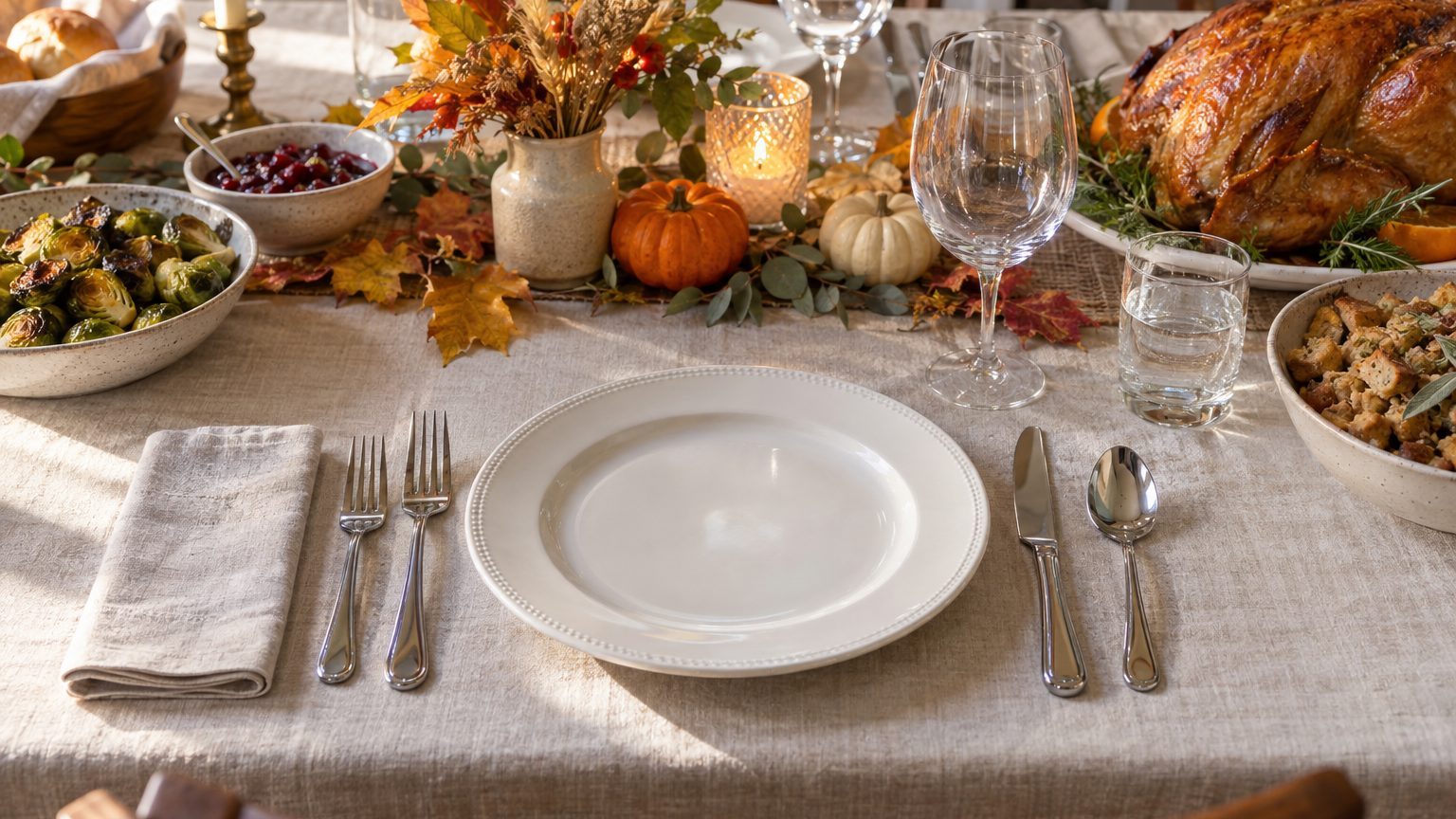
The napkin goes to the left of the fork
, so the fork or forks sit between the napkin and the plate. That is the standard American placement. On a casual or crowded table, the napkin can also sit on the plate, or under the forks. Fold it into a simple rectangle with the open edges facing the plate, lined up with the edge of the place setting. That covers most Thanksgiving tables.
Napkin on right or left of plate
The standard placement: to the left of the forks
Left, if you want the textbook answer. Forks sit on the left of the plate and knives and spoons on the right, so the napkin joins the forks on that side. In the Emily Post Institute’s informal setting,
the napkin is placed either to the left of the forks or on the center of the dinner plate
. For formal tables, the Institute’s Thanksgiving guidance adds that
the napkin goes to the left of the forks, not under them
.
When the napkin goes on the plate or under the forks instead
Space changes the rule. At a crowded table,
you might set the fork(s) on top of the napkin to save space
. The plate works too when no first course is served, because nothing is sitting there yet. The Institute also notes that
sometimes a folded napkin is placed under the forks
at informal tables. Keep that one out of formal dinners. For the full silverware layout, see how to set a table with silverware.
Napkin rings and napkins in a glass: what works and what to skip
A ring is decoration, nothing more.
Many hosts place the napkin in its ring at the center of the setting, which is more typical with a charger or placed plates.
A glass is not among the placements the Institute lists, so treat it as casual styling. It looks fine at a buffet and out of place at a formal dinner.
| Placement | Best occasion | Pros | What to watch out for |
|---|---|---|---|
| Left of the forks | Formal and most seated dinners | The standard; plate stays clear; easy to lift | Takes a little width; keep it from creeping under the forks |
| Under the forks | Casual or crowded table | Saves space; keeps the setting compact | Hides the fork’s position; avoid at formal events |
| On the plate | Casual, buffet-style, no first course | Tidy; frees side space | Must be moved before food is served, or it drags in sauce |
| In a glass | Casual or buffet-style | Saves table space; decorative | Hard to pull out neatly; wrinkles; not a formal placement |
| In a napkin ring | Formal or casual, often with a charger | Keeps the fold intact; decorative | A tight ring is hard to slide off |
The overall setting is covered in how to set a table, and the full multi-course version in formal table setting.
How to fold a napkin for a table setting
The simple rectangle fold that works for most dinners
Start with an ironed napkin.
Cloth napkins are typically ironed and either folded into a rectangle or a triangle.
The rectangle takes four moves:
- Lay the napkin flat and fold it in half, bringing the bottom edge to the top.
- Fold it in half again in the same direction, giving a long rectangle.
- Turn it so the open edges face the plate and the closed fold faces the table edge.
- Set it down square to the edge of the setting.
That orientation makes the napkin easy to grab and tidy to look at.
The pocket fold for holding silverware
Emily Post’s casual setting has
the fork, knife and spoon placed on top of the napkin, to the left of the setting
. A pocket fold goes a step further and holds the flatware in place. Fold the napkin in half to make a rectangle. With the long edge toward you, fold the bottom edge up about a third of the way, which leaves a lip. Flip the napkin over, fold the left and right thirds in to overlap, then flip it back. Slide the fork and knife into the pocket. It suits a buffet, where guests pick up everything in one grab.
Folding tips by napkin size and fabric
Size changes the fold. Cloth dinner napkins are commonly sold at
16 to 22 inches square
, while cloth luncheon napkins
run 14 to 16 inches square
. A 14-inch napkin folds into a tidy rectangle with no effort. A 22-inch one gets bulky, so a single extra fold can bring it down to size. Crisp cotton holds a crease. Soft linen tends to relax quickly, so press it just before guests arrive. Fancy decorative shapes are beyond the scope of this guide.
Paper napkins vs cloth napkins environment
Washing vs. throwing away: what the environmental comparison actually depends on
Neither wins outright. Four variables decide it: how often each cloth napkin is washed, how much water and energy the laundry uses, how many times the napkin gets reused, and how much recycled content the paper has. One commissioned life-cycle analysis, as summarized by a linen retailer, found that
when napkins are laundered after every use, as in restaurants, paper could be the better choice, while at home cloth came out ahead when napkins were reused a few times between washes
. That finding is limited to one study’s assumptions, so treat it as one data point rather than a verdict.
For a holiday, the picture is simple: one dinner, one load. Cloth napkins add a small amount to a laundry day you were probably doing anyway.
When paper napkins make sense, and how to choose better ones
Paper earns its place at big buffets, outdoor tables, and meals with hands-on food. Look for high recycled content. EPA data puts the overall U.S. recycling rate for paper and paperboard at
68.2 percent in 2018
, yet
nondurable paper goods, excluding newspapers, were recycled at 43.1 percent
. Paper napkins belong to the nondurable paper goods category, though EPA does not publish a napkin-specific rate. Food-soiled ones generally can’t go in curbside recycling, so check whether your area composts them. A box of paper napkins is not a failure of character. A stack of cloth napkins used once and never washed again is not a victory either.
Where does the napkin go when you sit down and when you leave the table?
What guests do with the napkin during the meal
Guests unfold the napkin and place it in the lap after sitting. At a dinner with a host, the common guidance is to wait:
if there is a host or hostess, wait for them to take their napkin off the table and place it in their lap
. Keep it half-folded on your knees and dab your mouth with the inside edge so stains stay hidden. If you drop it, ask for a fresh one rather than using it.
Where to leave the napkin when you get up or finish eating
Etiquette advice splits here. The Emily Post Institute says to place the napkin
folded loosely, to the left of your plate, not on the plate or chair
, and offers a memory aid:
‘LL’ for ‘Loosely’ to the ‘Left’
. Its reasoning:
a napkin on a plate gets soiled unnecessarily, and one on a seat can transfer food to the chair or your clothes
. Other consultants still teach the chair for a brief absence. At home, the left of the plate is the safer choice, and it applies at the end of the meal too.
Which napkin placement mistakes should you avoid?
Four slips are worth avoiding. The napkin tucked under the forks at a formal table. A napkin left on a plate that will soon hold turkey. A ring so snug that guests tug at it. And a napkin set at the wrong edge, hanging over the table rather than lined up with the setting. Wrong sizing matters as well: a small luncheon napkin at a heavy dinner leaves guests wanting more coverage.
Before guests arrive, a quick walk-around helps:
- Every napkin sits in the same spot at every seat.
- Open edges face the plate and the fold lines up with the setting.
- Napkins are pressed and free of stains.
- Rings slide off easily.
- A few spares are set aside for spills.
Frequently Asked Questions
How many napkins do I need per guest for Thanksgiving dinner?
One cloth napkin per guest, plus a few spares, covers a seated dinner. If you use paper, set one at each place and keep a stack nearby, since a meal with many hands-on dishes uses more. No source sets an official count, so treat this as a rule of thumb.
What size is a standard dinner napkin?
Retailers commonly list cloth dinner napkins at roughly 16 to 22 inches square. Cloth luncheon napkins are typically 14 to 16 inches. Sizes vary by maker, so measure yours before choosing a fold.
Can you use paper napkins at a nice dinner?
You can, particularly at casual or buffet-style dinners. The Emily Post Institute notes that
cloth napkins can be used in any table setting, regardless of formality
, which makes cloth the more flexible choice. A heavy, plain paper napkin looks better than a thin printed one.
Do you need napkin rings for a table setting?
No. Rings are decorative and optional. If you use them, make sure the napkin slides out easily.
Do you put the napkin on your lap before or after the host sits down?
After, if there is a host. Wait until the host unfolds their napkin, then follow. At a casual family meal with no formal host, sit down and place it in your lap right away.
Sources: archive.epa.gov | archive.epa.gov | allcottonandlinen.com