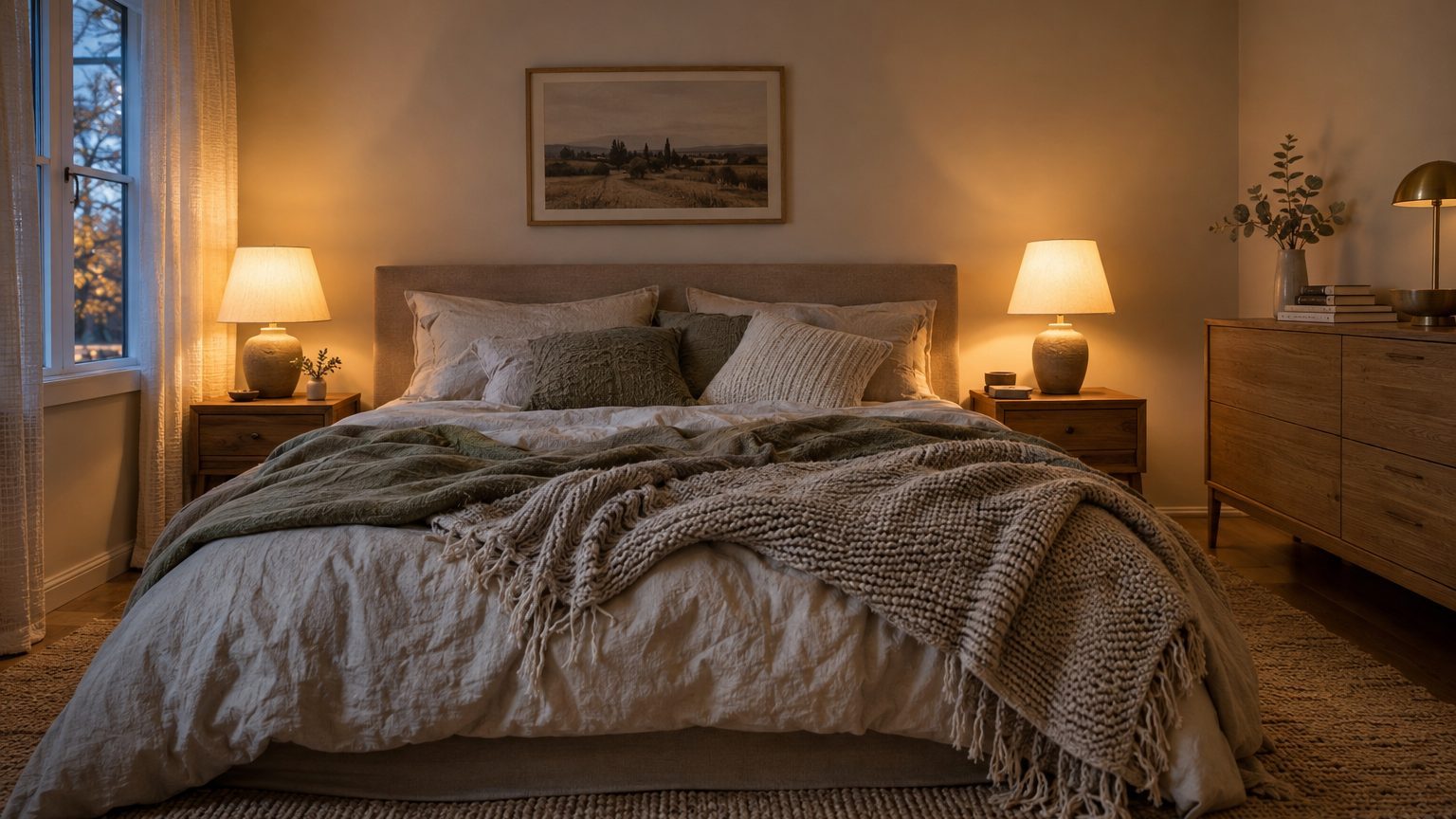
A cozy bedroom comes from three layers working together: warm light at low height, soft textiles in a restrained palette, and a layout that leaves the room feeling calm instead of crowded (the first decision there is where to place bed in bedroom). The easiest place to start is the light bulbs. For bedrooms, warm white bulbs in the 2700K to 3000K range are the standard recommendation, and they give the amber glow of a traditional incandescent lamp. Swap the bulbs first and you will notice the change within an evening, before you have bought a single pillow.
Cozy bedroom ideas
Start with the lamps, because light changes how every other object in the room reads. Evening light affects more than mood. In a study published in the Journal of Clinical Endocrinology & Metabolism,
exposure to room light before bedtime suppressed melatonin, resulting in a later melatonin onset in 99.0% of individuals and shortening melatonin duration by about 90 min
, compared with dim light. A cozy bedroom and a sleep-friendly bedroom turn out to want the same thing at 9 p.m.: lower, warmer, softer light.
In practice, that means retiring the single ceiling fixture as your main source. Put a lamp on each side of the bed, add a small accent light on a dresser or shelf, and keep the overhead for cleaning and dressing. Pick one color temperature and stick with it. As one lighting manufacturer’s guidance puts it,
all bulbs used simultaneously should have the same light temperature, so the room feels balanced
. A 2700K lamp beside a 4000K ceiling light makes the room look patchy and a little clinical. Dimmers, or smart bulbs that dim and warm up on a schedule, give you a gentler transition at night. For a deeper menu of fixtures and layouts, see these bedroom lighting ideas.
Textiles come next, and the trick is layering rather than buying one expensive piece. Think of the bed as three zones. The base is sheets in a breathable fiber such as cotton or linen. The middle is a duvet or quilt. The top is a throw, folded across the foot of the bed, that you can pull up on a cold night. Different textures also add visual warmth that a flat, uniform set cannot: a chunky knit against smooth percale, a velvet lumbar pillow against a woven blanket. If you want that polished, plush look without the clutter, how to make a bed like a hotel walks through the layering order.
The floor deserves the same attention. Bare floorboards or tile are among the coldest surfaces your feet meet in the morning, and a rug fixes that immediately. Size matters more than pattern here, since a small rug floating beside the bed looks like an afterthought. The guide to area rug size for bedroom covers dimensions for each bed size, so you can buy once.
Curtains do two jobs. Heavy or lined panels soften echo, frame the window, and block drafts. They also keep the room dark once you turn the lamps off. Light during sleep is not trivial: in one lab comparison,
a single night at 100 lux raised heart rate and next-morning insulin resistance compared with a dim room
. Streetlight leaking in counts too, and a bright charger or device light is worth covering. Fabric that falls to the floor, hung a few inches above the window frame, makes the ceiling look taller and the room feel wrapped rather than boxed.
Temperature belongs in this conversation, since a room can look warm and still feel cold. Drafty windows, a bare floor and a thin comforter will undo any decorating. The practical fixes (sealing gaps, layering bedding, managing the heat) are covered in how to keep bedroom warm in winter, and they pair naturally with everything in this guide.
Warm color palette for bedroom
Warm palettes lean on red, yellow and orange undertones: cream, oat, sand, camel, terracotta, rust, clay pink, olive and deep chocolate brown. The best way to build one is to treat color as a ratio. A common designer rule is roughly 60 percent for the dominant shade (walls and large furniture), 30 percent for a secondary tone (bedding, curtains, rug), and 10 percent for an accent. In a bedroom that could mean warm off-white walls, oatmeal and camel bedding, and a few rust-colored pillows.
Whites are where many people go wrong. A stark, blue-leaning white under warm bulbs can look gray and flat by evening, whereas a white with a creamy or slightly yellow base glows. Paint swatches should be judged in the room, taped to two different walls, and looked at in the morning and again under your lamps at night. The same swatch will read as two different colors, and the night version is the one you will live with most.
Darker walls are a legitimate route to coziness too. Deep greens, burgundy and earthy browns recede, which makes the room feel enclosed in a good way, like a den. They work best in rooms with decent natural light or in rooms used mainly at night. A matte or eggshell finish keeps the surface soft and hides wall imperfections, while high gloss throws light around and works against the hushed effect you are after.
Light and color interact in a predictable direction. Bulbs around 2700K deepen reds, oranges and browns and make creams look buttery. Cooler bulbs mute those same colors and make them look dull. So if you commit to a warm palette, commit to warm bulbs, and the reverse holds as well. A rule worth following:
2700K to 3000K is the ideal range for living rooms and bedrooms
, and 2700K is the softer, more amber end of that range.
Texture can stand in for color when you want a calmer scheme. A room built from one family of neutrals (ivory, stone, taupe) stays interesting if the materials vary: boucle, wool, linen, rattan, wood grain. Pattern works best in small doses. One striped or plaid blanket, or one patterned pillow pair, is plenty against solid bedding. Wood tones in a nightstand or headboard add their own warmth, so you do not need to match everything. Slightly different woods look collected, which is the point.
A warm palette does not have to mean beige. Dusty rose and muted mustard read as warm without feeling washed out. A single saturated piece, such as a burnt-orange velvet throw, gives the eye somewhere to land. Keep the accent in at least two places, say a pillow and a piece of art, so it looks deliberate rather than random.
How to make a small bedroom cozy
Small bedrooms have a built-in advantage: they already feel enclosed, which is half of what coziness is. The task is to keep that feeling from tipping into cramped. Bed placement is one of the biggest levers. In a tight room, a bed pushed into a corner or centered on the wall opposite the door changes how much floor you can see and how easily you can walk around it. The guide on where to place bed in bedroom compares layouts for small and awkward rooms.
Get lighting off the furniture. Wall-mounted sconces or plug-in swing-arm lamps with a hardwired look free up the nightstand surface, and a slim shelf or a floating table can replace a bulky bedside unit. Where a small room has one overhead fixture and nothing else, even a single plug-in lamp in the far corner adds depth, because dark corners are what make a small room look smaller.
Keep the color story tight. Using two or three related shades, with walls, bedding and curtains in the same warm family, makes the boundaries of the room blur slightly, which reads as more space. Curtains matched closely to the wall color work especially well. If you want a moody, dark scheme in a small room, painting the walls, trim and even the ceiling the same color can feel like a cocoon instead of a closet.
Choose textiles for volume, not quantity. A thick duvet with two sleeping pillows and one or two decorative ones looks inviting. Eight pillows means moving them all every morning. One good-sized rug, positioned so the front part of the bed sits on it, usually does more for warmth than several small ones, and it also anchors the furniture. Check the sizes in the rug guide above before ordering, since a rug that touches the wall on one side looks cramped.
Clutter is the enemy of coziness at small scale. Under-bed storage boxes, a bench with a lid, or hooks on the back of the door keep floors and surfaces clear. A mirror placed across from or beside the window bounces light and doubles the sense of depth, though in a warm scheme choose a frame in wood or brass over a stark black one. Plants can help, but one trailing plant on a shelf does more than a crowded windowsill.
Last, think about what you can adjust seasonally, since each season asks for something different. In winter, add a heavier throw and a wool or flannel layer, and move to the warmest bulbs you own. In summer, swap to lighter cotton or linen so the room stays inviting rather than stuffy. Evidence on sleep temperature is looser than the wellness industry suggests: one review of lab studies found
no difference in sleep across room temperatures from 13 to 23°C (55-73°F)
with normal bedding and clothing. That leaves plenty of room to choose what feels comfortable, as long as you avoid heat, which is what reliably hurts sleep.
One small experiment costs almost nothing. Tonight, switch off the overhead light an hour before bed, turn on only the lamps, and notice how the room looks. If the glow feels sharp or bluish, the bulbs are the first thing to change, and one of the cheapest upgrades in the room.
Sources : ncbi.nlm.nih.gov | ncbi.nlm.nih.gov | optimalsleep.org