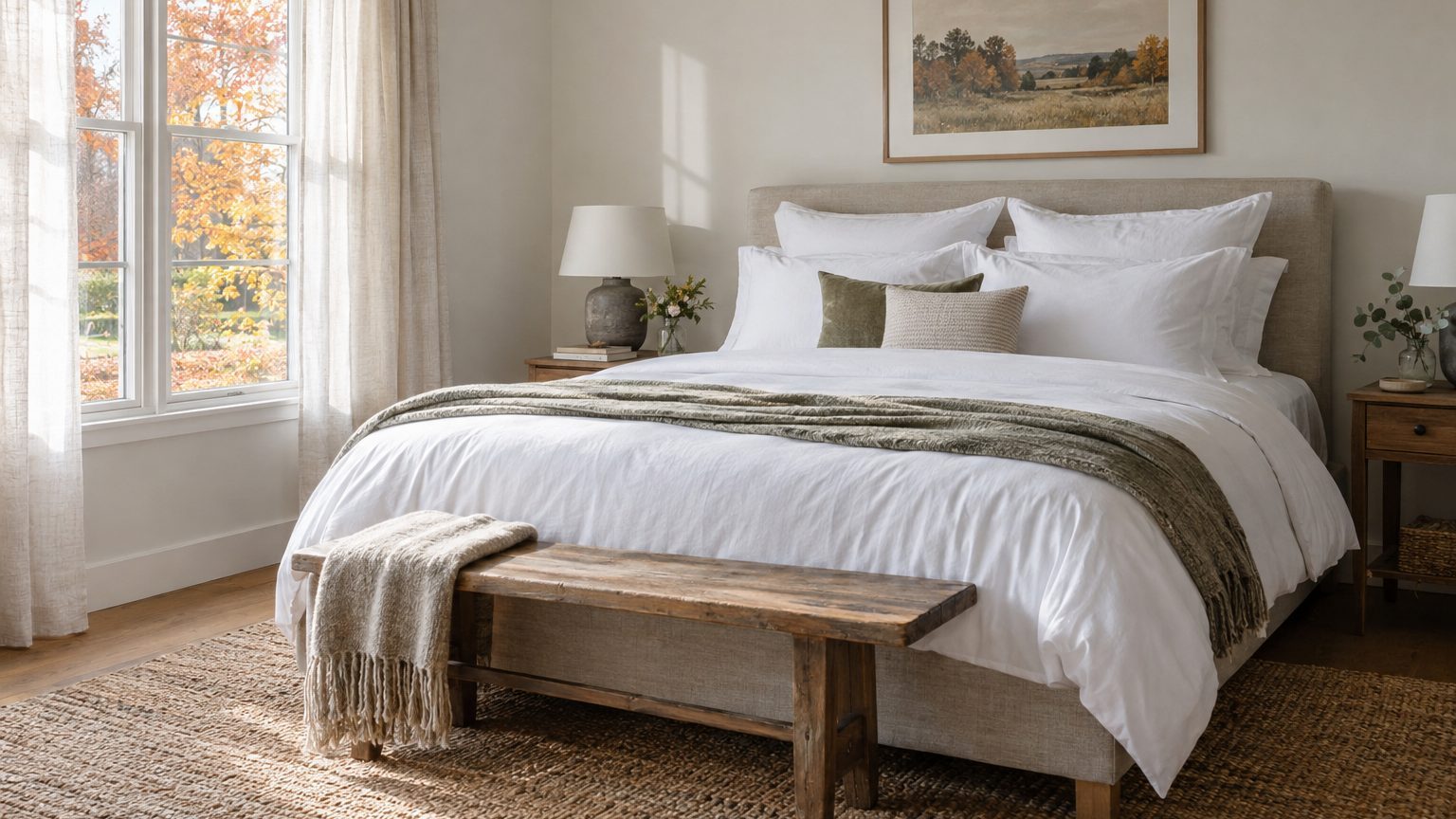
A hotel bed comes down to five things: a layered base, a drum-tight bottom sheet, crisp hospital corners, a duvet with a deliberate fold-back, and a pillow stack with real height. Most of it costs nothing. It’s technique, not shopping. A trained housekeeper strips and remakes a bed in
three or four minutes
, and the speed comes from following the same sequence every time.
The Layer Order Hotels Follow
Start from the mattress and work up.
The order runs: mattress protector, mattress pad or topper, fitted sheet pulled taut, flat sheet with hospital corners at the foot, a blanket or coverlet, then a duvet or comforter with the flat sheet folded back over it about ten inches.
The pad or topper is the layer most home beds skip, and it’s a big part of why a hotel mattress looks thick before anyone has sat on it.
Traditional hotel making uses a “triple-sheet” system.
The blanket is closed between two sheets, so it never touches the guest’s skin.
Where a duvet is used,
the duvet goes inside a washable cover changed at every departure, and the top sheet often disappears.
At home you can pick either version. The sheet-blanket-sheet approach gives you a bed you can adjust one layer at a time, which is handy when the bedroom temperature swings in winter. The duvet-and-cover approach is faster to make and easier to wash.
Fit matters before any folding does.
A sheet that is too short does not allow decent corners, and one that is too wide creates folds.
If your flat sheet is a size down from your mattress, no technique will rescue it.
Duvet cover wrestling has its own shortcut, the “burrito” method.
Lay the cover inside out on the bed, place the duvet on top, and align the corners.
Roll the whole thing up from the foot, flip the cover’s open end over it, and unroll. For a plumper look, some people put
two duvet inserts inside a single cover
. Keep the inserts close to the cover’s size so the corners don’t bunch.
How to Fold Hospital Corners
Here’s the detail that trips people up: the fold is made with the flat (top) sheet,
not the fitted sheet
. The fitted sheet already grips the mattress. The flat sheet needs the corner to stay put.
Lay the flat sheet so its top edge lines up with the head of the mattress and the other three sides hang evenly.
Tuck the sheet at the foot of the bed under the mattress.
That gives you a loose side flap at each foot corner. Now the fold itself, one corner at a time:
- Lift the hanging flap and lay it on top of the mattress, so the edge forms a 45-degree line. Lifting the loose sheet
about 12 to 18 inches from the corner
naturally produces that triangle. - Hold the triangle against the mattress with one hand and tuck the fabric still hanging below it under the mattress.
- Drop the triangle you were holding.
Tuck the hanging edges under the mattress, which creates an envelope-type fold at the corner. - Repeat on the other foot corner.
Then smooth.
Pull from the center outward to the corners until the surface is flat.
If you finish with a wrinkle running across the middle, it usually means the top edge was uneven at the start.
Placement affects how many corners you can do. Pulling a bed away from the wall gives you access to all four,
though two at the foot are enough when the headboard sits against the wall.
If you haven’t settled your layout yet, where to place bed in bedroom walks through the clearances that make this kind of access realistic.
Winter is when this technique earns its keep. A tucked, tight top sheet and blanket stop the drafts that creep in at the foot of the bed, and nothing stays pinned under a duvet that slides off by 3 a.m. If you’re building the whole room around warmth, how to make a bedroom cozy covers the rest, from textiles to lighting.
How Many Pillows on a Bed
The hotel look uses more pillows than any one person sleeps on. For a queen bed,
six to seven pillows creates a finished hotel look: two sleeping pillows hidden behind, two standard shams, two Euro shams against the headboard, and optionally one accent pillow at the front.
The sleeping pillows are the working pair. Everything else is staging, and it comes off at bedtime. Shams are decorative, so
they come off before sleeping
, which is why most people end up with a small pile on a chair or bench.
Euro pillows are the piece that changes the silhouette. They’re square,
26 by 26 inches
, while a standard pillow is
20 by 26 inches
and a queen pillow is 20 by 30. Stood upright against the headboard, they add height that rectangular pillows can’t. The math on a queen is tidy:
two 26-inch Euros total 52 inches, sitting neatly across a 60-inch queen.
A third would overflow. On a king, the logic scales:
three Euros and three sleeping pillows where a queen takes two of each.
Smaller beds scale down too. A twin takes
one sleeping pillow, one standard sham and one Euro behind, three pillows in total.
A full-size bed follows the queen formula.
Prefer a calmer bed? Four pillows work:
a minimalist arrangement
that suits a smaller room where a pile of six would crowd the headboard wall. The order, from back to front, stays the same: Euros against the headboard, sleeping pillows or standard shams in front, accent last. One small habit helps the look hold:
stand your pillows up instead of laying them flat.
What Is a Bed Runner
A bed runner is a strip of fabric laid across the foot of the bed, on top of the duvet. Retailers also call it a bed scarf, and
in practice most use the two names for the same product.
It is not a bed skirt, which hangs down the sides to hide the frame.
In hotels it’s a working part of the bed, not decoration.
The main purpose of a commercial runner is to protect white top sheets and duvets from dirt, stains and scuffs caused by guests’ shoes and luggage.
A suitcase gets lifted onto the foot of a hotel bed all the time, and the runner is what takes the hit. Hotels have long used the same trick to extend the life of the bedspread, since a runner is far cheaper to launder or replace than a whole comforter.
At home the job is different but real. A runner shields the foot of the duvet from a dog’s paws, a laundry basket, or the cold edge of a bag. It also adds a band of contrast or texture to an otherwise plain white bed. Solid runners in a tone that contrasts with the comforter
usually look more deliberate than an exact match.
A matching runner pushes the room toward formal. In a winter bedroom, a chunky knit or wool-feel runner also adds a bit of warmth right where your feet land.
On size,
the industry standard width for commercial runners is 24 inches.
Home versions run narrower, with many in the 19 to 20 inch range, but 24 inches is the safer pick if you want that hotel proportion. For length, queen-size runners are commonly sold around 84 to 90 inches, and the strip should
drape across the foot third of the bed.
Slipping is the usual complaint, so smooth the runner flat after the duvet is set, and tuck its ends lightly under the mattress edge if it keeps wandering.
The rug under the bed finishes the same visual band. A runner at the foot and a rug extending beyond the sides both read as “styled,” and they work best when the proportions agree. The sizing logic is in area rug size for bedroom.
One practical note before you rebuy anything: a bed made this way takes more laundry attention. Because the top layers get tucked and folded, washing sheets a bit more often than the rest of your bedding is worth planning for. The folded-back band of the flat sheet also tends to crease from storage and needs a light press or steam if you want it razor-sharp.
Sources : arredamentohotel.it | comfortbeddings.com | downlandbedding.co.uk