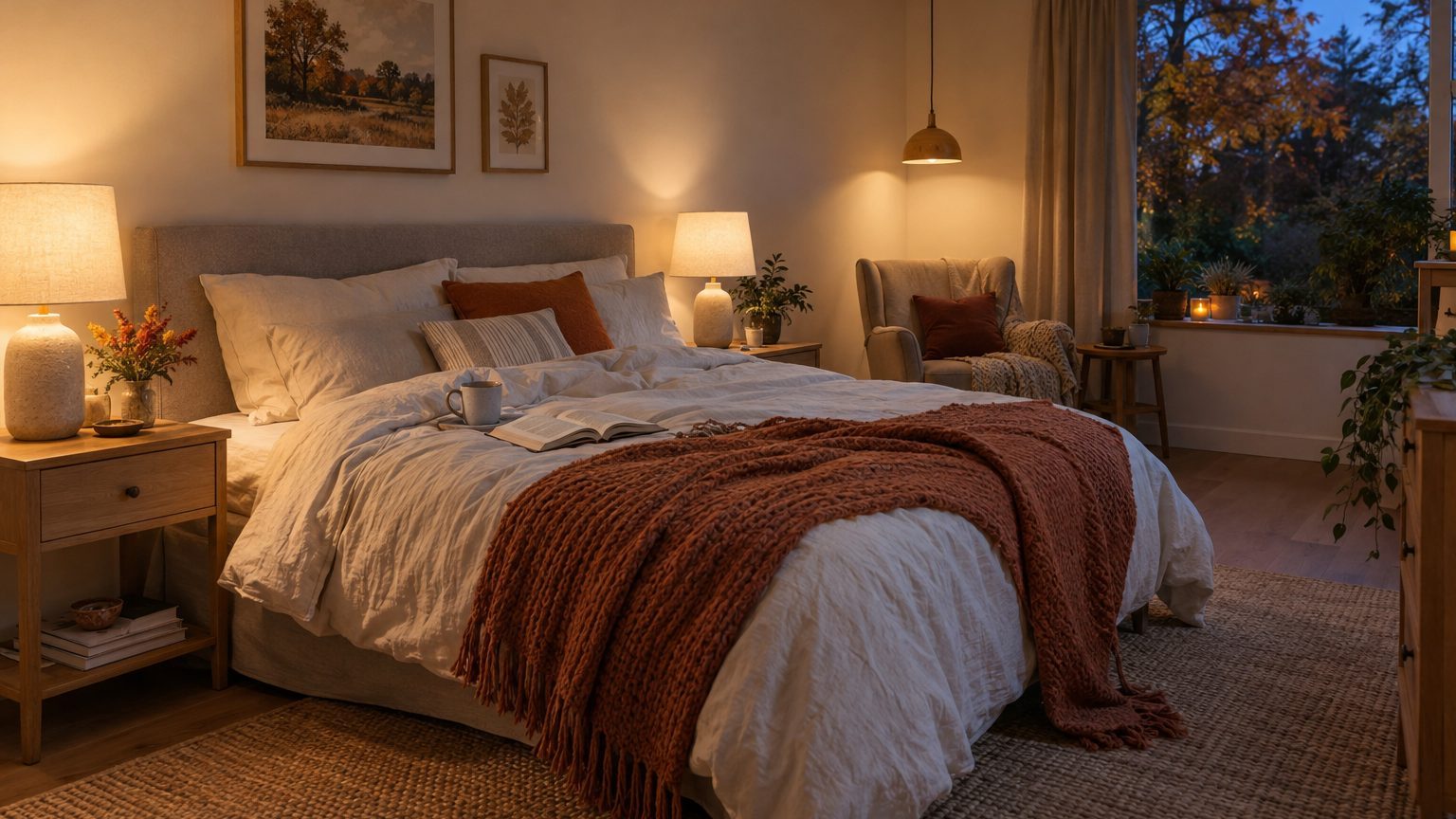
Warm white bulbs at 2700 K, dimmable, spread across two or three low sources, will light a bedroom softly for a long evening. Skip the overhead fixture after dinner. Keep every lamp, sconce, or pendant low and shaded so you never see the bare bulb from the pillow. That setup holds up in January, when the sun can be gone by 5 p.m. and the bedroom has to work as a reading room, a retreat, and a place to fall asleep.
Best light bulb color for bedroom
Look at the number on the box before you look at the shade or the fixture. Color temperature, measured in kelvins, tells you whether a bulb throws yellow-amber light or blue-white light. The U.S. Department of Energy notes that
lower color temperatures (2700 to 3000 K) are considered warm
, and that
warm light is preferred for living spaces because it is more flattering to skin tones and clothing
. For a bedroom, 2700 K is the safe pick. It matches the glow of old incandescent bulbs, which
mostly produce warm light around 2,700 K
, so wood nightstands, linen, and wool blankets look the way you remember them under lamplight.
What about 3000 K? It’s still warm, just crisper. A bulb at that setting suits a bedroom that doubles as a home office, or one with cool gray walls that can turn muddy under amber light. Go below 2200 K and you reach candle territory, lovely for a single accent lamp and too dim and orange for reading.
Brightness is a separate decision. Bulbs are sold in lumens now, not watts, and the Department of Energy offers a handy yardstick:
a 100-watt incandescent lamp emits about 1600 lumens
. A bedside lamp rarely needs more than the equivalent of a 40- or 60-watt bulb. A 60-watt replacement lands
around 800 lumens
. Buy bulbs that dim, and confirm that your dimmer or lamp actually supports dimming, because a bulb that buzzes or flickers at low settings defeats the purpose.
There’s a sleep case for keeping evening light low and warm, and it rests on peer-reviewed work, not décor opinion. In a study published in the Journal of Clinical Endocrinology & Metabolism, researchers compared people living in ordinary room light (under 200 lux) with people in dim light (under 3 lux) before bed.
Room light pushed melatonin onset later in 99.0% of individuals and shortened melatonin duration by about 90 minutes.
A systematic review of light and circadian rhythm reported that one study found that
about two hours of evening blue light (460 nm) significantly suppressed melatonin, while green light (550 nm) did not
. Warm bulbs contain less of that short-wavelength light, and lowering the level matters too. Dim and amber together is the goal.
One more spec is easy to miss: color rendering. The Department of Energy calls
color rendition generally a more important lighting quality than color temperature
. Two 2700 K bulbs can make the same bedspread look rich or flat. Check the package for a CRI figure, and favor higher numbers (90 or above is a common benchmark) if you can find them at a fair price.
How high to hang bedside pendants
Bedside pendants free up the nightstand for a water glass and a stack of paperbacks. They also draw the eye upward, which helps in a small room. But hang one wrong and you’ll either bang your head sitting up or squint at a page lit from the ceiling.
Guidance varies, and no code sets the number. Most designers and lighting makers land between about 20 and 30 inches from the nightstand surface to the bottom of the fixture. Some suggest
20 to 28 inches above the nightstand surface
, others
24 to 30 inches
, and a few go as high as 36. Measure to the lowest edge of the shade, not the cord canopy.
Do the math with your own furniture. With a nightstand of average height, a pendant 24 to 30 inches above it puts the bottom of the shade
roughly 48 to 58 inches above the floor
. That’s above a seated person’s eye level but low enough to throw light onto a book. Sit up in bed, in the pose you actually read in, and have someone hold the fixture while you check two things. Can you see the bulb directly? Does your head clear the shade when you lean toward the nightstand? If the bulb is visible, go higher or choose a shade with a deeper skirt.
Pendant placement also depends on bed position. A bed pushed into a corner leaves room for one pendant only, and a bed centered on the headboard wall suits a matched pair. If you’re still deciding, sort out where to place bed in bedroom first, then hang the lights to follow it. Keep the two pendants centered over each nightstand, not over the mattress edges, and keep wire runs tidy. A plug-in pendant swagged to a ceiling hook and run down the wall is the renter-friendly route, while a hardwired fixture should go to a licensed electrician.
A pendant, though, is only one layer of light. Sconces solve the same problem differently, mounted around
30 to 36 inches above the top of your mattress
, which works out to about five feet from the floor. They take no nightstand space and no ceiling work, though they do need wiring or a plug-in kit.
Bedroom lighting ideas without ceiling light
Plenty of bedrooms, especially in older homes and apartments, have no overhead fixture at all. Good. A single ceiling light is an unflattering way to light a bedroom anyway, because it casts shadows down the face and flattens everything else.
The fix is three layers at different heights. Start with low ambient light, usually table lamps on both nightstands or a dresser. Table lamps generally run
24 to 30 inches tall
, and a lamp about the same height as the nightstand, or two to three inches taller, usually looks balanced. Add a task light for reading, such as a sconce or a plug-in pendant aimed at the pillow. Then add one accent source: a floor lamp in a corner, a small lamp on the dresser, or a warm LED strip tucked behind a headboard. Floor lamps for bedside use
typically measure 54 to 60 inches
.
Keep sources low and shaded when you’re in bed, so the bare bulb is out of view. Light that’s low and spread wide feels like a fireplace, whereas one bright point overhead feels like a waiting room. A rule I’d offer as opinion, not a standard: if you can see a bare bulb from the pillow, change the shade or the angle.
Dimmers are especially useful here. A plug-in dimmer on a lamp cord, or a lamp with a built-in dimming switch, lets you drop from reading brightness to wind-down brightness without crossing the room. A smart plug on a lamp can turn it on at sunset or switch it off at a set time, and unlike wiring changes it costs a few minutes of setup. The goal is to lower the light gradually after dinner. That fits what researchers describe: the alerting effects of evening blue light
persist for at least 3 to 4 hours after the lights are turned off
according to the background description of a registered clinical trial, which is a good argument for dimming earlier than you think.
Placing lamps well also means thinking about the floor. A rug under the bed picks up the warm glow and keeps your first step in the morning off cold boards, so check the guidance on area rug size for bedroom before you buy. Textiles, throws, and layered bedding soften sound and light together, and you’ll find more on that in the guide to how to make a bedroom cozy.
Winter adds a practical wrinkle: a lamp near a window can double as a draft detector if the shade sways. Hang heavier curtains and the lamp glow stays inside the room instead of draining out through cold glass. One last practical note is that the whole setup can cost less than one statement chandelier. Start with warm 2700 K bulbs in the lamps you own, add a dimmer, and test the evening for a week before you buy anything else.
Sources : clinicaltrials.gov | energy.gov | ncbi.nlm.nih.gov