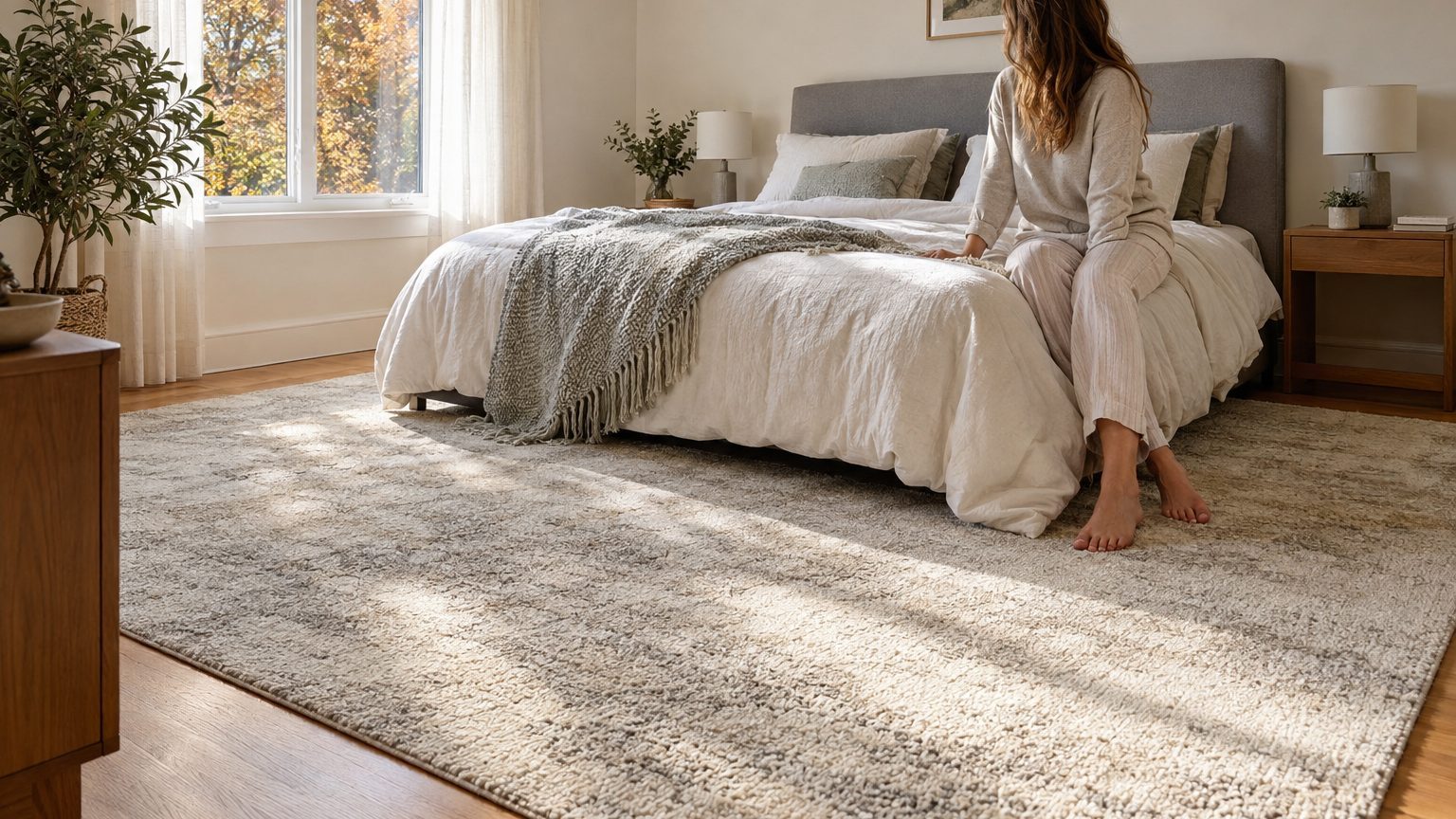
For a queen bed, buy an 8×10 rug. For a king, buy a 9×12. Those two sizes are the standard answers, and the reasoning behind them is simple.
A bedroom rug should extend at least 18 to 24 inches beyond the sides and the foot of the bed.
Your feet land on rug, not on cold floor, when you get up. Both sizes clear that margin at the sides. A 9×12 also clears it at the foot, while an 8×10 needs careful positioning to get there. A smaller rug leaves the floor bare at exactly the spot where you first step out of bed.
The sizing logic below shows why those numbers work, when to move up or down a size, and how to position the rug once it arrives.
What size rug for a queen bed
A queen mattress measures
60 inches wide by 80 inches long
. Add the 18 to 24 inches of margin on each side and you need a rug at least 96 to 108 inches wide, so about 8 to 9 feet. An 8×10 clears that bar.
It’s often called the most versatile size, and it usually works under a queen bed.
Run the arithmetic on an 8×10 laid with its 10-foot side parallel to the headboard wall. That gives 120 inches of width, so about 30 inches of rug shows on each side of a 60-inch queen. Depth is the tighter dimension. The rug is 96 inches deep and the mattress is 80, so if the rug starts at the headboard line, roughly 16 inches remains at the foot. Most people nudge the rug slightly toward the foot, so it begins a few inches under the headboard end. That helps the margin there reach 18 inches or more.
A 9×12 is the upgrade. It measures 108 by 144 inches, which leaves about 42 inches per side and roughly 28 inches at the foot.
A 9-by-12 creates more room around substantial frames.
It suits a sleigh bed, a bed with a footboard, or a room where bedside tables are wide. Check the room size first, though. A 9×12 in a 10×12 bedroom leaves only a thin strip of floor around the edges, and the rug looks like wall-to-wall carpet that doesn’t quite fit.
The 6×9 is the budget and small-room option.
It covers less floor and leaves more of the natural flooring showing, and it goes toward the bottom of the bed instead of fully underneath it.
At 72 by 108 inches, it works with the long side running across the width of the bed. It covers the lower two-thirds of the mattress, gives each side about 24 inches, and stops short of the nightstands. It’s a legitimate design choice, not a compromise, provided the rug sits far enough forward to land under your feet.
What size rug for a king bed
A standard king is
76 inches wide by 80 inches long
. A California king is
72 inches wide by 84 inches long
. The California king is narrower and longer than the standard king, and that changes the math for the foot margin. For either one,
a rug under a king should be at least 9×12.
Here’s what that looks like on the floor. A 9×12 is 144 inches wide, which leaves about 34 inches on each side of a 76-inch king. Depth is 108 inches against an 80-inch mattress, so you get roughly 28 inches at the foot. Both margins are comfortable, and the rug still looks balanced against the bed.
Some retailers list an 8×10 for a king, and it can work.
An 8×10 can fit under a king in smaller rooms, but a 9×12 gives more coverage.
By my math, an 8×10 leaves only 22 inches per side and about 16 at the foot. That margin is thin, and a rug that barely peeks out can look like a mistake. I’d treat it as a last resort for a room that can’t take a bigger rug.
For a large primary suite, a 10×14 deserves a look. It measures 120 by 168 inches, which gives a king about 46 inches per side and 40 inches at the foot.
A 10-by-14 rug gives a king bed more breathing room and can support large nightstands or a bench.
If a bench sits at the foot of the bed, its front legs on the rug and its back legs off is a common problem. A bigger rug avoids it.
Where to place a rug under a bed
Sizing is half the job, and placement is the other half. The standard approach is to run the rug’s long side perpendicular to the bed’s length, so the longer dimension sits parallel to the headboard wall.
The length of your bedroom rug should run perpendicular to your bed.
The rug then extends evenly on both sides and leaves a visible border at the foot.
The rug should start somewhere between the headboard line and the nightstands, and it should extend toward the foot. Bring it far enough under the bed that both side tables can sit with their front legs on the rug, or both entirely off it. Avoid having one table on the rug and the other off it. It looks unbalanced, and a table resting partly on a thick rug can wobble.
The bed’s position in the room matters before the rug does. If the bed sits off-center, or beside a door swing, the rug may not have room to extend evenly. Settle the layout first. The guide on where to place bed in bedroom covers wall choices, clearances and door swings, and a rug should follow those decisions.
Test the footprint before you buy. Mark the rug’s outline on the floor with painter’s tape, then place the bed and nightstands inside it. Walk the room as you would on an ordinary morning. Check that doors, closet openings and dresser drawers all clear the rug’s edges. A rug that catches a door will wear fast and annoy you daily. And a thick rug may need a trimmed or raised door to clear the swing.
The winter angle
In a cold bedroom, the rug is more than decoration. Hard floors
can make your space feel colder, especially over crawl spaces or concrete slabs
, and a rug adds a barrier between your feet and the surface. A bigger rug covers more of that surface. Thickness and fiber matter too.
Thicker rugs insulate better, and natural fibers like wool trap heat in tiny air pockets.
Keep expectations realistic, though.
A rug alone won’t significantly raise the room’s temperature.
It works best alongside weatherstripping, heavy curtains and a heating system that’s working properly. A rug pad underneath adds a layer of cushioning and helps hold the rug in place. For more ways to build warmth into the room, see how to make a bedroom cozy.
When the standard answer doesn’t fit
Not every bedroom is a 14×16 primary suite. A queen bed in a 10×11 room can only take an 8×10 rug with less than a foot of floor showing on some sides. In that room, a 6×9 rug under the bottom two-thirds of the bed works well. The 18 to 24 inches of border still holds at the sides and foot, and some floor still shows around the edges.
Another option is two runners, one on each side of the bed. It’s a good fit if you want to keep a floor you like visible, or if the room is narrow. Each runner should be at least as long as the bed, so about 80 inches or more. A 2.5×8 or similar runner suits that. It doesn’t cover as much floor, so it insulates less than one large rug does. In a cold room, I’d rather have one large rug than two narrow ones.
Room size gives a useful check on the final choice. A queen in a medium room, roughly 10×12 to 14×16 feet, takes either a 6×9 or an 8×10. Allow at least a foot of exposed floor between the rug and the walls. Rugs that run wall to wall look like carpet. Rugs that leave a clear frame look chosen.
One more factor is light. A rug’s color changes how bright the room reads, and a dark rug under a pale bed reads very differently from a pale one. If you’re planning lamps and sconces at the same time, the ideas in bedroom lighting ideas can help you match the rug to the lighting.
Before you order, measure the bed’s actual footprint, including any frame that extends past the mattress. Many frames and footboards add several inches, so a king that measures 76 inches on the mattress may occupy 80 or more on the floor. Rug sizes in catalogs are often nominal as well, with a “9×12” arriving a few inches short on one side. Add a small buffer to your own measurement.
Sources : mn.gov | belfurniture.com | chairish.com