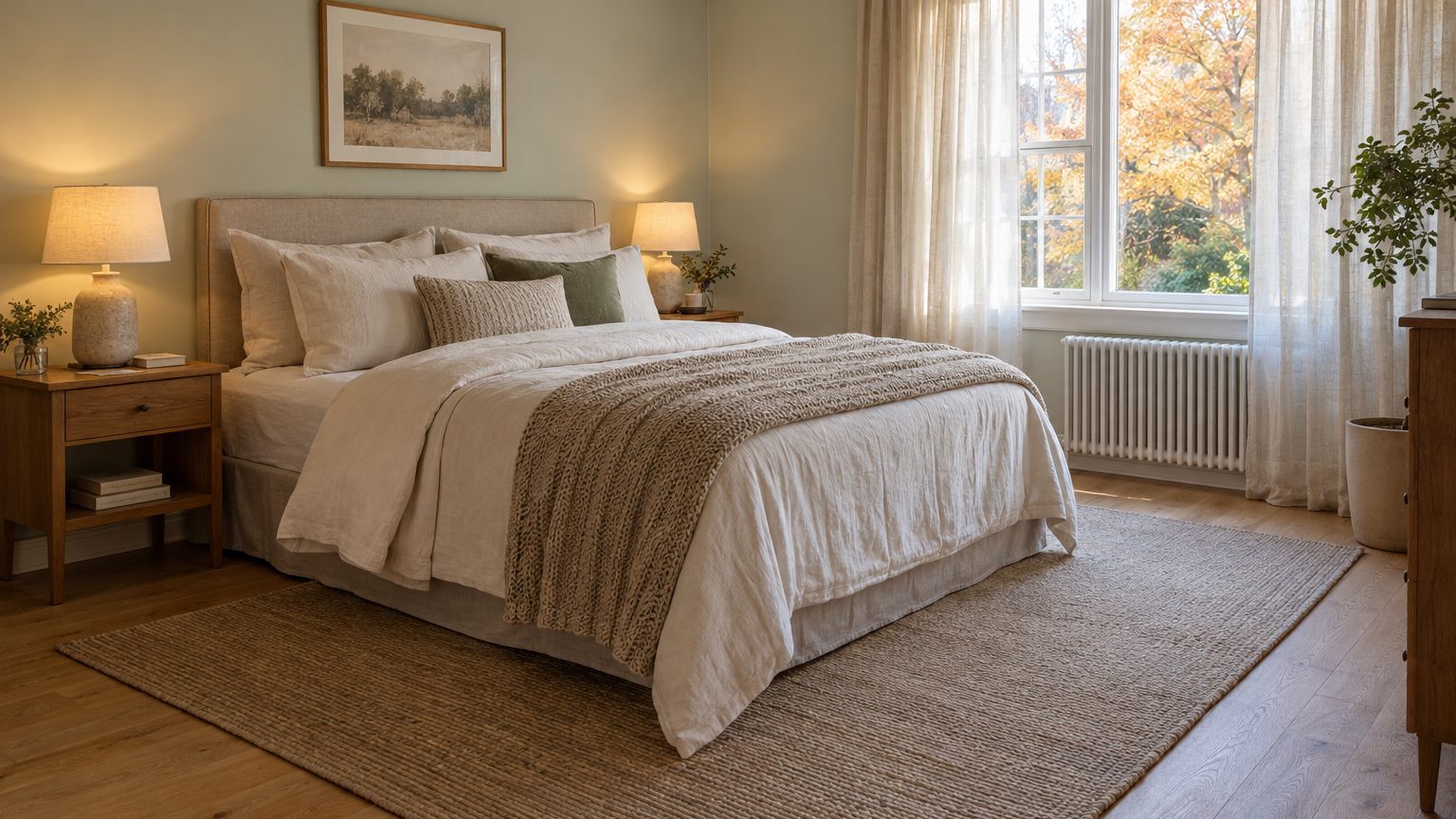
Put the bed on an interior wall, or at least away from the coldest exterior wall and the window. Leave about 30 inches of clear floor on each side you use and 36 inches at the foot if people walk through there. That layout keeps you out of the cold air that pools near glass, leaves room to make the bed, and keeps bedding away from heat sources. If the room only allows one good spot, give up the symmetrical look and keep the warmth and the walking space.
Should a bed be under a window
In winter, probably not. A window is often the coldest surface in a bedroom, and your body notices. According to ENERGY STAR,
the cold interior surface of an inefficient window pulls heat away from your body, so you can feel chilly in a sweater with the thermostat at 70 degrees.
Now consider that you spend about eight hours a night lying still, a few feet from that glass, in nothing heavier than pajamas.
Drafts add to the problem. The Department of Energy points out that
roughly 10%–20% of the annual average cost of energy in the United States is wasted due to drafts, air leaks around openings, and outdated heating and cooling systems.
A bed under a leaky window puts your head and shoulders in the path of that leakage. Condensation is the other cold-weather issue, since
water condenses on interior window surfaces when the surface temperature of the window is below the dew point of the humid indoor air.
Wet sills and damp curtain hems near a pillow are not what you want.
Safety adds a second reason, and it matters more if children sleep in the room. The Consumer Product Safety Commission advises you to
move all cribs, beds, furniture and toys away from windows and window covering cords, preferably to another wall.
The agency’s data show that
on average, about nine children under 5 years of age die every year from strangling in window blinds, shades, draperies and other window coverings with cords.
A bed is climbable furniture. It gives a toddler a platform to reach a cord that would otherwise be out of reach.
Sometimes the window wall is the only wall that fits the bed, which is common in narrow rooms or rooms with a sloped ceiling. In that case you can reduce the downsides:
- Seal gaps with weatherstripping or clear plastic film, and use insulating drapes or shades. The Department of Energy lists
weather-stripping, clear plastic window film, and insulating drapes or shades
as ways to cut airflow. - Keep windows closed and latched in cold snaps. Federal guidance says that when outside temperatures are extreme,
keeping windows tightly closed with all latches locked saves energy and minimizes uncomfortable drafts. - Switch to cordless coverings. If you keep corded ones, the CPSC says
cord stops should be within 1 to 2 inches from the head rail when the blind is fully lowered.
Finish with warm layers on the bed itself. The how to make a bedroom cozy guide covers bedding choices that make a window wall easier to live with.
How much space around a bed
The usual planning figure is 24 inches as the bare minimum and 30 to 36 inches for comfort. One layout guide says to
allow at least 24 inches on each open side and at the foot of the bed, and 30 to 36 inches if you can.
Bigger beds ask for more. A common rule of thumb is
30 to 36 inches for a queen and 36 to 42 inches for a king or California king when the room allows.
The math gets tight faster than most people expect. Take a queen bed, which is 60 by 80 inches, in a 12-by-12-foot room. Add 24 inches on one side and 36 on the other to the bed’s 60-inch width and you get
120 inches, exactly 10 feet.
That leaves 24 inches across the width to spare, and that is before any furniture. Put in a 24-inch nightstand and
the clearance on the 36-inch side drops to 12 inches, which is too narrow to walk through comfortably unless you use the 24 spare inches.
A king in the same room is worse. At 76 inches wide, it leaves about 34 inches per side at best, before any nightstand, which is below the 36 to 42 inches suggested for a king.
The foot of the bed is where many layouts fail. If a dresser faces the bed,
leave about 36 inches in front of it so the drawers open and you can stand there.
Closets want 24 to 30 inches in front of them so the doors or sliders don’t hit anything. Nightstands should sit
about 2 to 6 inches from the bed.
Measure all three before buying a bigger bed.
Can you go below these numbers? Yes, if you are honest about which side you use. Where space is tight,
about 18 inches can be workable on a side you rarely use, though it is below the usual 24-inch minimum.
One person sleeping alone can push a bed against a wall and keep the whole clearance on a single side. Two people sharing a bed need both sides open, and the room will tell you whether a queen is too big. Tape the footprint of the bed and the walking paths on the floor and live with it for a day. It costs nothing and beats moving a frame twice.
A rug can help mark the zone. The area rug size for bedroom page explains how far a rug should extend past each side so your bare feet land on something warm. Lamps matter as well, because a bed pulled away from the wall changes where outlets and cords sit. See bedroom lighting ideas for placement that doesn’t block the walkway.
Bed against wall or in middle of room
Most bedrooms put the headboard against a wall, and for good reason. It steadies the bed, frees the floor, and gives you a back to lean against. A layout guide suggests placing
the bed first, headboard against the longest uninterrupted wall, keeping 24 or more inches of clearance on each side you use.
That wall is usually the best candidate, but only if it isn’t also your coldest one.
Which wall? Prefer an interior wall, one with another heated room behind it, over an exterior wall. Interior walls tend to stay closer to room temperature, so the surface behind your pillow isn’t pulling heat from your head. If the only option is an exterior wall, don’t butt the frame flush against it. Warm, humid room air that meets a cold wall surface can condense behind furniture, and a bed is large enough to block airflow completely. Guidance on furniture and moisture suggests
pulling furniture at least 2 inches from exterior walls, with 3 to 4 inches better,
so room air can warm the wall. A slatted or open-backed headboard helps, and so does keeping indoor humidity from sitting high. The EPA’s often-cited target is
below 50%.
Pushing a bed into a corner is the compromise people make in small rooms. It works, with a catch.
Access is limited on one side,
which means one person climbs over the other and fitted sheets become a wrestling match. If you share the bed, don’t do it unless the room leaves no choice.
The middle of the room, sometimes called a floating bed, solves cold-wall problems but creates others. It works best in rooms of around 14 by 14 feet or more, where you can still walk behind the headboard or use that space for a bench or console. A floating bed also moves the sleeper away from the outer walls, and the headboard becomes the visible face of the room. In a small room, though, a floating bed usually eats the walking space you were trying to protect. It makes sense where windows or doors force the bed to the center. Otherwise, wall placement is simpler.
Keep heat sources and bedding apart
Moving the bed away from the cold shouldn’t mean moving it closer to a heater. If you use a portable heater, the CPSC says to
place it at least three feet away from combustible materials such as drapes, furniture or bedding.
The agency also advises:
never leave portable heaters turned on while sleeping.
And electric heaters belong in
a wall outlet, never an extension cord or power strip.
That three-foot rule shapes your layout. A radiator or baseboard heater beside the bed is fine only if your comforter doesn’t touch it. Duvets slide off at night, and that trailing corner is the one that ends up against a hot surface. As a precaution, leave a clear 36 inches between any heater, including a radiator or baseboard unit, and the mattress edge, then check that bedding can’t drape into that gap.
The figures behind the rule are worth knowing. According to CPSC estimates,
portable heaters, including electric space heaters, are involved in an average of 1,600 fires per year, resulting in an average of 70 deaths and 160 injuries annually from 2019 to 2021.
A heater is a stopgap. The permanent fix is a bed on a warm wall with a sealed window nearby.
Sources : cpsc.gov | energy.gov | energystar.gov