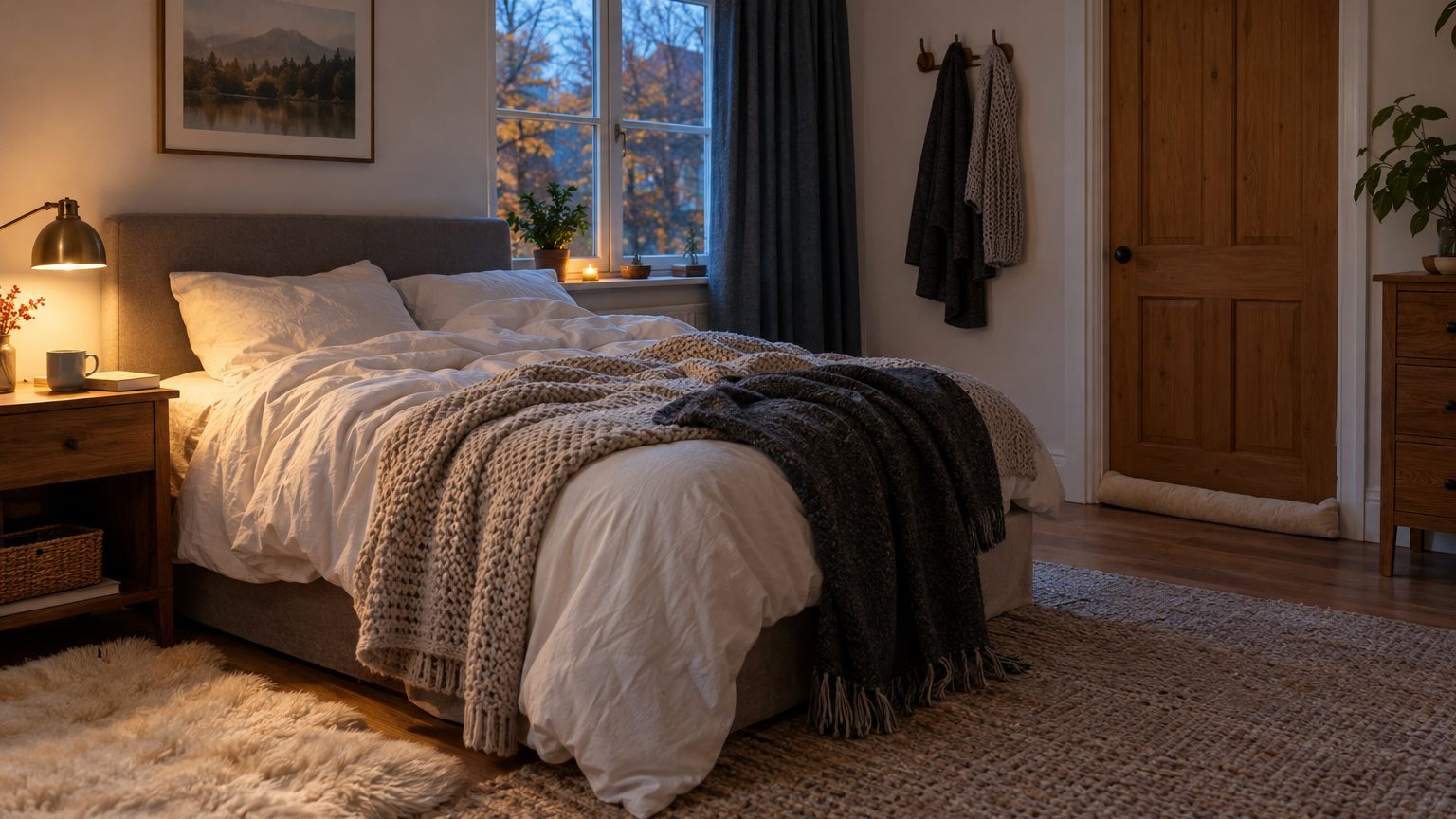
A warm bedroom in winter comes from four moves, in this order: seal the drafts, cover the glass with thermal curtains, layer the bed, and only then consider extra heat. Turning up the thermostat is the blunt option. Most of the comfort comes from slowing heat loss and keeping warmth close to your body, and none of that requires a hotter room. Sleep experts also don’t want the room very hot. The Cleveland Clinic’s rule of thumb is
60 to 67°F (15 to 19°C)
, so the goal is a room that holds its heat and a bed that does the rest.
Think of the bedroom as a bucket with holes in it. Pouring in more heat works for a while, but plugging the holes works better, a principle that also drives our guide on How to Keep a Room Warm Without a Heater. The sections below start with the biggest holes and end with the finishing touches (the same ones covered in our guide on How to Make a Bedroom Cozy), including a look at the Best Bedding for Winter.
How to keep a bedroom warm at night
The target temperature comes first, because it changes every other decision. For most adults the sleep-friendly range is 60 to 67°F, and Cleveland Clinic sleep psychologist Michelle Drerup recommends thinking of the bedroom as a cave:
cool, dark and quiet
. Colder isn’t better, though. She explains that when you’re cold,
the body goes into high gear to rewarm itself
, which is the opposite of what you want at 2 a.m. Older adults may prefer more warmth. Some research points to
68°F to 77°F (20°C to 25°C)
as a workable range, so treat the numbers as a starting point and adjust over a few nights. Babies have their own rules, so if you’re heating a nursery, read How to Keep Baby Warm at Night before adjusting anything.
That range fits neatly with how the U.S. Department of Energy suggests running a heating system. Energy.gov advises setting the thermostat
around 68°F to 70°F while you’re awake and lower while you’re asleep or away
. Programmable thermostats help here, since they
return temperatures to normal before you wake
. A bedroom that starts at 65°F and reaches 68°F by 6:30 a.m. beats one that sits at 72°F all night while the furnace works against the cold.
Drafts are the next target, and they’re easy to find. Light an incense stick and pass it along window frames, door edges and baseboards.
Wherever the smoke is sucked out of or blown into the room, there’s a draft.
A cheaper method is a strip of tissue taped to a dowel. A Florida extension guide suggests moving it around windows, doors, electrical outlets and ceiling fixtures on a windy day, because
air movement around these spots could mean an air leak
.
Once you’ve found a leak, the fix depends on whether the joint moves. According to Energy.gov,
caulk is generally used for cracks between stationary components such as door and window frames, while weatherstripping seals parts that move, like doors and operable windows
. The payback is quick, with both techniques
often paying for themselves in one year or less
. The DOE’s project page rates caulking an easy job that takes one to two hours, costs roughly $3 to $30, and can cut energy use by 10% to 20%.
Timing matters more than most people expect. The National Fenestration Rating Council’s consumer guide says caulk needs
relatively warm temperatures, above 45°F
to set properly, and weatherstripping should go on
clean, dry surfaces at temperatures above 20°F
. Do the job on a mild afternoon in October or November, not during a January cold snap. For small gaps, caulk handles openings
up to ¼-inch wide
, and larger gaps need foam backing material first. Outlets on exterior walls can also leak, and
foam gaskets made for the purpose fit behind outlet plates
.
The bedroom door matters too. A room that opens onto a cold hallway or an unheated stairwell loses warmth every time someone walks through. A door sweep and a closed door overnight keep the room’s air from mixing with the rest of the house. If you’re curious how far these low-tech fixes go, how to keep a room warm without a heater goes through them in more detail.
Best bedding for winter
Bedding gets the credit when a cool room feels fine. One sleep-research summary puts it plainly:
a cool room with a heavy duvet is not the same as a cool room with light blankets
. The body’s goal at night is equilibrium, with the core cooling slightly and the extremities staying warm. You want to avoid both sweating and shivering.
Layers do that better than one thick slab. A fitted sheet, a blanket or quilt, and a duvet on top give you three adjustable levels of warmth. Kick one layer off at 3 a.m. and you’re fine, whereas a single heavy comforter forces an all-or-nothing choice. A throw folded across the foot of the bed covers the area where cold feet usually start. Pairing this with socks and a base layer of sleepwear helps too, and University of Florida extension advice says
warmer clothing and an extra blanket or throw let you lower the thermostat even more
.
Fabric choice is where most winter bedding decisions get made, and where marketing gets noisy. Flannel, brushed cotton, wool and down all trap air differently, and comfort depends on how you sleep: hot sleepers and cold sleepers need different setups. The guide to the best bedding for winter compares the options by sleeper type, so there’s no need to repeat the full comparison here.
One exception to the “add more layers” rule: infants. A baby’s room runs warmer than an adult’s, and the bedding rules are stricter. Pediatric guidance puts the nursery at
about 68 to 72°F (20 to 22°C)
, and a baby should wear
one more layer than an adult would need to feel comfortable
. Loose blankets don’t belong in a crib. Mercy Health’s guidance notes that
loose bedding can raise the risk of suffocation, strangulation, and sudden infant death syndrome
. If a child sleeps in your room or you’re setting up a nursery, how to keep baby warm at night covers sleepwear and room setup in detail.
Thermal curtains
Windows are the largest cold surface in most bedrooms, and the cold air they cool drops to the floor and settles around your ankles. Glass can’t be changed overnight, but what hangs in front of it can. Energy.gov says that when drawn in cold weather,
most conventional draperies can reduce heat loss from a warm room by up to 10%
and raise comfort. Thermal-lined versions are built for more. If you want the details on how the lining works and what to look for, the guide to thermal curtains covers it.
How you hang them matters as much as which curtains you buy. The DOE’s guidance reads like a checklist:
hang draperies as close to windows as possible, falling to a windowsill or floor
. For the best result,
install a cornice at the top or hang the drapery against the ceiling, then seal it at both sides and overlap it in the center
. Velcro or magnetic tape can fasten the edges to the wall, and a pair of layered draperies makes a tighter air space than a single one.
A rod mounted six inches above the frame, with curtains that stop at mid-window, leaves a chimney of cold air flowing down the glass and into the room. That’s a common setup, and a poor one for winter. Moving the rod up toward the ceiling and choosing floor-length panels costs little and fixes the problem. An independent energy-efficiency guide makes the same point: the best performers
create the highest amount of insulating air space between the covering and the window
, and heavy, multi-layered curtains that drop tight to the floor do this well.
Timing is the other half of the job. The DOE’s advice is to
close all draperies at night, along with draperies that don’t receive sunlight during the day
. The corollary is to open south- and west-facing curtains on sunny days and let the glass collect free heat. Close them at dusk, before the room cools, to hold that warmth in. People who leave curtains in one position all year get the worst of both seasons.
Curtains reduce heat loss but don’t stop air movement. NFRC’s consumer guide is clear that
caulking and weatherstripping reduce air leakage but do not insulate
, so each handles a different job. For single-pane windows, it suggests
storm windows for better insulation of existing windows
. Low-e storm windows
save about 10-30% on heating and cooling costs when used with existing single-pane windows
, according to a summary of DOE data. That’s a bigger project, but for an old, cold bedroom window it may be the upgrade that pays back most.
How to keep a room warm without a heater
Start with the free heat. A sunny bedroom window can warm a room by midday if the curtains are open. After sunset, close them as described above. Other no-cost steps are keeping the door shut, keeping furniture clear of the vents, and avoiding any piece of furniture that blocks a radiator. A bare floor over a crawl space or garage is another cold source, and a thick rug helps more than it looks like it should. The longer playbook is in how to keep a room warm without a heater, which treats these one at a time.
Clothing and bedding do work that a heater would otherwise do. Wool socks, a base layer and a robe handle the 6 a.m. trip to the bathroom, and a bedside throw handles reading time. The University of Florida extension notes that
closed or tighter cuffs and collars help retain body heat
. Warm clothes make a 66°F bedroom feel normal, and they cost less than running a second heat source for eight hours.
Sometimes a space heater is the right call, such as in an older house with a cold corner room or when the main system fails. In that case, treat it like the fire hazard it can be. The U.S. Consumer Product Safety Commission estimates portable heaters are involved in
an average of 1,600 fires, 70 deaths and 150 injuries per year from 2020 to 2022
. Its rules are short and non-negotiable:
- Keep the heater
at least three feet from drapes, furniture, bedding and other combustible materials
. - Plug it
directly into a wall outlet, never an extension cord or power strip
. - Turn it off when sleeping.
- Choose a model with the seal of a nationally recognized testing laboratory such as UL.
The “turn off when sleeping” rule matters most for a bedroom. A heater can pre-warm the room for twenty minutes before bed and be unplugged before you’re under the covers, and that’s the safest use. CPSC also warns against using a kitchen range or oven to heat the house, since it
could overheat or generate excessive carbon monoxide
.
How to make a bedroom cozy
Warmth is partly measured with a thermometer and partly felt. A room at 65°F with soft textiles, low lighting and a thick rug feels warmer than a 68°F room with a bare floor and a hard glare overhead. That’s why a cozy bedroom is a legitimate part of staying warm, not a decoration afterthought. The full version is in how to make a bedroom cozy, but the core ideas are simple.
Texture does a lot. Heavy knit throws, a wool or tufted rug by the bed, and a headboard or upholstered piece against an exterior wall all add insulation and visual softness. Lighting matters in a less obvious way. Warm-toned bulbs and low lamps at bedside cue the evening wind-down, and a cool, bright overhead light feels wintry even when the room isn’t. Heavy curtains do double duty here, since they cut drafts and give the room a softer outline.
Furniture placement helps too. A bed pushed against a cold exterior wall can feel chilly on that side, and moving it a few inches away, or putting a bookshelf or wardrobe on the cold wall, reduces the effect. Keep that three-foot distance from any heater in mind when you rearrange. CPSC’s rule covers beds as well as curtains and sofas.
Before the season’s first cold night, check the alarms. CPSC recommends
smoke alarms on every level and inside each bedroom, and carbon monoxide alarms on every level and outside sleeping areas
. Interconnected units are best, and battery backup keeps them working through a winter outage, which is when people reach for the riskiest heat sources.
Sources : gov.uk