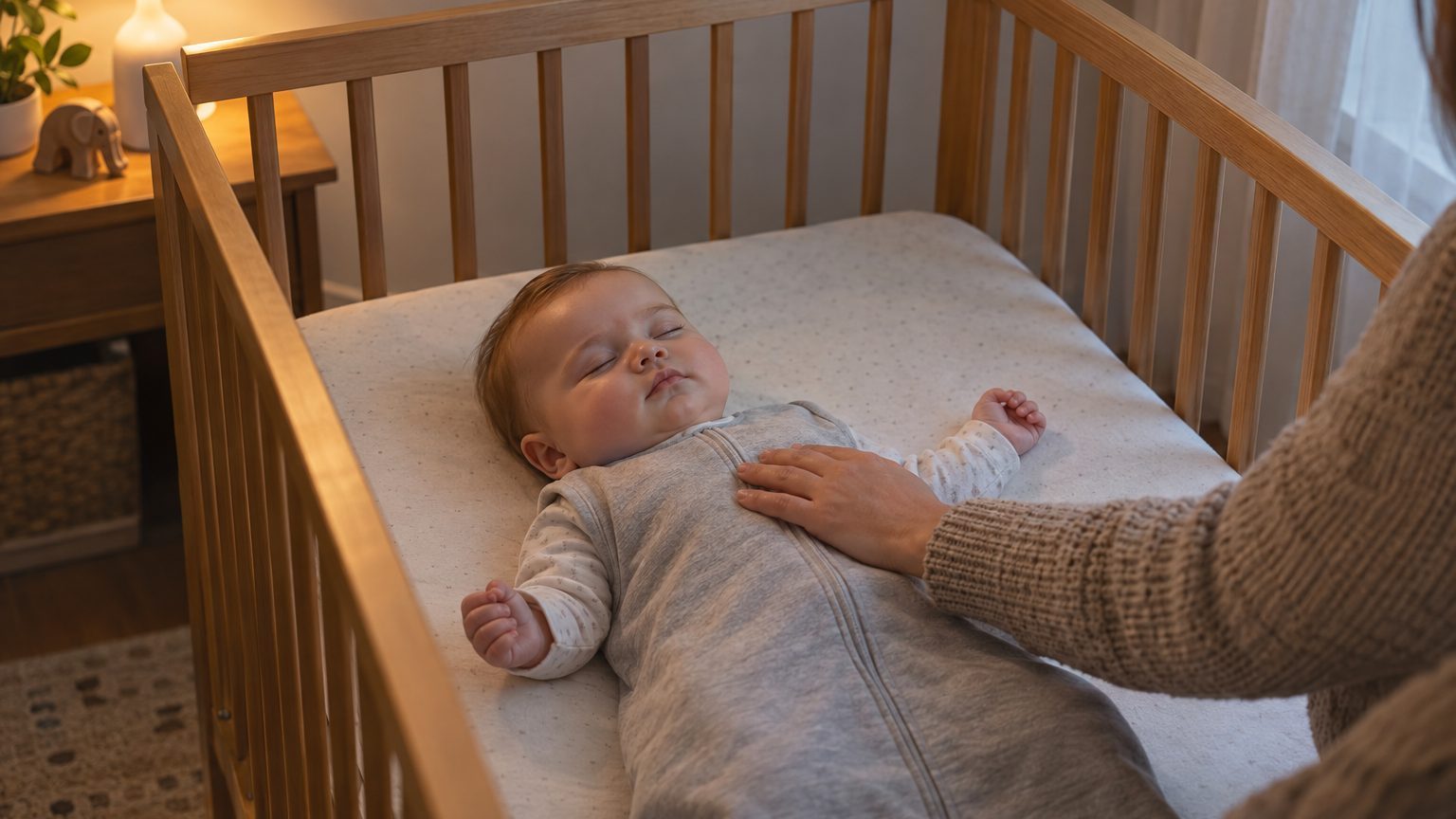
Dress your baby in no more than one extra layer than you’d wear, put them in a wearable blanket sized to the room, and keep the crib bare. The American Academy of Pediatrics (AAP) says that if you’re worried your baby is cold, the answer is a wearable blanket such as a sleep sack, or a warm sleeper that fits properly. Loose blankets are not the answer. Overheating is a documented risk factor for sleep-related infant death, so the goal is a baby who is comfortable, not toasty.
That runs against instinct. Parents lie awake at 2 a.m. wondering whether tiny hands that feel like ice cubes mean a freezing baby. They usually don’t.
How to tell if baby is too cold at night
Forget the hands and feet. They run cooler than the rest of the body, and cool fingers on a well-dressed baby are normal. The reliable spots are the chest, the tummy, the upper back and the back of the neck. Slide a hand gently under the sleep sack’s neckline and feel the trunk. Warm and dry means right. Cool means the baby needs another layer. Sweaty, damp at the neck or flushed means too much.
Beyond touch, several other signs point to a baby who is cold. Pale or blotchy skin, small tremors or shivering, and a curled-up, tucked-in posture are common ones. So are restless sleep and frequent waking with no clear cause such as hunger or a wet diaper. Waking in the early hours can be one of them, since that is often the chilliest stretch of the night. None of these signs is specific to cold, so look for a pattern: a cool neck, a cold room and a restless baby together.
Fix it in order. First, add a thin layer under the sleep sack or move up one warmth grade in the sack itself. Second, check the room. If the space sits well under the usual 68 to 72°F range that pediatric guidance cites, warm it a little instead of piling on fabric. The baby room temperature guide goes through the numbers, and the broader guide on how to keep bedroom warm in winter covers drafts, radiators and the habits that hold heat in after the thermostat clicks off. Heavy thermal curtains over a nursery window can cut the chill that radiates off cold glass at 5 a.m.
A room thermometer placed away from the window and at roughly crib height tells you more than your phone’s weather app. Cheap, boring and effective.
Overheating is a serious risk too, so learn that side as well. Sweating, damp hair, flushed cheeks and fast breathing all say remove a layer or switch to a lighter sack. Babies can overheat without having a fever, particularly when overdressed or swaddled too snugly. A rectal temperature of 100.4°F (38°C) or higher counts as a fever and needs a call to your child’s provider. The AAP recommends the rectal method as the most accurate for infants under 3 months.
A few signs go beyond “add a layer.” A baby with very cold, pale skin, unusual limpness or sleepiness, slow breathing, or who won’t wake for feeds needs medical attention. Call your pediatrician right away, and use emergency services if the baby is hard to rouse.
Are blankets safe for babies
Not in the first year. The AAP’s safe sleep guidance calls for a firm, flat sleep surface with a fitted sheet and nothing else in the sleep space: no loose blankets, pillows, bumpers or soft toys. A blanket can end up over a baby’s face, and a young infant can’t push it away or reposition. A blanket also holds heat against the body in a way you can’t easily monitor from the doorway.
The standard advice is to wait until at least 12 months before introducing a blanket in the crib. Plenty of parents wait longer, and a sleep sack remains an option well into toddlerhood. If you want something soft and heavy for a toddler’s bed later, our guide to the best bedding for winter covers what suits the grown-ups and older kids. For the baby, the crib stays plain.
Swaddling is the gray area that trips people up. A light swaddle can calm a fussy newborn, but the AAP says to stop as soon as the baby shows signs of trying to roll, which commonly happens somewhere between 2 and 4 months. A swaddled baby who rolls onto the stomach can’t use their arms to push up. At that point, move to an arms-free sleep sack. Also steer clear of weighted sleep sacks, weighted swaddles and other weighted infant products. The AAP recommends against them because the added weight can restrict breathing and movement, however cozy the marketing makes them look.
Hats follow similar logic. Babies lose a lot of heat through the head, which is why a knit cap is the right call in the delivery room and outdoors. Indoors, at night, a hat is one more way to overheat and one more thing that can slip over the face. Pediatric guidance says skip it.
Several places and situations deserve their own mention:
- Car seats, strollers, swings and infant carriers are for travel and supervised use, not overnight sleep. Move the baby to a flat, firm surface as soon as you arrive.
- Sofas, armchairs and adult beds are unsafe for infant sleep, and the AAP recommends room-sharing without bed-sharing.
- Sleeping bags and fleece pajamas count toward total warmth, so don’t stack several heavy items together.
- If your sleep sack’s arm and neck openings are loose, the baby can slide down inside it, so follow the manufacturer’s size and weight guidance.
Safe doesn’t have to mean chilly. A warm footed sleeper, a snug sack and a properly heated room can keep a newborn comfortable at a thermostat setting that wouldn’t make an adult shiver.
Sleep sack tog guide
TOG stands for thermal overall grade, a rating of how much insulation a fabric provides. A low number is thin and cool, while a high number is thick and warm. The system came from UK textile testing and is used by manufacturers, not set by the AAP or any US safety agency. So treat the charts as a starting point, not a rule. Brands vary slightly, and US charts tend to look like this:
- 0.5 TOG for rooms around 74 to 78°F, over a diaper or a short-sleeved bodysuit.
- 1.0 TOG for rooms around 69 to 73°F (some charts stretch it to 75°F), over a long-sleeved bodysuit or thin cotton pajamas.
- 2.5 TOG for rooms around 61 to 68°F, over long-sleeved pajamas, with an optional undershirt.
Look at the overlap. A room held at 68 to 72°F lands squarely in the 1.0 TOG zone, and sometimes at the edge of 2.5. If your nursery sits at a steady 70°F and you put the baby in a 2.5 TOG sack over fleece pajamas, you’ve probably overdressed them. The heavy sack is for the colder rooms: older houses, bedrooms over garages, the end of a hallway where the heat never reaches. Match the sack to the room you have, not the room you wish you had.
The ratings also stack. A bodysuit might contribute roughly 0.5 TOG, pajamas around 1.0, and the sleep sack its own number on top. A baby in all three can end up at a total that suits a much colder room than yours. If you’re checking the sack label, add up what’s underneath before you decide.
For what goes beneath the sack on different nights, the guide on what should baby wear to sleep works through the layering options by room temperature and by age.
A few practical points keep the numbers honest. Check the chest after about 20 minutes, not just when you zip them in, since a baby can feel fine in the first minutes and sweat later. If the chest is damp, drop a layer or go down a TOG grade. If the trunk is cool and the baby is restless, go up. Keep the zipper pulled up and the sack sized to your baby’s weight and length. If your baby was born prematurely, has a condition that affects temperature regulation or wears a hip brace, ask your pediatrician before relying on a generic chart. Special sacks exist for hip dysplasia treatment, and low body fat shifts how much insulation a baby needs.
The chart also assumes a healthy baby in a normal sleeping position. It can’t account for a drafty window, a cold exterior wall or a heating vent blowing straight at the crib. Those are room problems with room solutions, which loops back to the thermometer, the curtains and the draft stoppers.
One last wrinkle for the early hours: the coldest point in the house usually arrives shortly before dawn, when the furnace has been cycling lightly for hours and outside temperatures bottom out. If your baby sleeps well until 5 a.m. and then wakes fussy with a cool chest, the fix may be as small as one grade up in the sack or one warmer layer underneath. Make that change on the next cold night, then recheck the chest on your first early wake-up and adjust from there.
Sources : gshvin.org | hopkinsmedicine.org | publications.aap.org