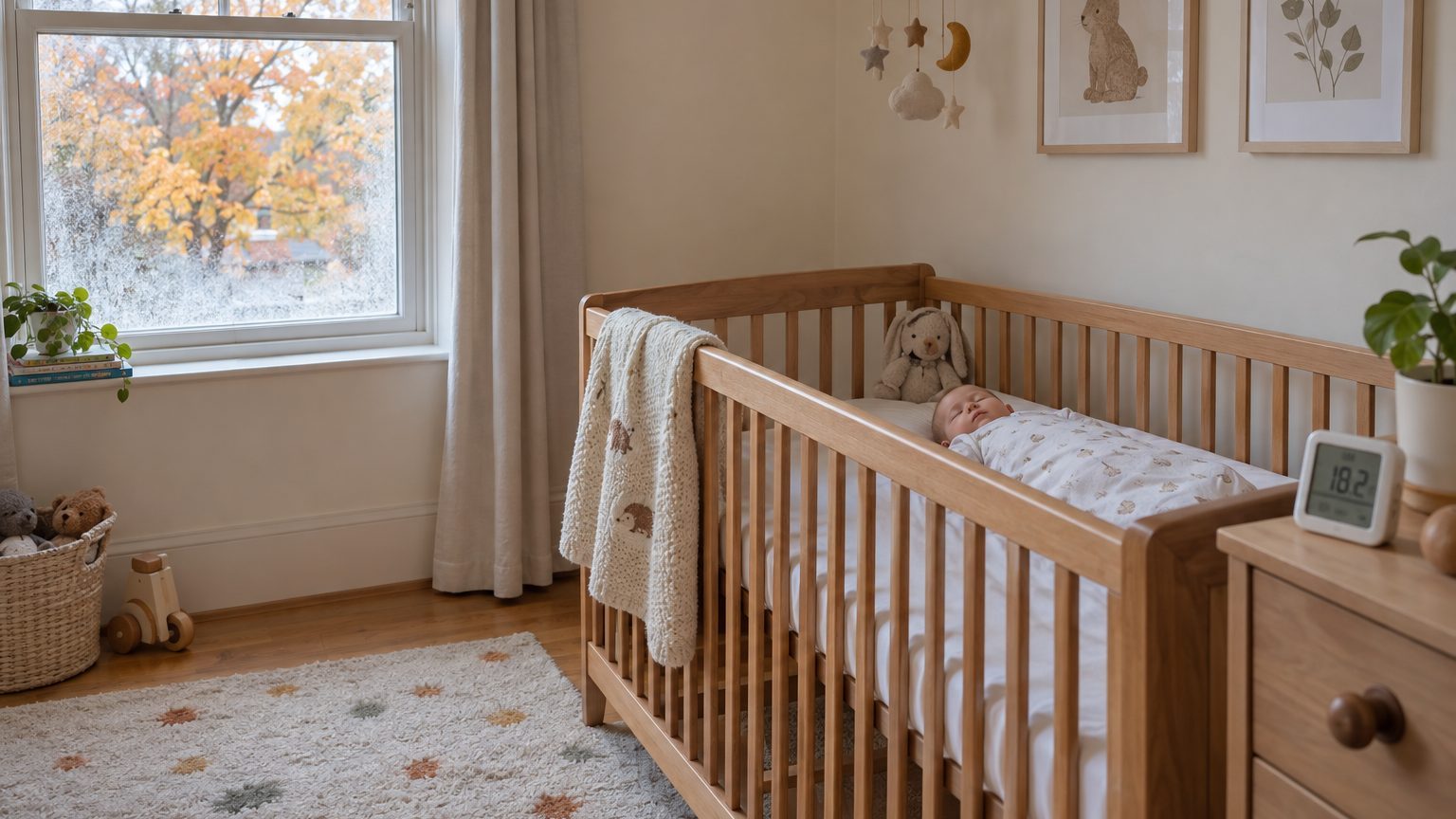
Keep the room between 68°F and 72°F (20 to 22°C). Sleep-safety sources commonly cite that range, and it matches the 68°F the U.S. Department of Energy suggests for winter when you’re home, so you don’t need to crank the heat for a newborn. The American Academy of Pediatrics (AAP) doesn’t set an official number. Its emphasis is on dressing the baby for the room and avoiding overheating, so the thermostat is only half of the setup.
Ideal room temperature for baby in winter
Winter makes that 68 to 72°F window harder to hit than it sounds. The thermostat in the hallway may read 70°F while the nursery, with its single-pane window and exterior wall, sits at 64°F. Rooms over a garage or at the end of a heating run often behave this way.
So measure where the baby sleeps. A basic digital thermometer placed at crib-mattress height, and away from radiators, vents and windows, gives a truer reading than any wall dial. Many baby monitors include a sensor, but the same placement rule applies. A device sitting next to a heat source will report a warmer room than the one your baby is in.
The room figure only works alongside clothing. A common rule of thumb is one more layer than an adult would wear to be comfortable in the same room. Anything that goes over the baby should be wearable, not draped, which is why sleep sacks and fitted sleepers replace blankets. The details of fabrics and weights are covered in what should baby wear to sleep, and the heating-side tactics (draft control, curtains, rugs) are in how to keep baby warm at night.
Overheating is the risk parents tend to underestimate. The AAP notes that too much warmth raises the risk of sudden unexpected infant death (SUID), and a baby who is overdressed in a warm room can’t easily shed heat. Hence the instinct to bundle “just in case” works against you. Check the chest or the back of the neck instead of the hands: if the skin is sweaty or flushed, remove a layer. If it feels cool, add one.
Winter heating habits deserve a quick audit too. Space heaters should stay well clear of the crib and of anything flammable (the standard guidance is at least three feet), and ideally you’d heat the room with the central system rather than a portable unit running unattended overnight. The AAP also recommends that babies share a room with parents, though not a bed, for at least the first six months and ideally up to a year. In practice, that means the baby’s “nursery” in winter is often your bedroom, and the 68 to 72°F target applies there.
One more detail: consistency beats precision. Setting the thermostat to hold the same temperature at bedtime and through the night avoids the 3 a.m. dip that comes when a programmed setback kicks in. Many programmable thermostats lower the temperature by several degrees overnight to save energy, which is sensible for an adult bedroom and less so for an infant’s.
Is a cold room bad for a baby
A cool room is fine. A cold one is a problem. The distinction matters because the safe-sleep advice about overheating sometimes gets read as “colder is safer,” and that isn’t what it says.
Babies lose heat faster than adults, because they have more skin surface relative to their body weight and little insulating fat. Newborns have a limited ability to shiver, so a baby in a chilly room can’t warm itself up the way you would by pulling on a sweater. A baby who is too cold may become unusually sleepy, feed poorly, or feel cool across the chest and belly. Those are reasons to warm the room and add a layer straight away, and to call the pediatrician if the baby seems lethargic or won’t feed.
Cool hands and feet, on the other hand, are normal in young babies and tell you very little. Circulation to the extremities is still immature. This is a common false alarm at 2 a.m., and it’s why the chest check is more useful than touching a foot.
What’s the practical lower limit? The AAP publishes no lower limit, but the commonly cited range starts at 68°F, and I’d treat anything consistently below 65°F as a signal to act: close the gap around a window, move the crib away from the exterior wall, run the heating a little longer before bedtime, and choose a warmer sleep sack. Some sleep-focused guidance suggests a slightly cooler room helps babies settle, and a comfortably cool room is fine, provided the sleepwear matches. What you shouldn’t do is compensate for a cold room with loose blankets, pillows, a heavy hat, or a heating pad in the crib. Those add suffocation and overheating hazards that the room’s chill never posed.
A temperature reading can also help you decide whether a baby feeling warm has a fever. Normal body temperature is around 98.6°F, and 100.4°F or higher is generally considered a fever. In a young infant that is a reason to phone the doctor rather than adjust the thermostat. Premature babies and those with medical conditions may have different needs, so the pediatrician’s advice takes precedence over any range in a general guide.
Humidifier in baby room
Heated winter air is dry air. Indoor relative humidity can fall below 30% in a house with forced-air heating, and the Environmental Protection Agency suggests keeping indoor humidity between 30% and 50%. Dry air can chap skin and make a stuffy nose feel worse, which is the main reason parents reach for a humidifier.
Whether the baby needs one is a separate matter. A humidifier isn’t typically necessary for a healthy baby, and it’s better to measure first. A hygrometer (often built into the same thermometer-hygrometer units sold for nurseries) tells you whether the room is actually dry. If it reads within 30 to 50%, leave the humidifier in the closet. If it sits at 20 or 25% and the baby has dry skin or a congested nose, a humidifier can reasonably help.
If you buy one, choose cool mist. The AAP considers cool-mist humidifiers safer for young children than warm-mist models or steam vaporizers, because there’s no burn risk from hot water or steam if the unit is knocked over. Warm-mist devices heat the water, which is exactly what you don’t want near a baby who will eventually be crawling.
Cool mist has its own catch, and it’s cleanliness. A dirty humidifier can send bacteria, mold and mineral particles into the air, and the CDC has warned that unclean units can spread germs through the mist. Follow the manufacturer’s directions for emptying and cleaning, which for many units means daily attention. When the manual doesn’t specify a cleaner, the EPA recommends a 3% hydrogen peroxide solution for surfaces that touch water. Always let the tank dry completely before refilling.
Water choice matters as well. Ultrasonic models turn the water’s minerals into a fine white dust, so distilled water is the safer fill for those. Evaporative models trap minerals in the wick, which then needs replacing on schedule.
Placement is a safety question, not a styling one. Put the unit on a stable surface, well out of reach, with the cord out of reach too. Keep it several feet from the crib, and aim the mist into open air rather than at bedding, curtains or the wall. Too much humidity creates its own trouble: fogged windows, damp sills and musty smells are signs that moisture is going somewhere you don’t want it. Dial back the output or run the unit for shorter periods when you see them. If the baby’s cough or breathing seems worse with the humidifier on, switch it off and check the machine, the water and the room’s humidity before using it again.
A humidifier doesn’t warm anything. Moist air can feel slightly different on the skin, but it doesn’t replace heat, and it shouldn’t change how you dress the baby.
The cheapest improvement is a second reading. Compare the nursery sensor with the thermostat for a couple of nights, and check the number again around 5 a.m., when the house is usually at its coldest. If the two differ by more than a few degrees, trust the one at the crib.
Sources : sleepfoundation.org | babyenroute.com | care.com