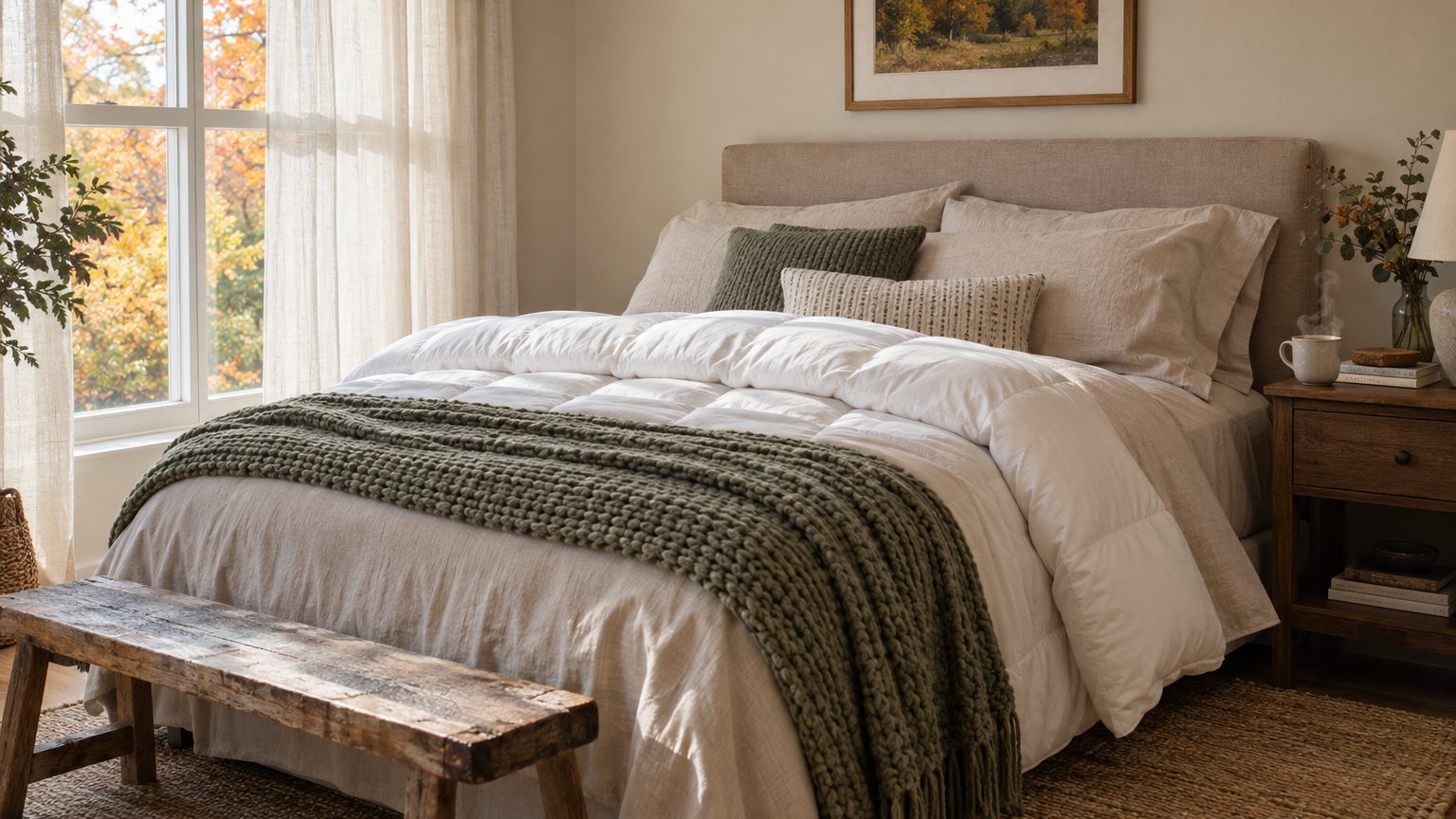
The warmest winter bed is built in three layers: cotton flannel sheets at about 5 ounces per square yard or heavier, a down or down-alternative comforter chosen by fill weight as well as fill power (our roundup of the Best Comforter for Winter shows top options), and a wool or quilted blanket you can add or remove. Each layer does a separate job. Sheets hold warmth against your skin, the comforter traps the bulk of your body heat, and the extra blanket gives you a dial to turn when the forecast drops (if you’d rather use a heated one, see our comparison of Heated Mattress Pad vs Electric Blanket and read up on Electric Blanket Safety first). Pairing them well matters more than buying the priciest version of any one piece, and our guide on How to Layer Bedding walks through how to combine them.
Warmest sheets for winter
Forget thread count.
Flannel sheets aren’t measured by thread count but by ounces per square yard.
The number reflects how dense the fabric is and how thick the brushed surface (the nap) has grown, and the nap is what traps a thin layer of warm air against you.
A fair baseline?
Five ounces is a fairly standard weight, and you can go lighter or heavier depending on how much you overheat at night.
Five ounces lands around 170 GSM (grams per square meter), the metric many retailers use instead. Some listings blur the two scales, so check which unit a product page is quoting before you compare. Heavier cloth costs more and behaves differently. In one lab test,
a set described as 6 ounces per square yard weighed in at 6.5 ounces
, so labels are approximate. A set labeled 6 ounces or more is for cold bedrooms or cold sleepers, and it tends to be
slower to dry
.
Brushing quality is the other half of the story. One tested set was
brushed on both sides and sheared three times, which made it warmer and smoother
, with no pilling reported. Pilling is flannel’s best-known flaw, and reviewers regularly flag it on cheaper sets. Care helps too: gentle cycles and low heat keep the nap from matting, and our guide on how to wash flannel sheets covers the details.
Not everyone wants a fuzzy sheet. A sleeper who runs warm can look at brushed cotton percale, which is
suggested for warm sleepers who still want a winter layer
. Jersey knit is another option, with
a similar cozy feel and a bit more breathability than flannel
. One category to skip in January:
silk or satin, which feel cool to the touch and do little to keep you warm.
Cotton earns its place because of what happens overnight. Estimates of nightly moisture loss run from
up to 500 ml
to
0.5 to 1 liter
, most of it invisible vapor. Even in a cold room, a heavy comforter can leave you sweating by 3 a.m. Sheets that absorb that moisture keep you from waking up damp and then chilled.
Flannel vs fleece sheets
Both feel warm the moment you climb in. They get there differently. Flannel is
typically crafted from natural cotton (and occasionally wool)
, while fleece is
mostly polyester, sometimes blended with microfiber
. That fiber difference decides how each one behaves at hour four of your sleep, and our full guide to Flannel vs Fleece Sheets goes into more detail.
Polyester absorbs very little water. One comparison puts it at
around 0.4%, against up to roughly 25% of its weight for cotton
. In practice, sweat sits on a fleece sheet’s surface instead of moving away from your skin. Fleece sheets
tend to trap more heat
, which is why
people prone to night sweats may find flannel more breathable through the night.
Fleece has real strengths. It’s
machine washable and quick to dry
, it resists wrinkling, and it usually costs less. For a guest room that’s rarely heated, or for someone who is always cold and never sweats, a fleece set is a defensible pick. Retailers also sell a middle path:
fleece retains body heat but lacks breathability
, so some people use it only on the coldest weeks and switch back to flannel when the temperature rises.
My view: flannel is the safer default for most households, particularly couples who sleep at different temperatures. Fleece makes sense as a specialist. The full breakdown, including weights, pilling and price tiers, is in our flannel vs fleece sheets comparison.
How to Layer Bedding
A single thick duvet is a blunt instrument. It’s either too hot at midnight or too thin at dawn. Layering gives you adjustments. As one retailer’s winter guide frames it,
instead of choosing the heaviest bedding you can find, combine several breathable layers.
The order, from the mattress up, runs roughly like this:
- Mattress protector and, if you want one, a pad or topper (
the usual first two steps
). - Fitted flannel or jersey sheet, plus a flat sheet if you use one.
- A light blanket or quilt as the thermal base.
- The comforter or duvet as the main insulator.
- A throw or coverlet at the foot of the bed for emergencies.
One popular layering guide summarizes the logic as
going from light to heavy.
That sequence also keeps the bed manageable. You can kick off the throw at 2 a.m. without untangling the entire stack.
The blanket layer is where material choice pays off.
A thick wool blanket suits cold winter nights, while a thin one works for layering year-round.
A cotton-linen gauze blanket may be
too light as a standalone winter blanket but works well as another layer on colder nights.
Fleece blankets are common and cheap, though
synthetic materials rarely allow as much airflow as wool.
If you tend to overheat, wool or cotton underneath the comforter is the smarter place to spend. A full walkthrough, with sample combinations for different bed sizes and sleepers, lives in our guide on how to layer bedding.
Best Comforter for Winter
Two numbers decide whether a down comforter will feel warm: fill power and fill weight. Most shoppers only see the first.
Fill power measures how much space one ounce of down takes up.
Higher numbers mean fluffier clusters, which trap more air per ounce and add less heft.
Fill weight is the total amount of down inside. Consider this comparison:
a 550 fill power insert with 60 ounces of down can be noticeably warmer, and heavier, than an 800 fill power insert with only 24 ounces.
A high fill power comforter with a skimpy amount of fill won’t beat a modest-quality one that’s generously stuffed, except in how light it feels. When you compare product pages, look for both numbers. If a listing hides the fill weight, treat that as a warning sign.
For most households,
a fill power between 600 and 800 offers the best balance of warmth, loft and price.
Above that, the gains are real but small:
fill power above 800 delivers marginally more warmth-to-weight efficiency at a significantly higher cost
, so it suits cold sleepers or anyone who dislikes a heavy blanket on their chest. Construction matters as well. A baffle-box design
gives even warmth and reduces shifting, whereas sewn-through designs can leave cold seams.
Match the comforter to the room, not just the sleeper.
A warm sleeper in a well-heated room wants a summer or medium weight; a cold sleeper or a chilly bedroom calls for winter weight.
Couples who disagree can do what some European households do:
two twin comforters, or a medium weight, to settle the argument.
Protect the investment with a duvet cover. It
takes the washing so the comforter doesn’t have to
, and down comforters need only occasional airing and a professional clean every few years. That makes the cover your second purchase after the comforter itself, and a flannel cover is a cheap way to add warmth without buying a heavier fill. Our roundup of the best comforter for winter goes deeper on fill types and sizing. For the rest of the room, including drafts, rugs and curtains, see how to keep bedroom warm in winter.
Bedding also affects the heating bill. The U.S. Department of Energy says you can save as much as 10% a year by turning the thermostat down
7 to 10°F for 8 hours a day
in fall and winter, which is easiest to do overnight when you’re under a proper comforter. One retailer notes that
a heavier comforter often makes a nighttime setting of 60 to 68°F feel just right.
One caution:
with a heat pump, the DOE advises doing this only with a thermostat designed for heat pumps
, so check your system before dropping the setpoint by a large margin.
Sources : macys.com | parachutehome.com