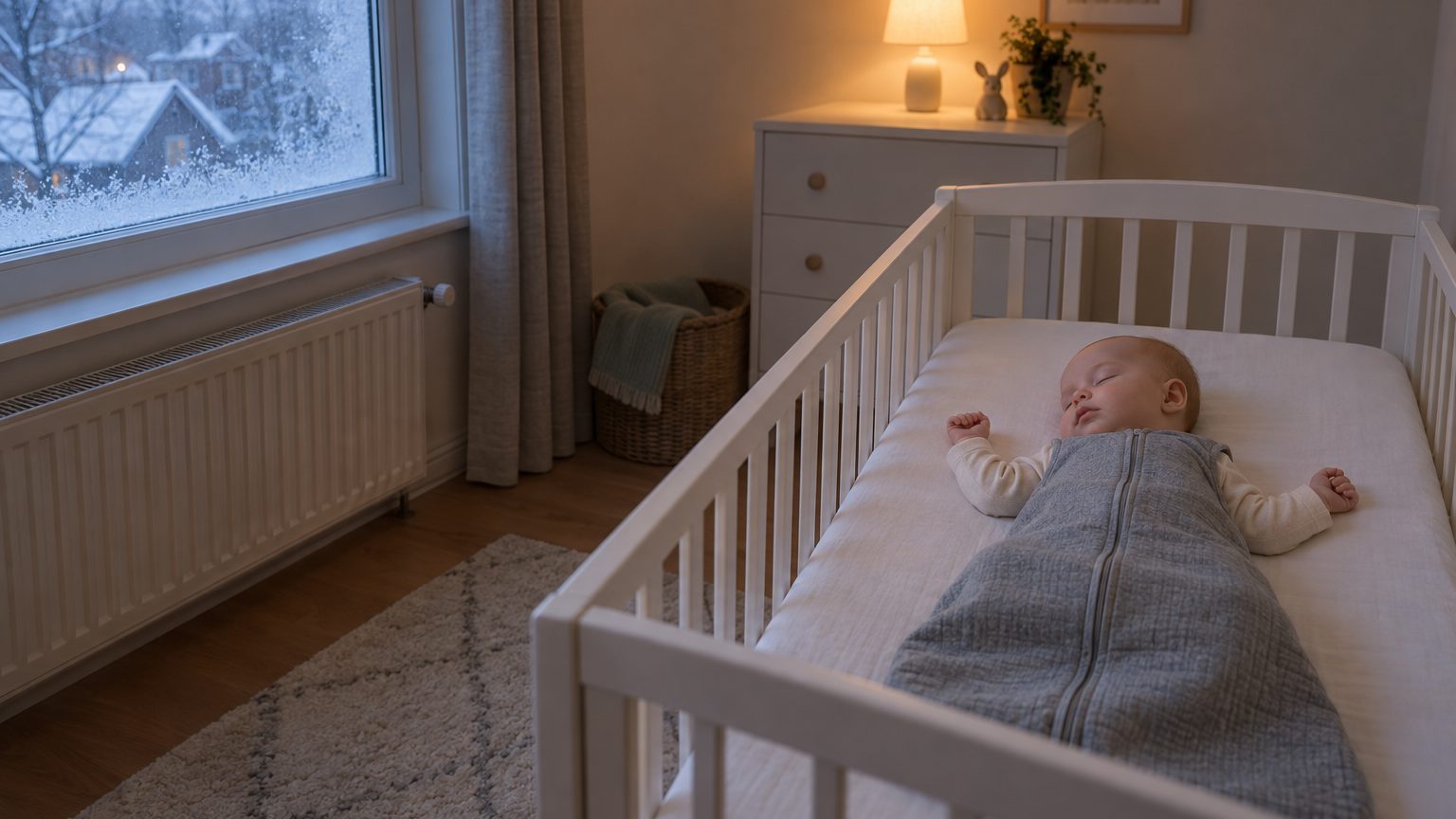
If you’re worried about your baby getting cold, dress them in layers of clothing or use a wearable blanket. In general, that means only one layer more than you’re wearing.
That’s the whole rule. Everything below is about applying it on a January night, when the furnace cycles on and off and a window sits a few feet from the crib.
What should baby wear to sleep in winter
Start with the base: a snug, breathable bodysuit or a one-piece sleeper, then a wearable blanket (a sleep sack) on top. The National Institute of Child Health and Human Development (NICHD) says
a one-piece sleeper or wearable blanket can be used
. The sack does the job a quilt would do, minus the risk. Nothing loose is left in the crib that could ride up over a face.
The American Academy of Pediatrics (AAP) is blunt on this point. Dressing an infant in layers is
preferable to blankets and other coverings
, because it reduces the chance of head covering or entrapment. Winter makes people reach for the thick comforter. Resist it.
No blankets, pillows, stuffed toys or bumper pads belong in your baby’s bed, since your baby could roll into any of them and block their airflow.
A practical winter setup looks like this. In a room you’d call cool, try a long-sleeve footed sleeper under a sleep sack in a heavier fabric. In a well-heated room, swap to a short-sleeve bodysuit and a lighter sack. Thin layers beat one thick one, because
several thinner layers make it simpler to adjust a baby’s clothing to the bedroom temperature, with less risk of overheating
. Fabric matters too. Breathable cotton generally wins over heavy fleece, which holds heat against the body.
Heating is where families trip up. Cranking the thermostat to compensate for a drafty room, then also adding a thick sack and a hat, stacks three warming measures at once. Fix the room first. Our guide to baby room temperature covers the target range and how to measure it at crib height, and the companion piece on how to keep baby warm at night goes deeper on drafts, windows and heat sources. Many pediatric guides cite 68 to 72°F for a sleeping baby’s room. Treat that as a starting point and let the baby’s own signs overrule the number.
How many layers should a baby wear at night
One more than you. Not two, not “a few extra to be safe.” NICHD puts it as
no more than one layer more of clothing than an adult would wear to be comfortable
, and the AAP’s consumer arm repeats the idea:
your baby only needs one more layer than you would wear in the same environment to be comfortable
.
The test is simple and slightly humbling. Ask what you would sleep in, in that exact room, under no covers except what you’d normally use. If a T-shirt would do, a bodysuit plus a sleep sack is a sensible match for your baby. If you’d want long pajamas and a light blanket, a long-sleeve sleeper plus a sleep sack fits. The sack counts as the extra layer, so don’t pile a second sweater under it.
Why the restraint? Because heat is a risk in its own right, not only a comfort issue.
Overheating can increase the risk of SIDS.
A baby who is a little cool may fuss and wake you. A baby who is too warm is at higher risk, which is the opposite of what any parent wants to risk for the sake of cozier-looking pajamas.
So check your baby, not the clock or the chart. The AAP advises that you
check for signs of overheating such as sweating, a hot chest or flushed skin
. Slip a finger at the nape of the neck or touch the chest. Damp hair is another giveaway. If any of those show up, take a layer off and reassess the room, as the room is often the real culprit.
Cold hands and feet send many parents back to the dresser drawer, and they shouldn’t. Newborn extremities tend to run cool whatever the rest of the body is doing, so adding a layer because the toes feel chilly is a classic mistake. Holding your baby for a few minutes can warm those hands and feet without adding clothing. The chest and back tell the real story.
Swaddles, sleep sacks and the rolling milestone
Swaddling traps heat, especially when the wrap is too tight, so monitor temperature closely and keep it to a thin, breathable fabric. Once your baby shows signs of trying to roll, the swaddle is done.
A sleep sack or wearable blanket that restricts movement shouldn’t be used once a baby starts trying to roll over, which may start around 2 months.
At that point, move to a sleeveless sack that frees the arms.
Can baby sleep in a hat
Not at home. The AAP’s updated safe sleep guidance says infants should
not wear hats indoors except in the first hours of life or in the NICU
. That 2022 update, the first since 2016, was
based on a review of nearly 160 scientific articles published since 2015
.
The logic comes in two parts. A hat can slip down over the nose and mouth, and it can also act as one more insulating layer that adds to the risk of overheating. The AAP points to the questionable benefit of hats for preventing hypothermia, set against that overheating risk. Safe-sleep educators add that headbands, hoods, bibs, teething necklaces and clothing with strings should stay off a sleeping baby too, as they raise the risk of suffocation, strangulation or overheating. The same goes for bows, ties and barrettes in the hair.
The hospital hat is the part that confuses people. Nurses put one on in the delivery room because newborns are wet and have just left the warmth of the womb. That’s why the AAP carves out the first hours of life and the NICU. Once you’re home,
your baby has adapted to the environment
, so the exception no longer applies.
What about outdoors? Winter walks are a different setting. A hat in the stroller makes sense in cold air, though if your baby dozes off in the car seat or stroller wearing it, take it off the moment you step inside, before the baby goes down in the crib. A baby who arrives home bundled for 20 degrees needs unbundling at the door, fast.
If you still worry about a bare head on a cold night, address the layers below the neck and the room itself. A warmer sleeper, a better-fitting sack and a draft-free crib position do more than any cap could. Our guide to how to keep baby warm at night walks through those fixes room by room.
Reading your baby when the rules run out
Rules of thumb break down at the edges. A premature baby, or a baby with a medical condition, may have different needs, so ask your pediatrician for specific guidance in those cases. An older baby who kicks off the covers of a sack-free crib at 3 a.m. isn’t a candidate for extra blankets either, because loose bedding stays out for the first year. One sleepwear guide notes that after the first birthday, a thin blanket may be introduced, although many families keep using sleep sacks well past that point.
Sizing is the unglamorous detail that decides whether a sleep sack is safe at all. An oversized one can let a small baby slide down inside it. A tight one restricts the hips and traps heat. Check the neck and arm openings against your baby’s current size every few weeks, because infants outgrow gear faster than seasons change. Do that, keep the hat in the diaper bag for outdoor trips only, and the winter wardrobe stays as simple as safe sleep wants it to be.
Sleep sacks come in different weights, often described by a warmth rating on the label. Manufacturers’ charts that pair those ratings with room temperatures can help you pick a fabric weight. Still, they are guides, not guarantees. Your hand on a warm, dry chest is the final check.
Sources : nichd.nih.gov | healthychildren.org | safesleepacademy.org