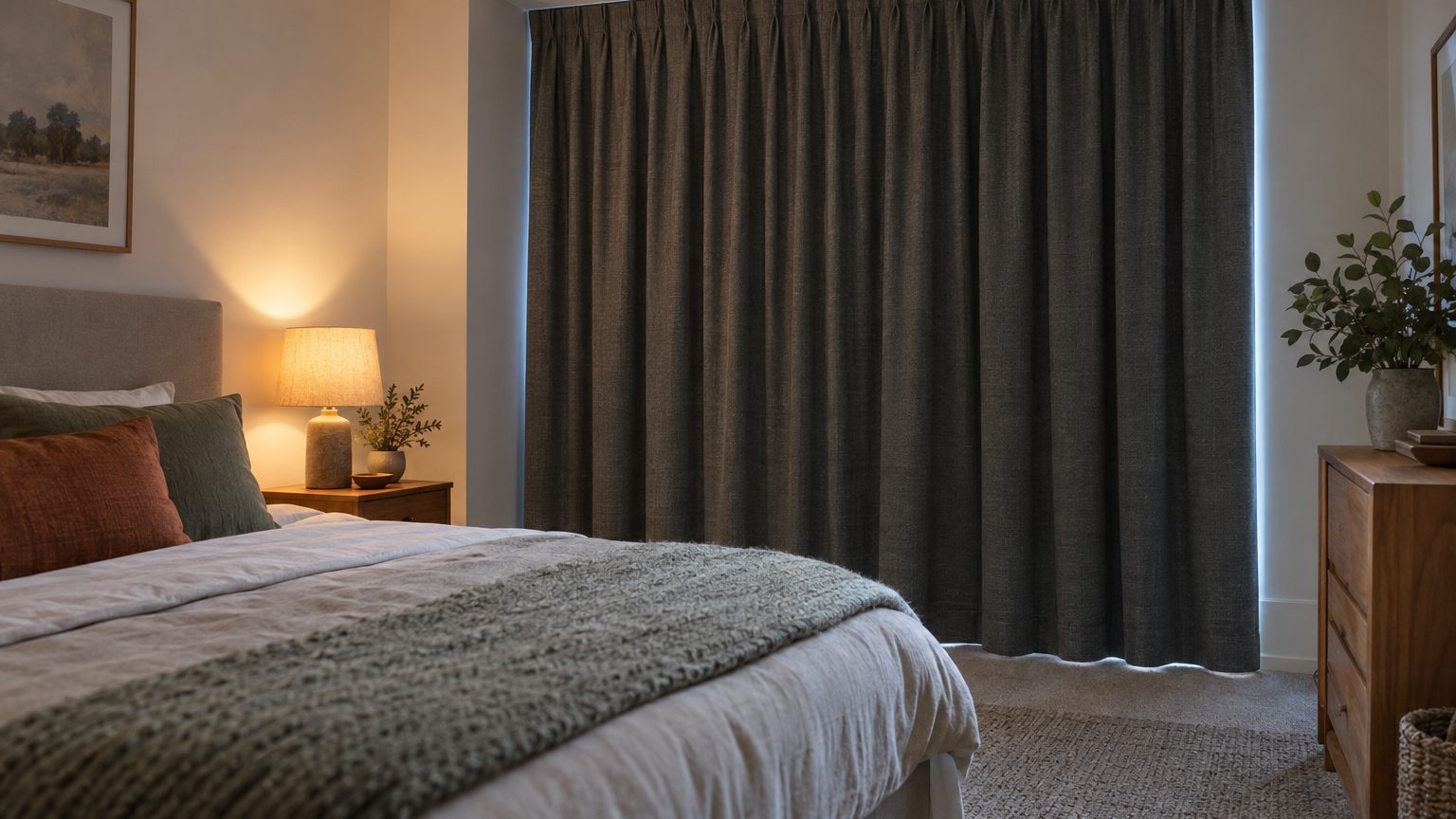
Yes, thermal curtains keep some heat in, but the gain is modest and depends heavily on how you hang and use them. Cornell Cooperative Extension puts the ceiling for ordinary, unsealed draperies at
no more than 10 percent of window heat loss
. Treat a thermal curtain as a comfort upgrade with a small energy dividend, not a replacement for better glass.
Do thermal curtains keep heat in
A thermal curtain is built to slow heat at the window.
It usually adds density or extra layers: a decorative face fabric, sometimes a middle layer, and a backing or lining.
A closed curtain holds a thin layer of relatively still air between the fabric and the glass, which slows how fast your warm room gives up heat to a cold pane.
The stakes are real. The U.S. Department of Energy is widely cited for the figure that
as much as 30% of a home’s heating energy can escape through windows in winter
. A bedroom with one large window on a north wall feels that loss at 3 a.m., when the glass is the coldest surface in the room and the air near it sinks and pools around your ankles.
Why do curtains underperform their reputation? Convection. Cornell’s extension office describes a “tunnel” between drapery and glass:
warm air enters at the top of the drapery, drops toward the floor as the glass cools it, enters the room and is warmed, then rises and repeats the cycle.
A curtain hung loose, with gaps at the top and sides, becomes a chimney (see How to Hang Thermal Curtains for a setup that limits those gaps). The same source says draperies need to be
sealed at all four edges
to do better, and that a closed top cornice is one way to cut the tunnel effect.
On the 10% number itself, a caveat. It comes from older Department of Energy guidance, and Energy.gov’s current window-coverings page reserves its quantified claims for insulated cellular shades. One recent consumer breakdown notes that
tightly installed cellular shades cut window heat loss by 40% or more
. Any curtain listing promising a precise percentage, including the ones selling you curtains, deserves skepticism. Compare the claim to the 10% ceiling for ordinary drapes, and if you are still deciding which fabric suits your bedroom, see Blackout vs Thermal Curtains for how the two differ.
Timing matters as much as fabric. The Department of Energy’s winter advice is blunt:
open curtains on south-facing windows during the day to let sunlight heat the home, and close them at night to reduce the chill from cold windows.
Cornell adds a useful wrinkle for bedrooms. Treatments on north windows
may be left closed 24 hours a day
, since they collect almost no solar gain. East- and west-facing glass sits in between, so close those curtains when the sun leaves the window.
One habit to watch. A curtain pulled tight against cold glass can hold moisture there. Wipe the pane if it fogs, and crack the curtain open for a few minutes each morning. If condensation is a recurring problem, the fix starts with ventilation, not heavier fabric.
What separates a thermal curtain from a pretty one
The label “thermal” is not regulated for curtains the way a window’s performance rating is, so the construction tells you more than the name. Three features carry most of the weight.
First, the lining. The Department of Energy has long advised
a medium-colored drape backed with plastic
, a combination the DOE credits with cutting summer heat gain rather than winter heat loss. For winter, Cornell recommends a separate lining, because the trapped layer of air adds some insulating value. Tight-weave fabrics such as cotton or velvet also resist airflow better than loose weaves. Cornell notes that how well a drapery works depends on
fabric type (closed or open weave), color, the season and other factors.
Second, fullness. A flat panel stretched across the window leaves nothing to seal against the wall. Designers typically want
total panel width of two to two and a half times the rod width
, and that extra fabric also overlaps in the middle where cold air likes to slip through.
Third, and often overlooked, the fit. Hang the panels as close to the glass as the rod allows, extend them past the frame on the sides, top and bottom, and consider attaching the edges to the wall. One source describes
velcro closures or magnetic tape
as a way to block drafts, an old trick that costs a few dollars. The step-by-step mechanics are in how to hang thermal curtains, so I won’t repeat the rod-height math here.
Light is a separate question. Plenty of bedrooms need blackout fabric for sleep, and a blackout panel often doubles as a decent thermal one, but the two are not the same product. The breakdown in blackout vs thermal curtains sorts out which claims on the packaging matter for warmth.
If you can add one thing behind the curtain, add a shade. Energy.gov says
insulated cellular shades are typically considered to have the highest R-values of all window coverings
. A cellular shade inside the window frame with a lined curtain outside it gives you a seal and a layer of mass. That pairing suits the coldest rooms, and it costs far less than replacing a window.
Thermal curtains vs window film
Both products target the same weak spot, but they work in different ways. Insulating window film is a thin coating on the glass. The most relevant type for winter is low-emissivity (low-e) film. A technical paper hosted by the Department of Energy’s research library explains that warm objects in a room
radiate heat toward the cooler outdoors
, and a low-e film applied on the room side of the glass helps
reduce the loss of room heat during the heating season.
That paper was written by a film maker, so read its performance claims accordingly, but the physical mechanism is standard.
A curtain does the opposite job. It slows convection and conduction at the room side with a layer of air and fabric. It does little about radiant heat going through the glass until it is closed, and then it blocks that too.
Where the two differ most is control. Film is permanent. A low-e film cuts heat leaving the room, but it also trims the free solar heat entering through the glass, and the same research notes that low-e films
improve window insulating properties sufficiently to offset the loss of free solar heat
in the heating season. Note the word “offset” there: it is a trade, not a pure gain. For a south-facing bedroom that bakes in winter sun at midday, that trade is less attractive. Even reflective-film guidance echoes this, stating that on south-facing windows
the benefit could be offset by the reduction of heat from the winter sun.
A curtain opens. You pull it back at 10 a.m. and let the sun in, then close it at dusk. Film cannot make that choice for you.
Film has its own advantage: it works around the clock without anyone remembering to do anything, and it leaves the window free of fabric. That matters on a window above a radiator, a desk, or a bed pushed against the wall, where a long curtain is awkward. It is also less helpful for drafts, because it sits on the glass rather than sealing the frame. For leaks around sashes, the Department of Energy’s winter advice is a separate item:
cover drafty windows
, with weatherstripping and caulk as the real fix.
My own read, for a typical bedroom: choose curtains first if the window faces south, east or west and you want winter sun. Consider film first if the glass is old single-pane and mostly north-facing, where you give up almost no solar heat. Many rooms benefit from both, since the film works at the glass and the curtain works in the room, though check the film manufacturer’s instructions before combining it with a snug curtain, because some films need ventilation or have limits for glass types.
Neither one beats broader fixes. If the whole room is cold, start with how to keep bedroom warm in winter, and if the heating itself is the problem, how to keep a room warm without a heater covers the no-equipment options.
How long should curtains be
For warmth, longer wins. A curtain that stops at the sill leaves the bottom of the window exposed, and it lets the cooled air at the glass spill into the room. Tennessee’s electric cooperatives put it simply: draperies should be
placed as close to windows as possible to reduce heat exchange and long enough to fall onto a windowsill or floor.
A related warning from a window company: drapes that don’t reach the floor can let cold air in, and curtains draped over radiators block heat circulation.
In a bedroom with no radiator under the window, floor length is the right default. Designers generally recommend that
floor-length panels break within half an inch of the floor
, and one common complaint is the opposite problem:
a gap of several inches is a common mistake
they correct. Ready-made panels typically come in 84, 96 and 108 inches, and these may not match your ceiling. Measure from where the rod will actually sit down to the floor, not from the top of the window.
The hardware changes the number. Per one measuring guide,
clip rings let the curtain hang below the rod, often adding 1 to 2 inches to the drop
, whereas grommet panels sit about an inch or so shorter than their labeled length. A 96-inch panel on clips and a 96-inch panel with grommets are not the same length on your wall. Check the product dimensions against your rod before ordering.
Width matters as much. Hanging the rod roughly 6 to 12 inches past each side of the frame, as many designers suggest, lets the panels stack off the glass when open and cover the frame edges when closed. Both effects help: you keep the light, and you reduce the gaps where cold air moves.
When should you go shorter? An apron length, which runs
roughly 4 to 6 inches below the window frame
, makes sense when a radiator, heater or deep furniture sits directly under the window. Letting a long curtain hang over or in front of a heat source blocks the heat and can be a fire concern. A shorter curtain keeps warm air in the room, and a closed, snug apron-length panel still beats a bare window.
Puddle lengths look luxurious and gather dust, and they add nothing to warmth. Skip them in a room you want to keep easy to clean.
Curtains also work alongside the bed. If the room is still chilly after you’ve fitted the window, flannel sheets and a thicker duvet are an inexpensive next step before you buy a second set of drapes. Best bedding for winter lays out what to put on the mattress, and the window and the bed together make a bedroom that feels warm without cranking the thermostat.
One last check before you buy: hold the panel up to the window with the rod in place and see where the hem lands. If the hem lands more than about half an inch off the floor, the curtain will look the part but won’t finish the job.