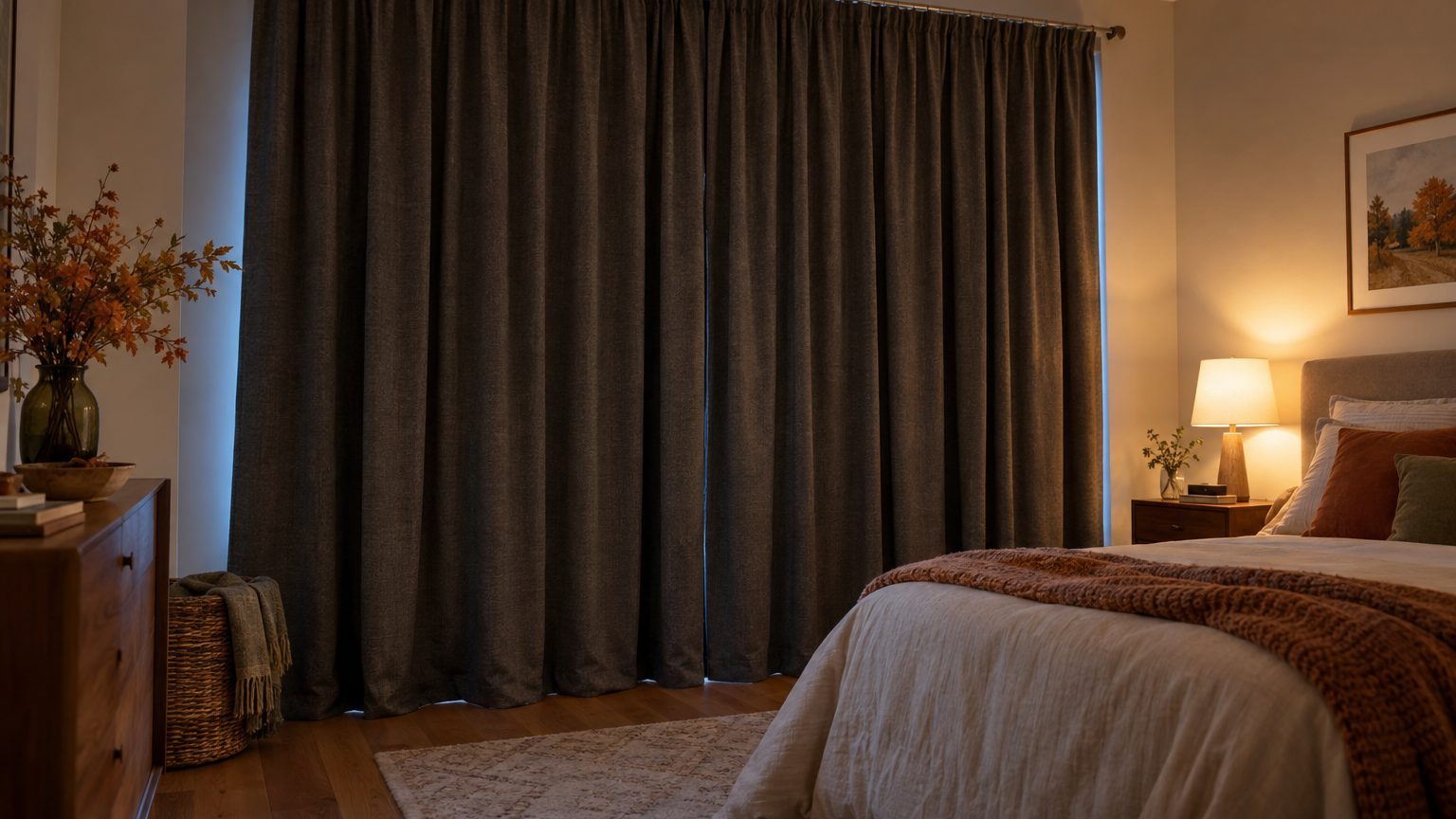
Mount the rod 4 to 6 inches above the window frame, or higher if the ceiling allows. Extend it 8 to 12 inches past each side of the glass. Hang the panels with the lining against the window and the decorative fabric facing the room. Those three decisions matter a great deal for how well a thermal curtain performs. One retailer’s installation guide puts it bluntly:
hang the best thermal curtains wrong and their effect plummets
.
Thermal curtains work by holding a layer of still air between the glass and the fabric. A curtain that stops at the window trim, or hangs a few inches off the wall, lets that air escape and cold air in. The goal is a closed pocket at night, and each measurement below serves it. For the bigger picture on what these panels do in a bedroom, see our guide to thermal curtains.
How high to hang curtains
The design-world starting point is simple.
A common rule is 4 to 6 inches above the window trim
, and
it isn’t a strict rule
. Other guides stretch the range to 8 inches. Home Depot’s measuring guide gives the outer limits:
somewhere between a few inches above the trim and a few inches below the ceiling
.
For a thermal curtain, the higher end of that range earns its keep. A rod that sits well below the ceiling leaves a band of bare wall above the panel. One installation guide describes how
a rod mounted 6 or 8 inches under the ceiling leaves an open triangle at the top corners, and warm air rises into that gap and flows behind the curtain
. Its fix is to
mount higher, or cover the space with a valance or top treatment
. The U.S. Department of Energy’s advice on drapes, as summarized by Forbes, goes further:
hang them from a cornice or right up to the ceiling, down to the floor, as close to the window as possible
.
There’s a practical limit. If the window sits 12 inches or less from the ceiling,
one guide suggests going near the ceiling
rather than leaving an awkward strip. Where the ceiling is high and the window short, you can’t seal everything, and a top valance is the neater compromise.
Where the hem should land
Height is only half of the vertical story. The bottom edge matters as much as the top. Among the common mistakes one drapery retailer lists,
panels that don’t reach the floor let cold air in
. In a bedroom, where the coldest air pools low, a hem that brushes the floor or sits just above it works better than a sill-length panel. (A sill-length curtain looks tidy, but it leaves the wall below the sill open to drafts.)
Mind the heat source, too.
Hanging drapes over a radiator blocks heat circulation
. If a baseboard heater or radiator sits under the window, a floor-length panel will trap its output behind the fabric. In that case, stop the hem at the sill, or put the rod on a different wall plan altogether.
How wide should a curtain rod be
A rod cut to the width of the window is a common error. Standard guidance runs from
4 to 6 inches beyond each side of the window
up to
about 12 inches on both sides
. Home Depot’s worked example:
a 48-inch window calls for a rod of 64 to 68 inches
. That is 8 to 10 inches of overhang per side.
For warmth, lean toward 12 inches. The extra width lets the panels stack on the wall instead of on the glass, so you lose far less daytime sun. It also lets the closed fabric cover the wall around the frame, where drafts often leak. One bedroom-specific table in a rod-placement guide recommends
the 4 to 8 inch height range and going toward 12 inches wide, with more overlap to cut side light gaps
. The same logic applies to cold air.
Fullness, overlap and the wall gap
Width isn’t only about the rod. The fabric needs enough bulk to form folds, and those folds hold insulating air. One installation guide advises you
measure the full wall span the rod will cover, not just the window, then multiply by 1.5 to 2
. A 60-inch window with 12-inch extensions on each side gives an 84-inch rod. At 2x fullness,
that means 168 inches of fabric, typically two panels of 84 inches each
. Check the labeled width of the panels you’re buying, because a “52-inch” panel is a single flat piece, not a pair.
Two more details close the remaining gaps. With two panels,
overlap them several inches in the middle so no gap opens when closed
. And on the sides, a standard straight rod leaves the panel hanging away from the wall, which one source says
lets air circulate freely behind the fabric
. A wrap-around rod,
which lets the panel curve back to touch the wall
, is the usual fix. Velcro or magnetic tape between the panel edge and the wall does the same job on a budget, and it cuts drafts at the edges, though
we can’t point to a verified savings figure for it
.
Support matters once the rod gets long. Thermal panels are heavy, often several layers deep, and an 84-inch span with a thin rod will bow. Brackets typically go
4 to 6 inches in from each end, with additional support brackets spaced evenly on wider spans to prevent bowing
. For heavy fabric, screw into studs where you can. Where there’s no stud,
use heavy-duty drywall anchors
.
Which side of thermal curtain lining faces out
The standard answer: the lining or coated side faces the window, and the decorative fabric faces the room. One guide to thermal lining says plainly that
the coated side must face the window to resist the sun, cold and damp
. Another explains the logic:
the lining or coated side faces the window, and the decorative face fabric faces into the room, which puts the denser layer against the glass and keeps still air between the two layers
.
There’s a second reason, and it’s practical. From the street, the lining color is what neighbors see. Many people prefer a uniform white or cream back to a patchwork of patterned fabrics across the facade. A damp window also soils the lining first, and
a lining left next to an open window in the rain may develop mildew
, so it’s better for that layer to be the one against the glass, where it can take it.
When the rule doesn’t apply
Not every source agrees, and it’s worth knowing why. Some web guides claim the coated side should face away from the window to push heat back into the room. That logic is sometimes applied to reflective, metallized layers, but it’s not the common practice for household linings. Treat it as a minority view and defer to the product’s own label or care card.
Construction type makes a real difference. A European curtain maker’s guide distinguishes two kinds. A single-layer curtain with a metallized lining
should be installed with the technical side facing the window
. A multilayer curtain with built-in insulation, by contrast,
can be hung in either direction with no difference in performance
. Many ready-made U.S. thermal panels are the second type, sewn so the lining is already on the back. If the hem and header show a clear “front” and “back,” follow that. If the panel is sold as a flat, finished piece with the same fabric on both faces, you can’t get it wrong.
If you’re lining your own curtains rather than buying them ready-made, the sidedness matters more, because you’re choosing the order of layers yourself. Check the lining’s packaging before you stitch, since one face is usually a coating and the other is brushed cotton or similar. In a sewn panel, the header tape or rod pocket usually sits on the lining side’s seam allowance too, and a backward panel shows it immediately. Compare it against your decorative fabric’s back before cutting anything.
Putting it together in a bedroom
A reasonable sequence runs like this. Measure the wall, not the window. Mark the rod 4 to 6 inches above the frame (higher if the ceiling is close). Mark 8 to 12 inches out on each side, and set brackets 4 to 6 inches in from the rod ends. Slide the panels on before lifting the rod into place, which saves the awkward balancing act on a ladder. Then check the closed position: overlap in the middle, hem at the floor, side edges near the wall.
If light-blocking is part of your reason for buying, the fit rules are the same, but the fabric choice isn’t. Our comparison of blackout vs thermal curtains explains where the two overlap and where they don’t, which helps if you’re deciding between panels before you hang anything.
One last point on use, since a perfectly hung curtain left closed all day wastes a free resource. Department of Energy seasonal guidance, as relayed by one curtain maker, is to
open the curtains on sun-facing windows, especially south-facing ones, on sunny winter days, then close them at night to help hold heat in
. A wide rod makes that routine easy, because the panels park off the glass instead of shading it.