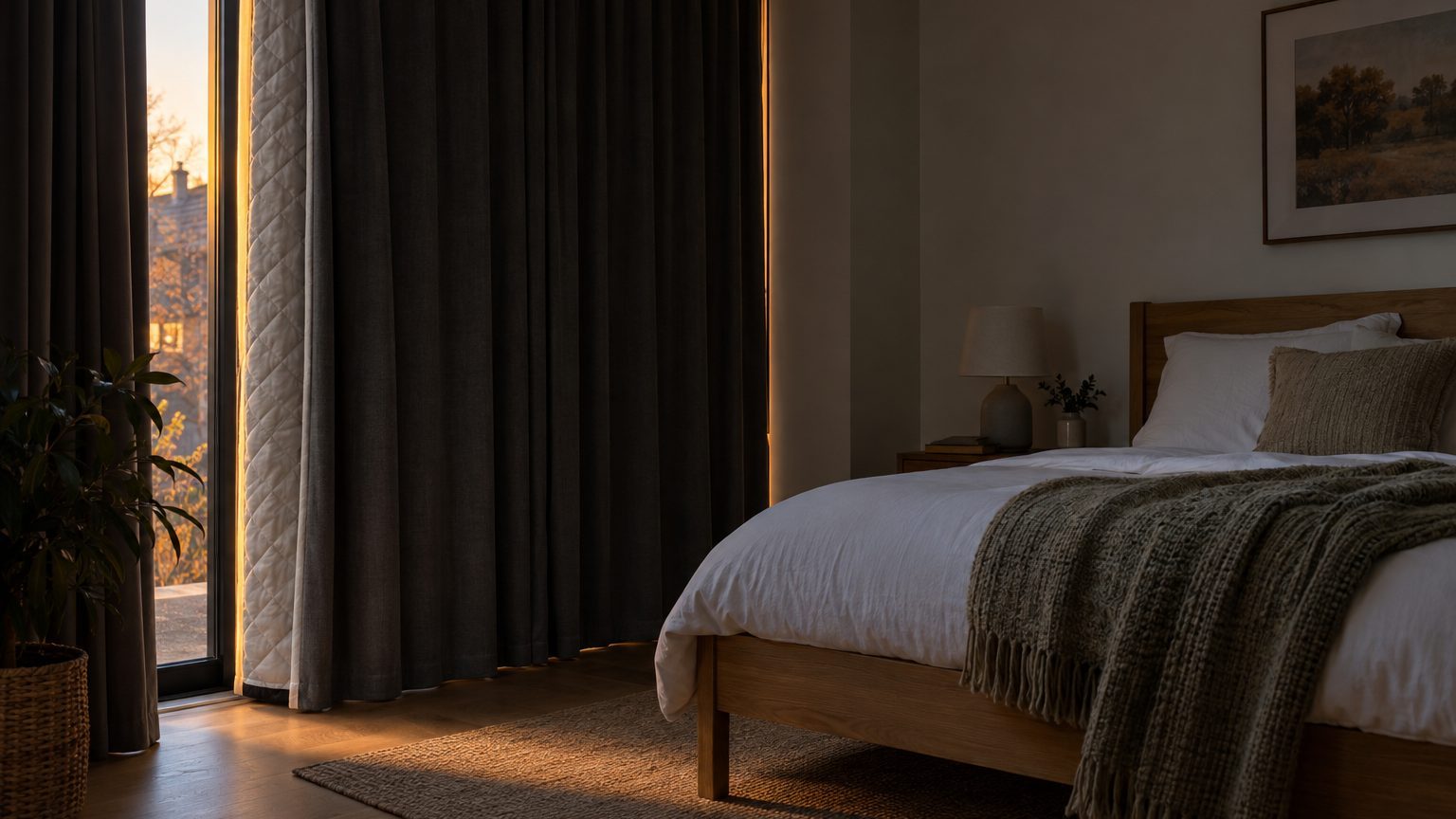
No, not automatically. A blackout curtain is defined by how much light it stops, while a thermal curtain is defined by how well it slows heat. Many curtains do both jobs, but one label doesn’t guarantee the other. A thin blackout panel can leave you in the dark and still cold, and a thick insulated curtain can let a glow of streetlight through at the edges.
Are blackout curtains thermal?
Partly, and only by accident.
Blackout curtains are defined by light blocking, and any heat reduction is a bonus from the dense fabric.
A good one
blocks 95 to 100% of outside light
, usually thanks to a tightly woven or coated fabric. Some use a construction with
black yarns sandwiched in the middle lining
. That layer is built to absorb light, not to trap warm air.
Thermal curtains work from the opposite brief.
They add an insulating lining, such as acrylic foam, polyester or reflective film, that creates a barrier against temperature exchange between inside and outside.
Some use a foam or flannel interlining that reduces heat transfer more aggressively than a standard blackout fabric.
Light blocking is secondary. One comparison notes that thermal curtains
may not give a complete blackout because they lack the black-yarn layer in the lining
, which is a fair warning for anyone who sleeps badly with the light on.
The gap narrows with weight.
A heavyweight blackout velvet with a lining functions as a thermal curtain too.
One retailer puts the threshold for a meaningful insulating barrier at
350 GSM and up
. That figure comes from a retailer, not a standard, so treat it as a rough guide rather than a pass-fail test. The distinction matters most when you compare a lightweight blackout panel with a purpose-built insulating one.
Keep expectations realistic, too. The U.S. Department of Energy says it’s
difficult to generalize about the energy performance of draperies
because it varies so much by fabric type and color. It also says that
most conventional draperies drawn in cold weather can reduce heat loss from a warm room by up to 10%.
You’ll see “up to 25%” on plenty of retail pages. I couldn’t trace that number to the DOE’s own current guidance, so treat it with caution. For comparison, the DOE says
tightly installed cellular shades can cut heat loss through windows by 40% or more, about 10% in heating energy savings.
Curtains are a comfort upgrade with a modest energy dividend, not a replacement for good windows.
A quick shopping test: if you can’t tell what a panel is built for, read the product description for the words “thermal lining,” “insulated,” or “foam.” Then hold the fabric up to a bright window. If light glows through, it isn’t a true blackout. If it feels as light as a bedsheet, it isn’t going to insulate. For a deeper look at how the insulating kind work, see our guide to thermal curtains.
Best thermal curtains for cold weather
Construction beats branding. A single layer of fabric, unless it’s very heavy velvet, rarely does much against a cold pane. One guide advises looking for
descriptions mentioning “2-layer,” “3-layer,” or “bonded fleece”
, and
notes that single-layer curtains, unless extremely heavy velvet, rarely offer significant thermal protection.
A glass-repair company reaches the same conclusion from experience:
homeowners see better efficiency from curtains made of multiple layers of material.
Weave and color matter next. The DOE flags
fabric type (closed or open weave) and color
as the factors that decide how a drapery performs. A closed, dense weave restricts air movement far better than an open one. Medium-colored drapes with a white plastic backing are the DOE’s reference case for blocking summer heat, with studies showing
heat gains reduced by 33%.
In a bedroom that’s a bonus, since the same panel that keeps January out also tames a July afternoon.
Size is where many people lose the benefit. Warm room air cools against cold glass, sinks, and escapes under and around the fabric, which then pulls more warm air in at the top. That’s why fit matters as much as fabric. One buying guide recommends a width
2 to 3 times the width of your window
and floor-length panels, since
a curtain that stops at the sill lets cold air leak out from the bottom.
Mount the rod high and wide as well, so the fabric overlaps the frame. We cover the details in how to hang thermal curtains.
For a bedroom, the best curtain is usually a hybrid: an insulated, multi-layer panel with a blackout face or liner. Madura describes this category as
total light blocking plus enhanced insulation
and suggests it for east- or south-facing bedrooms, where dawn light and sun gain both cause trouble. If you share a wall with a busy street, the heft helps there too. Dense, multi-layer fabric also tends to
dampen outside noise
, according to one liner manufacturer.
Timing counts as well. The DOE’s advice is to
close draperies on sun-facing windows during summer days
, and winter calls for the reverse on those same windows. On a sunny day,
open them, especially on south-facing windows, to use free solar warmth, then close them after dark.
Worth noting:
keeping them closed around the clock gives up daytime gain and can trap moisture at the window.
That moisture risk is worth remembering in a bedroom where two people breathe all night.
Can you layer curtains?
Yes, and layering is often the cheapest way to get both light control and warmth. Each layer adds a separate pocket of air, and trapped air is what does the insulating. One energy-efficiency site explains that
a double layer of drapes is more efficient than a single layer because more separate air spaces are created and convection is reduced.
A window-treatment maker likewise notes that
two layers hung together create a tighter air space for added insulation.
The simplest combination puts the insulating layer closest to the glass and the decorative layer in front. Another route is a liner attached behind curtains you already own.
Even when the outer fabric is mostly decorative, a liner can make the overall setup feel warmer.
A blackout-lined panel in front of a lightweight sheer works in reverse: you keep daytime softness and drop the heavy layer at bedtime. Adding a liner means one rod and one panel to manage, which beats wrestling two sets of drapery on separate tracks.
Another pairing is a shade plus curtains. Because the DOE’s strongest numbers belong to cellular shades, a honeycomb shade under a lined drape puts the best-documented insulator closest to the glass. The shade handles the heat; the curtain handles the darkness and the look. It costs more than a liner, so it suits the coldest window in the room, often the one by the bed.
Layering has a few limits. Two heavy rods can push the front curtain far from the wall, which defeats the purpose, since
curtains that hang close to the window offer better insulation than those that hang far from it.
A double-rod bracket can keep both layers snug. On drafty older windows, you can also seal the curtain edges:
magnetic or Velcro strips along the edges seal curtains more tightly.
That kind of sealing is what separates a curtain that looks warm from one that stops a draft.
Know where curtains stop. One manufacturer’s guide says it plainly: curtains are
not a fix for drafts, so seal gaps in the frame separately with weatherstripping.
Do that first, then add the layers. A sealed window behind a lined, floor-length panel will feel noticeably different from a leaky one behind the same fabric.
If you can only buy one thing this season, pick a hybrid thermal-blackout curtain, wide enough to overlap the frame and long enough to touch the floor. Add a second layer or liner only if the room is still cold, and check the room’s coldest window first. It’s often the largest one, or the one that gets the least sun.
Sources : dotcomblinds.com | dunelm.com