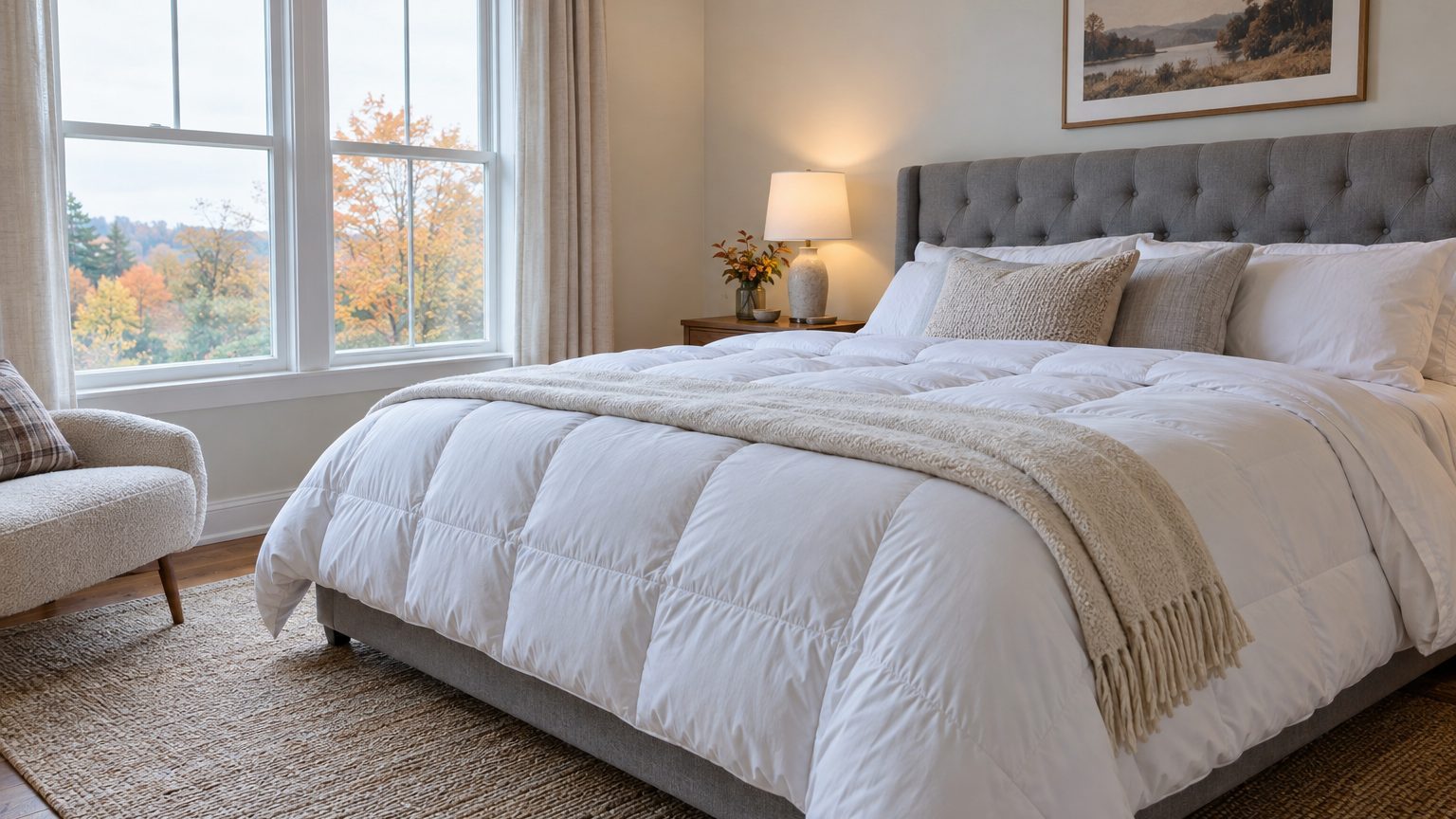
The warmest comforter for most winter bedrooms is a baffle-box down comforter. Look for a fill power somewhere between 650 and 800+, a high fill weight (the ounces of down inside), and dimensions that match your mattress depth. If you have allergies, run hot, or want something you can wash at home, a heavyweight down alternative can get close. It takes more filling to do it.
Down vs down alternative comforter
The Sleep Foundation recommends down for sleepers who want a cozy, warm top layer and are willing to pay more for one of the most durable bedding materials.
Down alternative is the budget-friendlier route.
It can keep you warm, but it needs more filling to match down, which makes the comforter heavier and traps more heat.
How much more? Compare two product listings.
One American maker lists a queen in 850+ fill power goose down at 30, 38 or 46 ounces, depending on warmth level.
A winter-fill down alternative from a wholesale bedding brand packs 70 ounces into its full/queen.
Different brands and different sizing, so treat it as an illustration, not a lab result. The gap is still hard to miss.
That extra bulk has a side effect.
Down alternative can be less breathable and may feel a little warm to some sleepers.
In a 62°F bedroom in January, that may be exactly what you want. In a 70°F one with a hot sleeper next to you, it isn’t.
Allergies are where the reputation of down is often overstated.
Down itself is often not the problem: dust mites and mold in unwashed bedding are common triggers, and they can affect almost any fill.
If you’re sensitive,
check the product description for whether the company washes the down to remove dirt and dust.
Plenty of retailers still market synthetic fill as the safer pick, so a person with severe reactions should weigh that with an allergist’s advice.
Not all alternatives are polyester, either.
Synthetic versions often use PrimaLoft, polyester fibers, or microfiber, while natural options include cotton, silk, and wool.
What is fill power on a down comforter
Fill power is a volume measurement.
It’s the number of cubic inches that one ounce of down occupies.
A 700 fill power ounce takes up 700 cubic inches once fluffed, a 500 ounce only 500. Bigger clusters trap more air, and trapped air is what insulates. Down doesn’t make heat.
It holds your body heat in.
Higher numbers buy you lightness.
Higher fill power down needs fewer ounces to reach the same warmth, so the comforter weighs less.
Trade guides generally put
700 to 750 as excellent for colder climates and winter use
, and
550 to 650 as mid-range warmth for spring and fall
.
Here is where shoppers get tripped up. The number alone doesn’t predict warmth.
Warmth combines fill power (quality) with fill weight (quantity), so a comforter with more ounces of 650 down can beat one with fewer ounces of 800.
One retailer’s guide makes the same point from the other direction:
a high fill power comforter with low fill weight may be cool and light, ideal for summer.
Product labels show how much the ounces matter.
L.L.Bean’s queen baffle-box comforter uses 600-fill goose down at 35 ounces
and
is described as midweight, suited to cooler temperatures or moderate climates.
Down Etc. pairs 650 fill power with 34 ounces in a queen and calls it a fall weight.
Neither is a winter comforter in the cold-bedroom sense. At the other end,
Feathered Friends recommends its Arctic weight for bedrooms under 65°F or for anyone who reaches for an extra blanket all winter.
That’s a manufacturer’s guideline, not a standard, but it’s a useful calibration point.
Look at how the comforter is built, too.
Baffle-box construction lets the down loft fully and limits shifting and cold spots.
Sewn-through designs pinch the shell flat at every stitch line. One retailer argues for
a point of diminishing returns
on fill power, and I’d agree: past roughly 700, extra ounces usually do more for warmth than extra fill power does.
Comforter vs duvet
The terms get swapped constantly, so here’s the distinction.
A duvet is a fluffy insert placed inside a separate cover, while a comforter has the insert and the outer fabric sewn together in a single piece.
In the UK, “duvet” means what Americans call a duvet insert.
Comforters are more popular in the US and are often sold as part of bedding sets.
Warmth depends on the fill rather than on the name.
At a glance, a duvet insert and a comforter are almost the same thing, both fluffy toppers filled with down or down alternative.
Some sources claim duvets run warmer, but that mostly reflects the high-loft fills they tend to carry. Compare ounces and fill power, not the label.
Cleaning is where the formats really differ.
Duvets are easier to maintain because the cover comes off for washing, and many comforters are too large for a standard washer and dryer.
Over a long winter, that’s the practical argument for a duvet and cover: a down comforter is bulky to launder, and the cover takes most of the dirt.
The line is also blurring.
Some comforters now have sewn-in loops at each corner so you can attach a duvet cover with ties.
Duvet inserts typically have corner loops
as well, so a plain comforter with loops does the job of both. That’s the most flexible buy.
The comforter is only one layer in the stack. What touches your skin matters about as much, which is why the flannel vs fleece sheets comparison is worth reading before you buy anything else. If you land on flannel, the how to wash flannel sheets guide covers keeping them from pilling.
Sizing a warm comforter
A warm comforter that stops at the mattress edge lets cold air pour in along the sides. Size is where many people go wrong, partly because
comforters have no fixed dimensions, and the same “queen” can be 86 or 96 inches wide depending on the brand.
Most queen comforters measure 86 to 96 inches wide.
Mattress depth drives the choice.
A standard queen was once 8 to 10 inches deep, while popular models are now often 12 to 15 inches thick.
A simple formula:
mattress width plus twice the mattress depth gives the minimum comforter width, so 60 + 14 + 14 for a 14-inch queen is 88 inches.
A more generous drape, closer to 16 inches per side, calls for
92 inches on a 12-inch queen
. In a cold room, that extra overhang is real insulation.
Couples should go bigger.
An oversized queen (90 to 92 inches wide by 96 to 100 long) suits shared beds where partners compete for coverage, mattresses 12 inches or thicker, or anyone who pulls the comforter over their head.
Be wary of combination sizing.
Full/queen and king/California king comforters are common because one product covers two mattresses, but the larger bed gets less overhang.
One more catch applies to lofty down.
Feathered Friends notes that measurements at rest run a few inches smaller depending on the warmth level.
A heavier fill puffs up and takes in the shell, so a stuffed-to-the-brim winter comforter can hang shorter than the listed dimensions. If your measurements are borderline, size up.
For a duvet cover setup, check the loop count before you order.
One maker gives king and California king sizes eight loops, one on each corner and one at each midspan
, because a heavy insert shifts more inside a cover than a light one does. For the rest of the layering, see the guide to the best bedding for winter.