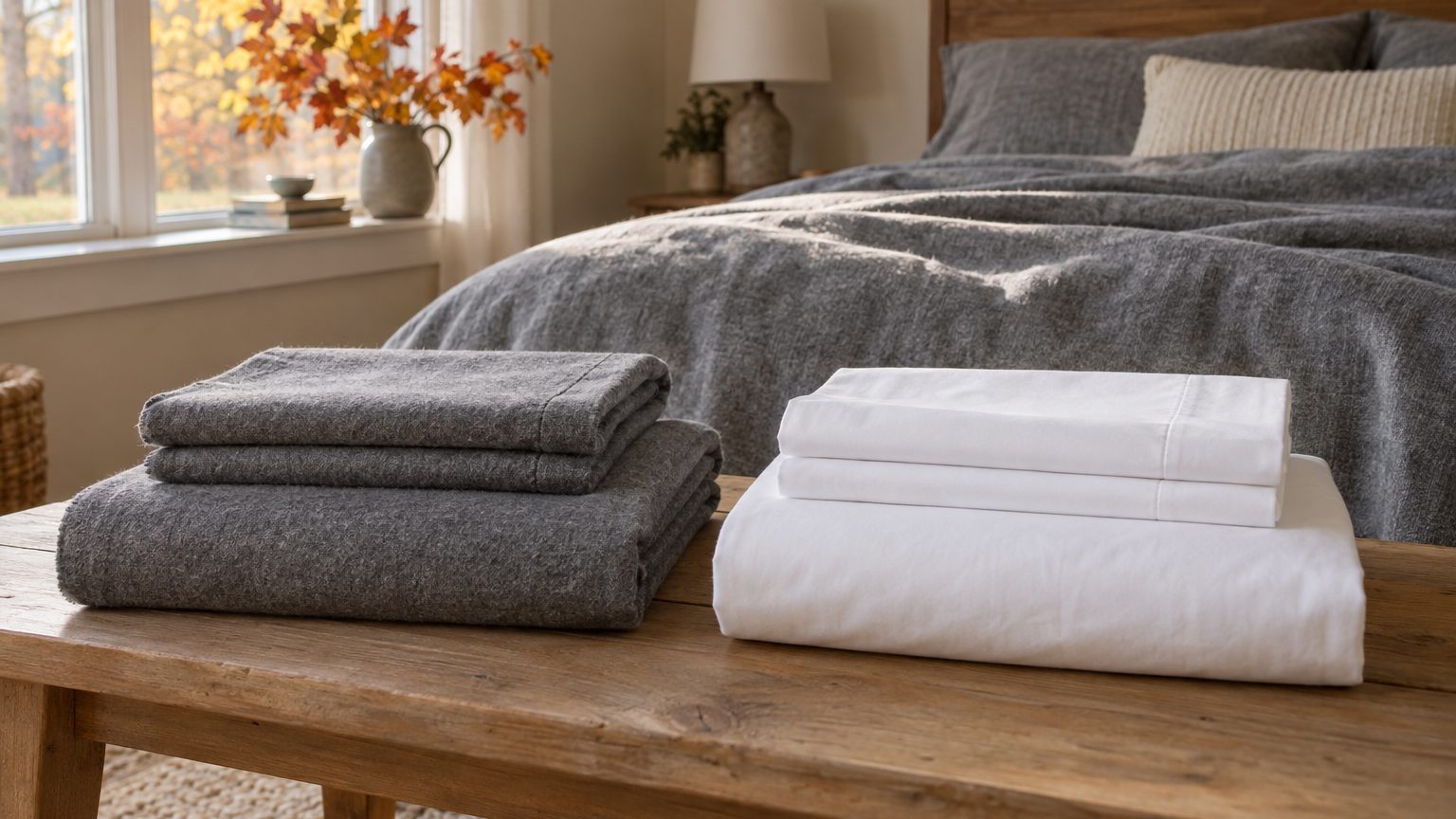
Fleece is usually the warmer sheet, and flannel is usually the more comfortable one to sleep in all night.
Fleece is a knit polyester fabric that traps air for warmth, while flannel is a woven cotton fabric brushed for softness.
That difference in fiber and construction explains most of what follows: how each one heats up, how it handles sweat, and how it looks after a season of washing.
The two fabrics tend to appeal to different sleepers.
Fleece holds heat well but can’t regulate your temperature, so you may overheat, while flannel keeps you warm and lets excess heat escape.
If you wake up chilly at 3 a.m. in a cold bedroom, that favors fleece. If you wake up damp, it favors flannel.
Are flannel sheets warmer than cotton?
Yes, and the reason is mechanical, not magical. Flannel is cotton. The difference is the finish.
Brushing raises fiber ends on purpose, and those ends trap a thin layer of still air against the sheet. That is why flannel feels warmer than a plain cotton weave of similar weight.
A percale sheet, by contrast,
usually feels crisp, cool, and lightweight against your skin.
Some of that warmth is a first-impression effect. Standard cotton can feel cold on first contact in winter. Brushed cotton
feels warmer initially because the raised fibers hold a layer of air at the surface, which reduces the cold-sheet sensation instead of changing the body’s natural temperature balance.
You still generate the heat. The sheet just stops stealing it for the first ten minutes.
Brushing isn’t uniform across products. Single-brushed cotton is brushed on one side only and is
lighter in weight and slightly more breathable.
Double-brushed flannel has the nap on both faces, so it feels plusher and holds more air. Weight matters too. Retailer listings for cotton flannel sets cite figures like
180 gsm
and
185 GSM
, so look for a gram-per-square-meter figure in that neighborhood when comparing, and treat vague “heavyweight” claims with suspicion.
There’s a catch. In a bedroom that stays heated overnight,
that extra still air is the problem, not the cotton itself.
Flannel also behaves like cotton in the laundry.
It can shrink in heat
, which is why pre-shrunk sets exist and why a gentler routine pays off (our guide on how to wash flannel sheets covers the details).
What is the warmest type of sheets?
Among the options most people shop for in winter, polar fleece sits at the top. Not all fleece is equal, though.
Microfleece is thin and lightweight, while polar fleece is warmer and thicker.
Another buying guide puts it this way:
polar fleece is warmer and heavier than other options, which makes it ideal in cooler environments.
A thin microfleece set and a thick polar fleece set can feel like two different products, even when both say “fleece” on the package.
Why does fleece win on raw warmth?
It is warmer for its weight because its knit pile traps a thick layer of air.
Flannel needs more fabric to get there. The price of that insulation is breathability.
Because it’s synthetic, fleece lacks the breathability of natural fibers like cotton, linen and flannel.
Some sleepers describe the feeling as
“sleeping inside a teddy bear.”
That’s a selling point for some people and a dealbreaker for others.
Moisture is where the sources disagree, and the disagreement is worth knowing about. One bedding retailer says fleece
has no moisture-wicking properties and can trap sweat.
Others market microfleece as engineered to wick moisture away. My read: thin, tightly knit microfleece may move moisture better than a thick pile, but the warm, enclosed feel of any polyester sheet can still tip a hot sleeper into sweating. Cotton flannel, meanwhile,
absorbs moisture rather than wicking it away
, which feels drier against skin but takes longer to dry in the machine. Fleece
dries fast and resists shrinking.
One more contender deserves a mention: wool flannel. It’s rarer in sheet form, but
wool flannel offers natural thermal regulation, whereas heavy cotton flannel is warm but less breathable.
Expect a higher price and more careful laundering.
A practical way to choose:
- Cold sleeper in an unheated or drafty room: polar fleece or heavyweight double-brushed flannel.
- Average sleeper with moderate heat: mid-weight cotton flannel.
- Hot sleeper who still wants a soft winter feel: single-brushed cotton or lightweight flannel, with the warmth added by blankets you can kick off.
That last point matters more than the sheet itself. The sheet is only one layer, and a removable blanket gives you control a fitted sheet never will. Our guide on how to layer bedding walks through the order that traps heat without trapping you, and the roundup of the best bedding for winter shows where sheets fit in the larger setup.
Do fleece sheets pill?
Eventually, many do, though less dramatically than you might fear.
Pilling is loose fiber rolling into knots on the surface.
Any fabric with exposed fiber ends is a candidate, and both flannel and fleece are built on exposed fibers.
The two fabrics pill differently. With flannel, the nap is the culprit.
Hot dryers, overloaded drums, and washing sheets with towels grind the nap into pills.
The upside is that
cotton pills often break off, which looks messy for a while before the surface settles.
Polyester behaves the other way around.
It is a strong filament, so pills that form tend to cling instead of falling away.
A fleece pill you see in March is likely still there in April.
What you buy changes the odds. Fleece labeled “anti-pill” has usually been treated in production, either mechanically (
singeing off protruding fuzz or shearing the surface so fibers are uniform
) or chemically. Treat the label as a head start, not a guarantee:
an anti-pill finish doesn’t mean the fleece will never pill, but it significantly slows the process.
Heavier fleece also tends to hold up better. One fabric supplier notes that
higher-GSM fleece, 300+ g/m², can be more durable and pill-resistant than very lightweight microfleece.
That’s a supplier’s general guidance for fleece fabric, not a rule for any specific sheet set, but it lines up with the common-sense idea that thin pile wears faster.
Blends deserve caution. A cotton-polyester fleece may feel nicer, but
the polyester in the blend will hold pills that form from the cotton.
You get cotton’s tendency to shed fuzz combined with polyester’s tendency to keep it.
You’ll also run into bold marketing, like claims that double-brushed microfiber is “structurally incapable of pilling.” I’d read those as a brand’s position, not a tested standard. Continuous-filament polyester does have fewer loose ends, which helps, but I wouldn’t count on a sheet to stay pill-free through hundreds of nights if you wash it carelessly.
Washing habits that slow pilling on both fabrics
Laundry matters more than the label. For fleece, a care guide recommends
turning it inside out to protect the pile from friction
, washing in
cold water (86°F or below)
and choosing the
gentle cycle, which uses slower agitation and reduces friction.
Heat is the bigger risk: the same guide warns that
high heat melts the fibers.
One manufacturer’s product-page instructions for a polyester pile sheet are equally plain:
machine wash cold with similar colors, tumble dry low, and do not bleach.
Flannel follows the same logic: don’t wash it with towels, denim or anything with zippers, don’t cram the drum, and keep the dryer on low. A half-full machine often does more for your sheets than any fabric treatment.
If pills show up anyway, a fabric shaver will clear them, but it comes with a trade-off.
Each pass removes surface pills and a thin layer of surrounding fiber, thinning the fabric over time.
Use it sparingly, because every shave takes a little warmth along with the fuzz.