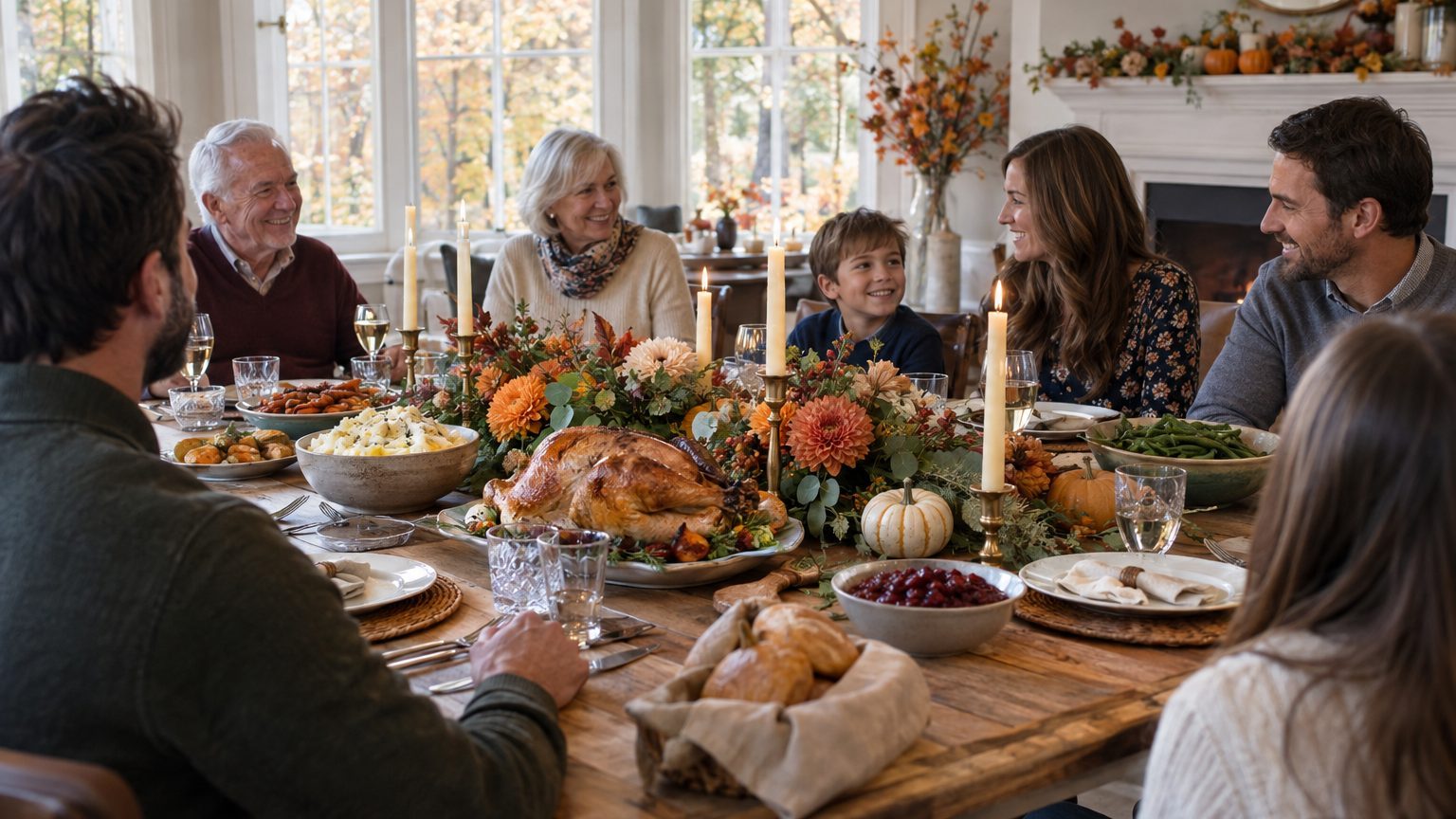
Keep the arrangement
around 12 inches or lower so guests can see each other across the table
, measured from the tabletop to the highest point. The alternative is height above roughly 20 inches on a slim stem or pedestal, so people look beneath it. On a long table, repeat a small low motif down the center and leave gaps for dishes. Cap the whole arrangement at about one-third of the table’s width, and skip strongly scented flowers near the food.
This guide covers the mechanics of the middle of the table: height, width, spacing, candle clearance and a test you can run before anyone arrives. The wider look of the table belongs to the thanksgiving table setting guide.
How tall should a centerpiece be
Two zones work, and one zone fails. Below about 12 inches, seated guests see over the arrangement. Above about 20 to 24 inches, they see under it. Between those numbers,
the middle zone is where conversation goes to die
. Treat 20 inches as the minimum for a tall design and 24 as the comfortable version.
The 12-inch ceiling matters on a Thanksgiving table. At a long table,
people talk across and on the diagonal, so a tall arrangement blocks more than one conversation
. For small tables, 8 to 10 inches works better, according to one florist’s guidance. Tall designs only qualify when they are
very slim or sit on a pedestal above eye level
. Slim tapers are the easy way to get height without blocking a face.
How to test height before guests arrive
Judging from a standing position is a common error, because everything looks lower from above. Run this check instead:
- Set the table completely: plates, glasses, candles, and stand-ins for every platter.
- Seat two people directly across from each other. Each should be able to find the other’s eyes. Repeat on the diagonal.
- Count the serving spots. Every dish needs a landing place within reach of at least two seats.
- Nudge the table gently. Anything that rocks or wobbles needs a wider, heavier base.
Long table centerpiece ideas
One big piece in the middle of a long table looks lost, and it blocks the one spot where platters want to sit. The better approach is repetition. Place a small motif about every 24 inches along the centerline, and the eye reads it as a single flowing line. A runner-style version is simple:
a strip of greenery with small pumpkins, pears and votives
. For a long rectangular table,
three to five smaller pieces spaced evenly look balanced
, and an oval table follows the same logic, with the pieces thinning toward the rounded ends.
Staggered clusters give a looser look. Group three or four items, such as a pillar candle, two mini pumpkins and a few pinecones, then vary the heights while keeping the tallest element under the 12-inch line. Keep the spacing consistent, or the gaps stop working as landing spots for dishes.
How to leave room for serving dishes on a long table
Start with the numbers. Plan on
about 24 inches of table edge per guest
. A 6-foot table seats 6 to 8, an 8-foot table seats 8 to 10, and a 10-foot table seats 10 to 12. Many rectangular banquet tables are
30 inches wide
, which is tight. Home dining tables in the 60 to 72 inch range often run 36 to 42 inches wide.
Here is a planning rule built on the one-third limit (my own calculation, not a published standard). Give decor no more than a third of the centerline length and keep the rest for food. On a 72-inch table, that means about 24 inches of decor and 48 for platters, as three pieces roughly 8 inches long set 24 inches apart. The table below carries the same math to larger tables. If your menu is large, shrink the decor to a pair of tapers and a few small gourds.
Low thanksgiving centerpiece
Low usually wins at Thanksgiving because the meal is often passed family style and everyone wants to talk.
Candle, gourd and greenery combinations that stay under 10 inches
The reliable formula is one candle element, one fruit-or-gourd element and one soft layer. Pillar candles, votives, mini pumpkins, small gourds, pinecones and autumn foliage all fit under a 10-inch ceiling when the tallest piece is a pillar in a squat holder. Set them on a tray, a narrow wood board or a runner, which keeps the cluster compact and easy to lift away.
Real flame complicates the greenery. Fire safety guidance says to
keep lit candles at least 12 inches from anything that can burn
, and dry leaves and pinecones both burn. A candle nestled in foliage can’t meet that clearance. Either keep a naked flame on its own, away from the greenery, or use flameless candles in the cluster. Seattle’s fire department also suggests
flameless candles, which look and smell like real candles
.
Edible low centerpieces: fruit, nuts and bread
A bowl of pears, apples and pomegranates, a basket of unshelled nuts, or a few whole loaves on a board doubles as decor and dessert insurance. Low and broad, these builds sit well under the 12-inch line. The food safety caution applies to perishable dishes. The USDA says
perishable foods such as meat, poultry, eggs and casseroles left at room temperature longer than 2 hours
should be discarded. Keep cut fruit, cheese and anything dairy-based off the centerpiece unless it’s part of the meal and will be refrigerated on schedule.
How much space should a centerpiece take up on a Thanksgiving table
The workable limit is about one-third of the table’s width, and often less. That leaves two-thirds for place settings, glasses and the passing lane. Older styling rules give looser absolute caps instead:
no wider than 18 inches for a small table seating two to four
, and 18 to 24 inches for a table seating six. For a round table, one florist suggests a single arrangement about 10 to 14 inches wide. The place-setting side of this is covered in how to set a table.
Width limits by table size and shape
Use the cheat sheet below. Widths are one-third of the table width, and the piece counts follow the repeat-every-24-inches pattern from the long-table section. Heights come from the 12-inch and 20-inch thresholds.
| Table type | Recommended height | Max width | Suggested pieces | Space reserved for dishes | Style |
|---|---|---|---|---|---|
| Round, 48 to 60 in. | Under 12 in., or above 20 in. on a slim stem | 16 to 20 in. | 1 | Outer two-thirds, minus place settings | Low, or tall on stem |
| Square, 36 to 48 in. | Under 12 in., or above 20 in. on a slim stem | 12 to 16 in. | 1 | Outer two-thirds, minus place settings | Low, or tall on stem |
| 6-foot rectangular (72 in.) | Under 12 in. | 10 to 12 in. (30 to 36 in. wide table) | 3, spaced about 24 in. | About 48 in. of centerline | Repeating clusters |
| 8-foot rectangular (96 in.) | Under 12 in. | 10 to 12 in. | 4, spaced about 24 in. | About 64 in. of centerline | Repeating clusters |
| 10-foot banquet (120 in.) | Under 12 in. | 10 to 12 in. | 5, spaced about 24 in. | About 80 in. of centerline | Repeating or staggered clusters |
Round and square table adjustments
Round and square tables are the one place a single centered piece makes sense, since every guest sits roughly the same distance from the middle. A tall design on a stem works best on these shapes, provided the base is slim enough to leave the center free for a gravy boat or two.
What can you use as a Thanksgiving centerpiece besides flowers
Flowers aren’t required. The traditional list is
pumpkins, gourds, fall flowers, and cornucopias
, and florists note that many hosts now skip the woven horn and use
regular vases or wooden boxes
to keep the sense of abundance.
Seasonal produce and natural elements
Mini pumpkins, small gourds, pears, apples and pinecones all hold up through a long dinner with no water and no wilt. Autumn foliage and branches add a soft layer, though check the plants if you have animals. The ASPCA lists both
eucalyptus as toxic to dogs and cats
and
chrysanthemum as toxic to dogs and cats
. Wheat stalks and dried grasses are alternatives, though some berries and plants are toxic to pets, so check any specific plant before you buy.
Candles and safe flame placement
Taper candles in slim holders are the classic way to add height without blocking faces, because
light passes through them
. Pillars and votives sit lower and anchor a cluster. Whichever you choose, use
holders that are sturdy and won’t tip over easily
, on a sturdy, uncluttered surface. Fire safety guidance also says to
extinguish taper and pillar candles when they get to within two inches of the holder
. Paper napkins, place cards and dried leaves all count as fuel, and
three out of five candle fires occur when combustible material was too close to a candle
.
What are common Thanksgiving centerpiece mistakes
Failures tend to fall into three groups. The sit-down and nudge tests catch two of them (blocking and instability), while scent comes down to which flowers you choose.
Strong scents near food
Food is the main fragrance at the table. Heavily scented lilies or hyacinths, and scented candles, fight with the turkey and make some guests queasy. Lilies carry an extra risk:
the ASPCA lists true lilies as toxic to cats and potentially fatal even in small amounts
. Choose low-scent blooms, or lean on gourds, fruit and branches. Unscented candles are the safer pick.
Blocking conversation and serving space
Two errors repeat: a design that is too tall, and one that is too wide. The width mistake is quieter. A 14-inch cluster on a 30-inch table leaves no landing spot for the potatoes. Check both: heights against eye level, and the count of dish spots against the menu.
Unstable or top-heavy builds
Tall stems in narrow vases tip when someone reaches for the rolls. Build with weight at the bottom: a wide base, a heavy dish or tray, and the tallest items at the center rather than the edge. Keep any flame well away from where kids or pets might knock it. If it wobbles during the nudge test, widen the base before dinner, not after.
Frequently Asked Questions
Can you put candles in a Thanksgiving centerpiece?
Yes, with clearance. Keep flames at least 12 inches from anything that can burn, use sturdy holders on a stable surface, and never leave children alone in a room with a burning candle. If your design is packed with dry foliage, flameless candles are the safer option.
Should a Thanksgiving centerpiece be removed before serving dinner?
Not if it passes the sit-down test and leaves room for dishes. If the platters crowd it or the table is narrow, move it to a sideboard once the food arrives. Perishable dishes shouldn’t sit out for more than two hours (one hour if the room is above 90°F).
How far ahead can you assemble a Thanksgiving centerpiece?
Build the dry base early: pumpkins, gourds, pinecones, candles and trays hold for days. Add cut stems and fresh greenery last, and keep them in water in a cool spot until the day of the meal.
What colors work best for a Thanksgiving centerpiece?
Warm fall tones and organic neutrals suit most tables. Caramel, terracotta and deep burgundy are common choices. Match them to the tablecloth and candles, and the table reads as one scheme.
Do you need a centerpiece if the table is full of food?
No, but a small one still helps. On a crowded table, a pair of taper candles or a single bud vase with one branch takes almost no space.
Sources: cosumnescsd.gov | fireline.seattle.gov | fsis.usda.gov