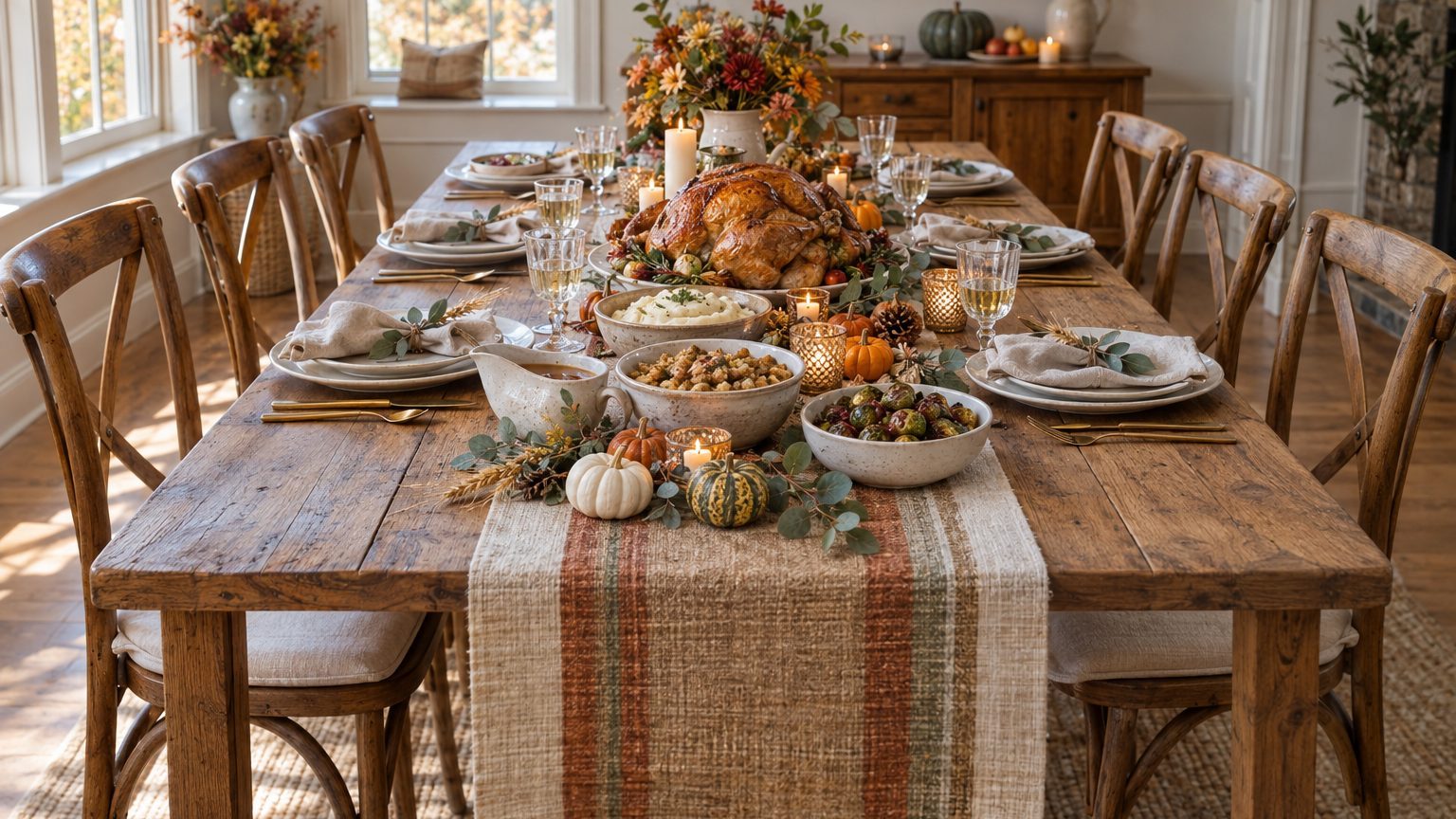
A Thanksgiving table runner should hang
6 to 12 inches past each end
of the table, or up to 15 to 18 inches for a dramatic drop. Most dining tables take a runner 12 to 16 inches wide. On a 6-foot (72-inch) table, that usually means a runner of about 90 inches. Use the runner alone for a casual look that shows off the wood. Use a tablecloth for full coverage. Layer the two for the most polished result. Center the runner lengthwise, leave room for place settings on both sides, and keep the middle clear for dishes.
How long should a table runner be
The formula is short: table length + (2 × overhang) = runner length.
Runner length equals table length plus twice the overhang you want.
For a 72-inch table with a 9-inch drop, that is 72 + 18 = 90 inches. To check a runner you already own,
subtract the table length from the runner length and divide by 2.
Commit to a drop.
A runner that ends flush with the table edge, or overhangs by an inch or two, reads as a mistake.
Either let it fall clearly past the ends or stop it 3 to 6 inches short. Too much drop has its own problem. A 108-inch runner on a 72-inch table
gives an 18-inch overhang
, which suits a formal look but can drape into the laps of anyone seated at the ends.
| Table length | Typical seating | Runner length (6 to 12 in. drop) | Nearest standard size | Runner width |
|---|---|---|---|---|
| 48 in. | 4 | 60 to 72 in. | 72 in. | 12 to 14 in. |
| 60 in. | 4 to 6 | 72 to 84 in. | 72 in. (90 for a deeper drop) | 12 to 14 in. |
| 72 in. | 6 | 84 to 96 in. | 90 in. | 13 to 16 in. |
| 84 in. | 6 to 8 | 96 to 108 in. | 108 in. | 13 to 16 in. |
| 96 in. | 8 | 108 to 120 in. | 108 or 120 in. | 14 to 16 in. |
| 120 in. | 10 | 132 to 144 in. | 120 in. is the longest common size, so order a custom length or use 108 and stop short | 14 to 16 in. |
Width follows a simple proportion:
about one-third of the table
.
On a standard 36 to 40 inch table, that means 12 to 14 inches.
Store sizes run
12 to 16 inches wide, with 13 to 14 inches a frequent choice
. Plates and glasses should land on the table, not the fabric.
Table runner vs tablecloth
The choice comes down to the table’s condition, how formal the dinner is, and how much laundry you want afterward. A runner is decorative. It covers a strip, not the table. A cloth covers everything, and layering gives you both.
| Setup | Coverage | Table protection | Cleanup | Formality | Best use |
|---|---|---|---|---|---|
| Runner alone | Center strip only | Minimal | One small piece to wash | Casual to modern | Good wood, smaller gathering |
| Tablecloth alone | Full top, with a drop | Good against spills and scratches | Large piece to launder | Traditional | Worn or mismatched table, big crowd |
| Layered | Full top plus accent | Good | Two pieces | Most polished | Formal dinners, leaf-extended tables |
Layering works best with contrast, such as a neutral cloth under a rust or plaid runner. If you skip the cloth, remember that fabric does not replace trivets.
Hot dishes can mark a wood top even with a durable finish, so put trivets or heat-resistant mats under hot serving dishes.
A felt pad under the runner is a cheap extra layer. Tablecloth sizing is a separate topic, so this guide stays with the runner.
How to style a table runner
Lengthwise is the default on a rectangular table. Lay it on the centerline, measure the drop at both ends, and tug until they match. A runner across the width suits a wide table, where
several runners can sit in front of each pair of guests
instead of one down the middle.
Placemats and chargers belong on the table beside the runner, with the runner running between the two rows. A wide runner can sit under the settings, but
placemats go on top of the runner, never underneath.
Keep plates off the edges, where the fabric tends to bunch.
On Thanksgiving, the runner has to compete with a turkey, three casseroles and a gravy boat. Keep the center clear enough to set them down. Choose one star: a bold runner with a simple centerpiece, or a plain runner with a fuller one. For the second approach, see these thanksgiving centerpiece ideas. A pumpkin centerpiece also works over a quiet, solid-color runner. Keep it low enough that guests can see each other.
What colors and fabrics work best for a Thanksgiving table runner
Classic harvest tones are burgundy, rust, mustard, olive and cream. Rust and plaid read warm against a neutral cloth. Olive and cream suit a quieter table. Burgundy hides cranberry and wine, which counts for something at this meal. Match the runner to your dishes: patterned plates need a solid runner, and white plates can handle plaid. Napkins can echo one color in the runner, not repeat it.
Fabric matters more at this dinner than at others because of gravy, wine and hot dishes. Cotton and linen launder well and look natural, though linen wrinkles. Burlap is rustic and forgiving of rough handling, but it sheds fibers and is harder to wash. Velvet looks rich, but it usually needs gentler care and is a poor match for gravy. Polyester is typically machine washable and wrinkle resistant, though it has a drawback:
polyester is an oil-loving fiber, and oil-based stains often darken and become more noticeable over time
. Treat greasy spills quickly. Check the care label before you buy.
Can you use a table runner on a round or square table
Yes, with a different layout. On a round table, lay one runner across the diameter with equal drops on both sides, or
cross two runners for a more festive look
. For a 48-inch round table,
a 63-inch runner gives about 7.5 inches of overhang per side
. Width stays the same as on a rectangular table.
On a square table, one runner with an overhang is the simplest option.
Two crossed runners of the same length give a four-sided look
, and
two runners crossing in the center create four equal place settings
. A diagonal runner turns the table into a diamond, which can also leave you with awkward seating at the corners. Cross runners leave a small square at the center, a natural spot for one centerpiece.
How do you keep a table runner clean and in place during dinner
A slipping runner pulls the centerpiece with it. A non-slip liner cut slightly smaller than the runner stops that. A cloth underneath does the same job, and so do clips at the hems. Smooth the fabric from the center outward before setting anything down, and check the drops again once the chairs are in.
For a day-of checklist:
- Press or steam the runner on an ironing board, not on the table.
- Add a grip liner or cloth underneath.
- Put trivets under every hot dish.
- Keep a white cloth and dish soap within reach.
For spills, blot and do not rub.
Blotting gently avoids spreading the stain and damaging the fabric.
For gravy,
scrape off the excess, work in liquid dish soap for 10 minutes, then launder in the hottest water the fabric allows with an oxygen-bleach product
. For cranberry or red wine,
remove the excess, rinse in cold water, and wash soon in the warmest safe water with an oxygen-bleach product
. Check the label first, because velvet and delicate blends may call for different treatment.
Frequently Asked Questions
Is a table runner necessary for Thanksgiving dinner?
No. A bare table, a cloth or placemats all work. A runner earns its place when you want color without covering the wood, or when you want to anchor the centerpiece and serving dishes in a clear central strip.
Can you use two table runners on one table?
Yes. Two runners crossed at the center work on round and square tables. On a wide rectangular table, several runners laid across the width can sit in front of pairs of guests. Keep them the same width so the table looks planned.
What should you do if your table runner is too long or too short?
If it is too long, fold the ends under or choose a longer drop on purpose, as long as it stays clear of laps. If it is too short, stop it clearly short of the ends, since a near-flush edge looks like a mistake. Or add a cloth underneath to give it more visual weight.
Should a table runner be ironed or steamed before the meal?
Yes, if the fabric wrinkles, as linen does. Do it on an ironing board and follow the care label, then lay the runner on the table once it has cooled. Pressing on the table risks heat and moisture on the finish.
Can you make a table runner without sewing?
Yes. Cut fabric to the length from the formula above, then finish the edges with hem tape or leave a fringe on a loosely woven material such as burlap. Felt does not fray, so it needs no finishing. For craft ideas beyond the runner, see this diy thanksgiving centerpiece guide.
Sources: blogs.extension.iastate.edu | dev.extension.illinois.edu | fcs.uga.edu