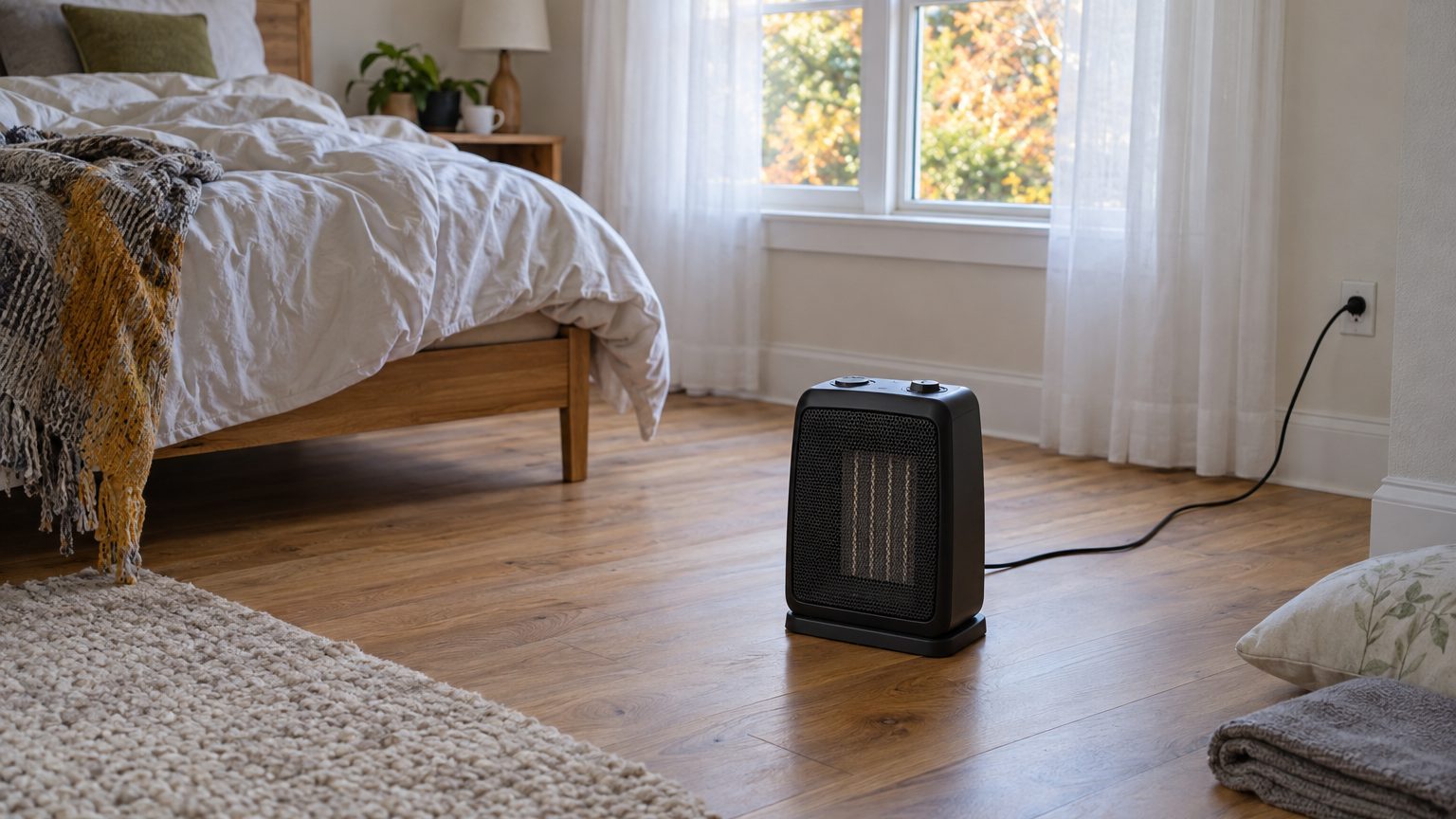
No. The U.S. Consumer Product Safety Commission (CPSC) says never leave a space heater on when you go to sleep.
It also says not to place one close to any sleeping person.
The National Fire Protection Association (NFPA) gives the same advice for portable electric models.
Its checklist says space heaters should be turned off and unplugged when you leave the room or go to bed.
A thermostat, a tip-over switch and a UL label lower the risk. None of them changes the rule.
Space heater safety tips
The numbers explain the firmness.
CPSC estimates that portable heaters are involved in an average of 1,600 fires per year, resulting in an average of 70 deaths and 160 injuries annually (2019 to 2021 data).
NFPA data for 2018 to 2022 show how lopsided the damage is.
Space heaters and heating stoves caused 46% of home heating equipment fires but 76% of the deaths and 72% of the injuries.
Space heaters and heating stoves are involved in fewer than half of heating fires, but in far more than half of the deaths.
Sleep makes things worse because nobody is awake to catch the early signs. A towel slips onto the grille. A cord warms up behind the dresser. A pet knocks the unit sideways. Awake, you are far more likely to notice a problem and react. Asleep, you may not.
If you run a heater while you are awake and in the room, a short list of habits applies. All of them come from CPSC and NFPA guidance:
- Plug it straight into the wall.
CPSC says to plug space heaters directly into a wall outlet and never into a power strip, to prevent overloading and causing a fire.
Extension cords are on the same list. - Check the plug as you go.
CPSC advises checking frequently during use whether the heater plug, cord, wall outlet or faceplate is hot.
A warm plug is a warning. - Buy certified and current.
CPSC recommends a heater tested to the latest safety standards and certified by a nationally recognized testing laboratory, because older units may not meet newer standards.It also suggests checking its recall list before you plug in a unit.
- Look for the right features.
NFPA recommends a thermostat with overheat protection and an auto shut-off that turns the heater off if it tips over.
Put the heater on a hard, level surface.
CPSC suggests a nonflammable one such as ceramic tile.
Do not put it on a rug or carpet, and never on a bed, a bean bag or a stack of laundry.
NFPA also says to keep heaters out of foot traffic and never block an exit.
In a bedroom, that means keeping the heater away from the path between the bed and the door.
One more risk gets little attention: overheating of the person, not the room.
A CPSC staff report found that space heaters can present a hyperthermia hazard, especially to children, people with disabilities and seniors, who may be less able to react to the elevated temperature.
CPSC warns against leaving heaters running unattended in a confined space around infants or people with reduced physical, sensory or mental capabilities.
A small nursery with the door closed is exactly that kind of space.
How far should a space heater be from a bed
At least three feet. That is the length of a standard yardstick. The figure is the same across agencies.
CPSC says to keep the heater at least three feet away from bedding, drapes, furniture and other flammable materials.
State fire safety guidance based on NFPA recommendations extends the zone to anything that can burn, including furniture, drapes and electronics.
The bed is the hardest place in the room to keep clear. A comforter hangs over the edge. A bed skirt drifts toward the floor. The nightstand holds paper, a charging cable and a robe on the chair. Measure the real distance with a tape, not by eye. Three feet looks like a lot until you set a heater down in a 10-by-11-foot room.
The three-foot clearance also applies to people, not only objects.
NFPA’s checklist says to keep the heater at least 3 feet away from anything that can burn, including people.
That reasoning sits behind the “kid-free zone” and “pet-free zone” that fire marshals recommend.
The Illinois State Fire Marshal’s office, for example, suggests creating a three-foot zone around portable heaters.
A dog curled up beside a heater is inside that zone.
Keeping the distance does not make it acceptable to run the heater overnight. The three-foot rule is for the hours you are awake. If you want heat in the room while you get ready for bed, a common approach is to warm the room, then switch the heater off and unplug it before you lie down. That follows the guidance, and a pre-warmed room holds heat for a while if the door is shut and the windows are sealed. How long depends on the room. Our guide on how to keep heat in a room covers the drafts, curtains and rugs that decide how long that warmth lasts.
Can a space heater cause carbon monoxide
It depends on the fuel. A standard plug-in electric heater (ceramic, oil-filled radiator or fan-forced) burns nothing, so it makes no carbon monoxide. Its hazards are fire, burns and overheating. Fuel-burning heaters are a different matter.
CPSC notes that fuel-burning space heaters can cause carbon monoxide poisoning and indoor air pollution because of improper venting or incomplete combustion.
The danger is greatest with unvented models, which release combustion gases into the room.
University extension guidance says all portable kerosene- or propane-fueled space heaters are classified as unvented.
The pollutants they emit include carbon monoxide and nitrogen dioxide.
CPSC says not to use portable propane space heaters indoors or in any confined space unless they are specifically designed for indoor use.
A bedroom with the door shut and the window sealed is a confined space.
The record on sleeping near these heaters is grim. When the CPSC proposed banning unvented gas space heaters in 1978,
it tied them to the carbon monoxide or asphyxiation deaths of at least 60 people since 1973. CPSC later said that most carbon monoxide deaths involving these heaters occur while the victim is asleep.
Modern units are safer.
An unvented gas space heater that meets current standards shuts off if oxygen levels fall too low.
That oxygen depletion sensor is a backstop, not permission to run the heater all night in a sealed room.
If you do use a fuel-burning heater, CPSC’s guidance includes the following:
- Keep doors open to the rest of the house when using an unvented fuel-burning heater.
- Have gas and kerosene space heaters inspected annually.
- Never use gas or electric stoves to heat the home.
- Never use gasoline in a kerosene heater, and use only 1-K kerosene.
Know the symptoms, because they are easy to dismiss.
Carbon monoxide poisoning symptoms resemble the flu, with headache, dizziness or nausea.
CPSC’s advice is to turn off the appliance at the first sign and open a window or door to see if the symptoms ease.
Don’t wait to see whether it passes. If you suspect poisoning, get everyone outside into fresh air and call 911.
Alarms are the last layer.
CPSC recommends a smoke detector with fresh batteries on each level of the house and a carbon monoxide detector outside your sleeping area.
NFPA says to install and maintain CO alarms to avoid the risk of CO poisoning.
An alarm in the hallway is a better bet than one in the basement, because it is the one you will hear at 3 a.m.
Staying warm without running a heater all night
None of this solves the real problem, which is a cold bedroom at 2 a.m. The fixes that don’t carry heater risks are mostly about holding the warmth you already have. Layered bedding, a rug over bare floorboards, a draft stopper at the door, and curtains drawn at dusk all help. Our guide to how to stay warm at night without heater sets out the bedding and sleepwear options. For the room itself, how to keep a room warm without a heater covers insulation and draft-proofing.
One last point about timing.
Fire safety guidance based on NFPA recommends testing smoke alarms monthly and replacing them every 10 years, regardless of condition.
Look at the date printed on the back of the one outside your bedroom. If it is more than a decade old, replace it before you plug in a heater this winter.
Sources : cpsc.gov