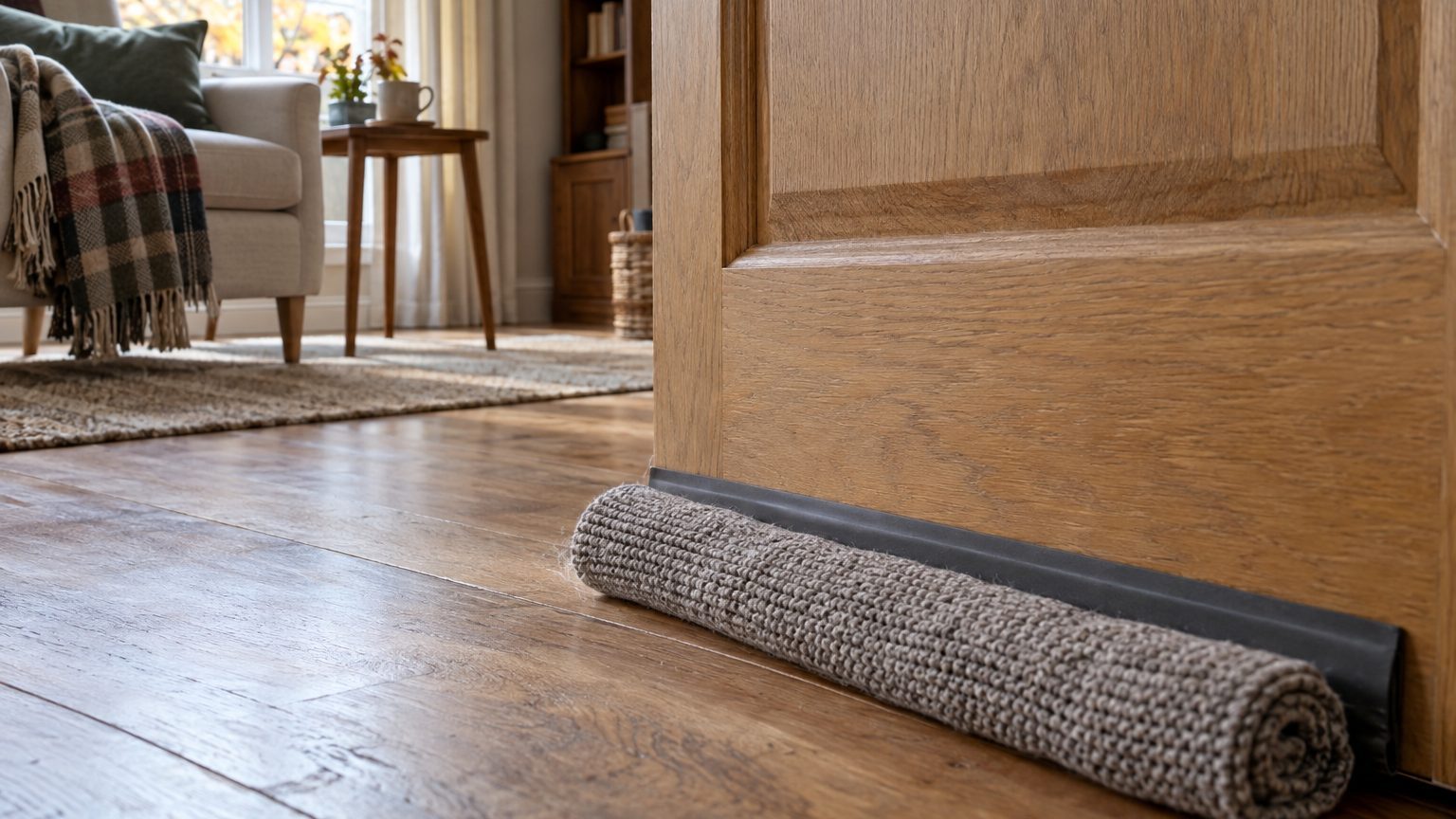
Start with the air, not the thermostat. Warm air leaves a room through gaps, through cold glass and floors, and through open doorways. So the order of attack is to seal the gaps, cover the windows after dark, put something between your feet and a cold floor, and then decide whether the door should be open or shut. Each step is cheap, and sealing gaps is a good place to start.
The Department of Energy has a neat way to explain why gaps come first. Insulation works like a sweater, keeping you warm when it’s cold out but doing little against wind.
Air sealing is the windbreaker.
A bedroom with good wall insulation and a leaky door is a sweater worn in a gale.
What can I put under my door to keep cold air out
Four things work, and they sit at different price and permanence levels: a door sweep, a door shoe, a draft stopper (the “snake”), and a rolled towel. The first two are permanent, the last two are removable. Which one fits depends on whether the door leads outside, to a cold hallway, or to a garage.
For an exterior door, or an interior door that borders an unheated space, a sweep or shoe is the right tool. University of Arkansas extension guidance says
weatherstripping goes along the sides and top of the door, with a sweep or similar device on the bottom.
That pairing matters, because a sweep alone leaves the sides and top open, and perimeter strips alone leave the bottom gap untouched. A door shoe wraps the bottom edge with a rubber or plastic gasket and tends to suit uneven thresholds. A sweep screws or sticks to the inside face of the door and is the easier job for most renters and first-time installers.
Removable options earn their place when you can’t drill into anything.
University of Georgia extension describes a “draft dodger” as a snake-like piece of fabric that lies against the bottom of the door, and says a rolled-up blanket or towel does the same job.
The weakness is that it sits on the floor, so it only works if you actually slide it into place each evening.
Before buying anything, find out where the air is really coming in. You don’t need a thermal camera.
A lit incense stick held near the door frame or window will show a leak when the smoke moves.
Run it along the latch side too, since that is where a sagging door tends to open up. If the door has dropped in its frame or the threshold is worn, tighten the hinges first, because a sweep can’t compensate for a door that no longer closes square.
Doors are not the only culprits. UGA’s guidance also points to
electrical outlets and switch plates, attic doors, and the openings where wires, cables and plumbing enter
as hidden leak sites.
Foam gaskets behind outlet and switch plates are a low-cost fix.
On an exterior wall, an outlet is a small hole directly into the wall cavity. The same extension article lists foam sealant for larger gaps around windows and baseboards.
The Department of Energy is realistic about this work.
A do-it-yourself approach can be effective for obvious leaks, such as around door frames.
Finding the subtle ones, such as those in the attic or behind walls, is where a certified energy auditor with a blower door earns the fee. If you can feel the draft on your ankles, you can fix it yourself.
Do rugs keep a room warm
A little, and mostly through your feet. The marketing outruns the evidence, so some caution helps. Rug retailers publish large savings claims, but I couldn’t find a government or university study that measures how much a rug changes a room’s heating load. What can be said with confidence is simpler: a rug adds a layer of material between you and the floor, and that layer slows the loss of heat from your body.
The floor type decides how much you’ll notice. Tile, stone and concrete conduct heat away quickly, and one rug-industry explainer notes that
thick rugs show a more noticeable benefit on those surfaces than on carpeted floors, which already insulate somewhat.
Hardwood sits in the middle. If you already have wall-to-wall carpet and pad, a bedroom rug is a style choice, not a heating strategy.
Thickness and fiber matter as well as size.
Wool and thick, high-pile rugs insulate best
, according to one retailer’s guide, which fits the general physics: air trapped between fibers is what resists heat flow. A thin cotton or flatweave rug looks nice but adds little. A rug pad underneath adds another layer of trapped air and keeps the rug from sliding on hardwood, so it counts as part of the system.
Where a rug can do real work is over a floor that sits above a cold space. A bedroom over a garage, a crawl space or an open porch loses heat downward, and a large rug in that room helps you feel the difference even if the air temperature barely moves. Think of it as comfort per dollar, and give your feet the first call. The rest of the room needs the sealing and window work, and the broader approach in how to keep a room warm without a heater covers the layering side of that strategy.
Windows: a large cold surface in the room
After the gaps, the glass. A window is usually the thinnest, coldest part of an exterior wall, and a bare one at 2 a.m. radiates cold toward the bed. The fix is to cover it at the right time. The Pacific Northwest National Laboratory’s Building America resource explains that
for winter heating savings, window coverings should be open while the sun hits the window and closed at night and on cloudy days.
Open them when the sun reaches the glass and close them at dusk. That routine is a big part of the benefit, whatever product you hang.
On the product itself, the same resource calls
multilayer cellular shades one of the most effective interior options for cutting winter heat loss.
Heavy lined curtains are a cheaper step up from nothing. Hang them close to the window, let them reach the sill or floor, and avoid a gap at the top where warm air can slip behind the fabric and cool against the glass. A curtain left open all night does almost nothing, so the habit matters as much as the product.
Bedrooms benefit a lot from this, since you use them mostly after dark and the coldest hours often fall while you sleep. If you’re working on the bedroom specifically, how to stay warm at night without heater pairs window covers with bedding choices.
Is it better to keep doors open or closed for heat
It depends on how the heat arrives. That sounds like a dodge, but the answer really does split into two cases, and getting it wrong can work against you.
With a central forced-air furnace, closing a bedroom door is not the free win it looks like. Most such systems have supply vents in each room but only a few return paths, often one central return. Building scientists at the Florida Solar Energy Center and Home Energy magazine have described what follows:
when an interior door is closed, more air is supplied to the room than can be returned from it.
The room becomes pressurized, and
that positive pressure pushes air into unconditioned spaces such as the attic and the walls.
Meanwhile, the rest of the house runs slightly negative and pulls outdoor air in through its own gaps. You’ve sealed one room and made the rest of the house leakier.
Researchers have measured this. In FSEC’s return-air work, rooms behind closed doors with only door undercuts commonly showed
pressures of +7 pascals or more relative to the main body of the house
, which is well above the 2.5-pascal ceiling that Florida’s building code sets for closed rooms. The studies were done in Florida homes with cooling in mind, and the physics runs the same way in a heating season. One more number from that work gives a sense of habit:
homeowners reported keeping interior doors closed about 11 percent of the time on average.
The fixes for a forced-air home are practical. Leave the door open during the day, or if privacy or sleep calls for a closed door, give the air a way back. FSEC notes that
undercutting interior doors is the conventional way to let return air out of a closed room
, though its testing found undercuts alone often fall short. Transfer grilles or jump ducts do a fuller job, and an HVAC contractor can add one.
The picture flips with room-by-room heat: baseboard, radiators, a mini-split head or a plug-in heater. There’s no duct network to unbalance, so the closed door becomes the insulation. One engineering explainer describes it as
preventing the exchange of conditioned air with adjacent, unconditioned spaces
. In that setup, shut the door and fix the gap beneath it, which brings us back to the draft stopper at the top of this guide. A caution: if a portable heater is your plan, read is it safe to sleep with a space heater on before leaving one running overnight.
Sources : britishgas.co.uk