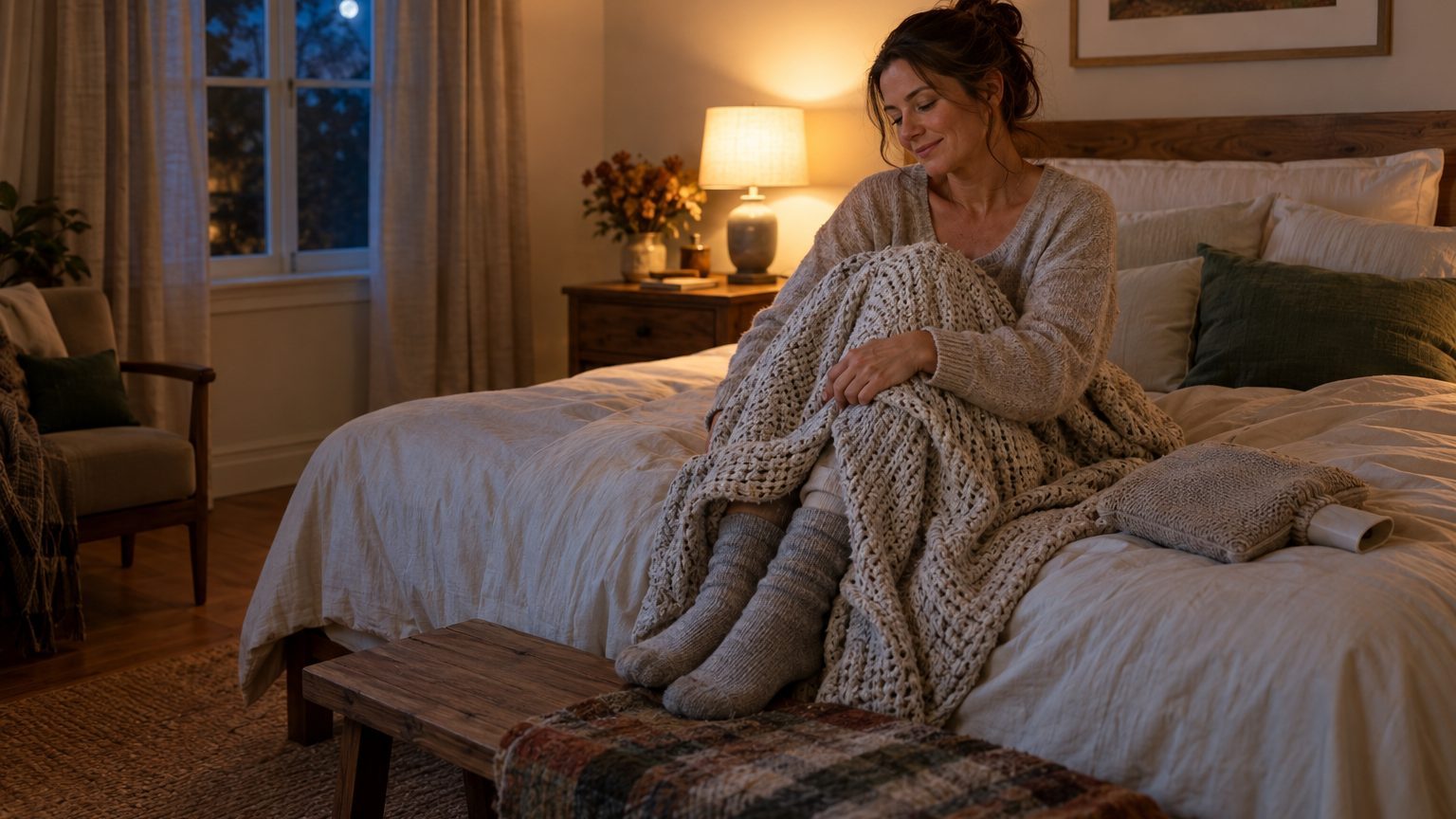
A simple way to stay warm at night without a heater is to warm your feet and your bed before you lie down, then add insulation on top of you rather than heat underneath you. A hot water bottle can do the pre-warming if you fill it carefully and take it out before you sleep. Bed socks and an extra layer of bedding handle the rest. The reason this works has less to do with the room than with how your body gets ready for sleep.
Why you get cold at night before bed
Your body is built to run colder after dark.
Body temperature stays fairly consistent through the day, then drops by around 1.8 degrees Fahrenheit at night.
The low point comes around 4 to 5 AM.
So some of the chill you feel under the covers is your own biology, not just a drafty window.
The mechanism is odd enough to be worth knowing.
The body sheds heat through vasodilation, meaning widened blood vessels,
and the hands and feet are the main exits. A 1999 study in Nature by Kräuchi and colleagues found that
how far the blood vessels in the skin of the hands and feet dilate is the best physiological predictor of how fast someone falls asleep.
Warm extremities are a sign the system is working. Cold, constricted ones leave you lying awake with a chilly core and nowhere for the heat to go.
Age shifts the picture.
Aging blunts the evening temperature decline, so middle-aged adults show a shallower drop and an earlier rise than younger adults.
That may explain why a bedroom that felt fine at 30 feels cold at 55.
The room itself still matters, of course.
Most doctors recommend a thermostat setting between 65 and 68 degrees Fahrenheit for sleep.
Drop well below that and you pay for it.
A cold bedroom is considered less harmful than an overly warm one, but it can cause discomfort and may affect REM sleep and blood pressure.
Older sleepers get some leeway on the other side:
a study of people 65 and up found sleep efficiency only began to fall once temperatures passed 77 degrees.
If the thermostat is off or the house simply runs cold, start by slowing the heat you already have from leaking out. The guide on how to keep heat in a room covers windows, doors and gaps. The bed-level fixes below do the rest.
Hot water bottle safety
A hot water bottle is a long-standing bed-warming tool, and it still injures people every winter. A UK burns unit reviewing cases between 2004 and 2013
identified 85 burn injuries caused by hot water bottles,
and the authors pointed to
a high rate of spontaneous rupture.
A broader review found that
contact burns were mostly due to prolonged contact during sleep.
The danger isn’t the first ten minutes. It’s the bottle you forget at 2 AM.
Low-temperature burns are sneaky because pain arrives late. A warning from Scotland’s national burns network noted that
people can easily burn at high temperature without feeling it.
The same advice is blunt:
use a cover, don’t use boiling water, take the bottle out of the bed before getting in, and never rest your feet on it.
That last point runs against instinct, since cold feet are the whole reason you grabbed the bottle. Resist it anyway.
Filling is one of the common moments for scalds.
Hot water bottles can scald during filling, leak or burst if rolled on, or cause contact burns on bare skin.
A short routine reduces the risk:
- Skip boiling water. Manufacturer guidance ranges from letting a kettle
stand for a couple of minutes
to
letting it cool for at least 20 minutes,
so check the instructions that came with your bottle. - Hold the bottle upright by the neck and
fill it no more than two thirds. -
Expel the air by lowering the bottle onto a flat surface until water reaches the opening,
then close the stopper. - Always use a cover, and don’t place the bottle against bare skin.
Age matters too. Rubber perishes.
The date stamp on the neck (the “daisy wheel”) shows when it was made, and bottles older than three years are best retired, and many manufacturers advise replacing them after about two.
One manufacturer puts
the normal life at two years, with careful handling stretching it to three or more.
If the rubber looks cracked or feels tacky, replace it. The British standard for hot water bottles is BS 1970:2012, so check the label for it.
Some combinations are off the table.
Never use a hot water bottle in a bed with an electric blanket.
Don’t microwave one unless the manufacturer clearly says that model is microwave safe.
For young children and sensitive skin, one manufacturer recommends
water no hotter than 104°F and always using a cover,
and another cautions that
elderly people and those with sensitive skin or reduced feeling should use bottles with care.
Anyone with numb feet, from diabetes or nerve problems for instance, should think twice about any heat source they can’t feel.
If a burn happens,
hold it under cool running water for 20 minutes while keeping the rest of the person warm.
Serious or blistering burns need medical attention.
How to warm up your bed before sleeping
The cleanest approach treats the bottle as a bed warmer, not a bedfellow. One manufacturer’s guidance says it plainly:
use a hot water bottle only to warm up your bed.
Slide the covered bottle between the sheets near the foot of the bed a while before you turn in, then pull it out, set it on the floor or nightstand, and climb into a bed that already holds warmth.
Feet deserve their own plan, and the research backs it. A study of bed socks in a cool room found that
sleep-onset latency was on average 7.5 minutes shorter, total sleep time was 32 minutes longer, and sleep efficiency was 7.6% higher
for people wearing them. Interestingly, the socks
had no significant influence on core body temperature.
They seem to help by keeping the feet comfortable, which keeps heat flowing out through the skin the way it should. Choose loose socks.
Socks that are too tight could reduce blood flow to your legs and feet,
and
feet that overheat and sweat can make it harder to sleep.
Layering comes next. If 65 degrees feels punishing, the standard advice is to
add a layer or two to your bedding
rather than crank the room warmer, since a cooler room helps keep your core temperature low. Stacking thin layers (a sheet, a blanket, then a comforter) lets you peel one off at 3 AM if you warm up. A single heavy duvet gives you only two settings: on or off.
Many people reach for a space heater at this point. That is a separate decision with real fire-safety questions attached (and carbon-monoxide risks if the heater burns fuel), covered in is it safe to sleep with a space heater on. If you’d rather avoid heaters altogether, the companion piece on how to keep a room warm without a heater walks through the room-level options.
A caveat on the bed sock research: it was small, with only six young men, and it ran in a room at roughly 73°F. A bedroom at 55°F is a different test, and we haven’t found a comparably controlled test. Treat warm feet as a well-supported tweak, not a cure for a seriously cold house.
Sources : bestheating.com