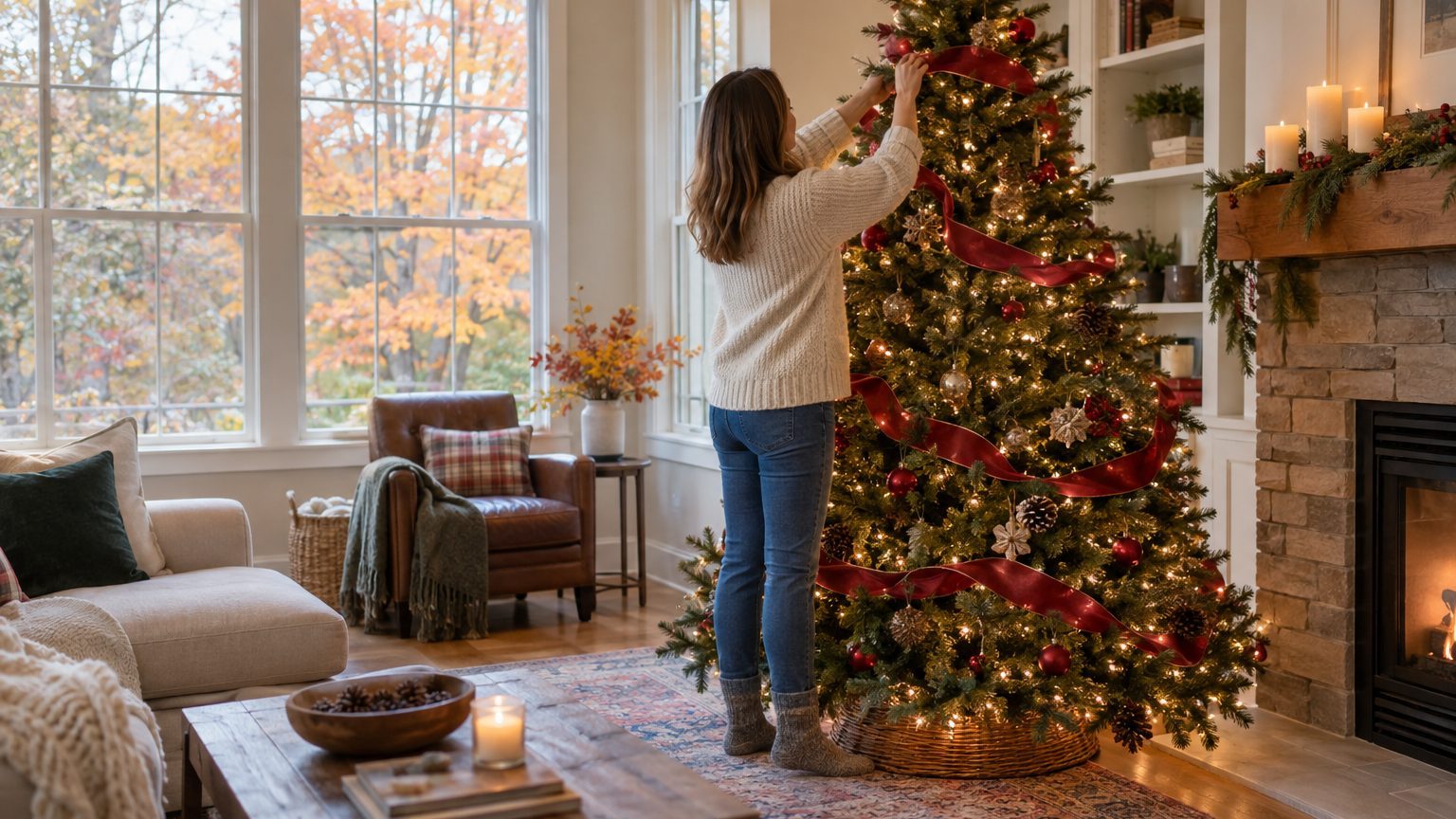
The short version of how to put ribbon on a Christmas tree: choose wired ribbon, add it after the lights and before the ornaments, and tuck it into the branches instead of laying it on the surface. Two layouts cover almost every look. In the cascade, loops drop from the crown. In the spiral, one long strand corkscrews to the base. Both are within reach of a first-timer.
Order matters more than most people expect.
Sort the supplies and the sequence first
Wired ribbon holds its shape when you pinch it into loops, which is why it keeps coming up in tree-decorating guides. Quantity is the surprise. Retail guidance suggests about 10 to 15 yards of ribbon for every foot of tree height. On a 7.5-foot tree, that works out to roughly 75 to 110 yards, which at the top end is close to the length of a football field. Most people buy one roll, hang it, and wonder why the tree looks bare.
Timing depends on the tree. On a natural tree, add vertical ribbon right after the lights. On an Artificial tree, add it right after you fluff the branches. Ribbon also goes on before the ornaments, since baubles come last.
For anchoring, skip the tape. Floral wire or pipe cleaners in a matching color grip branches far better, and bobby pins work for small adjustments. If you’re layering several ribbons, start with the widest one and add the thinner ones over it.
Widest first, always.
The cascade: loops that look like they fell by accident
A good cascade looks effortless and takes some planning. Push one end of a ribbon strip deep into the tree near the trunk at the top. Let it hang naturally for about 6 to 12 inches, then tuck it back deep into the branches. Bring it out again for the next loop and repeat, working toward the bottom.
The secret is that those long, graceful lines aren’t long at all. Each apparent length is really cut into several smaller pieces. One guide suggests 2-foot pieces started from the top. Tuck the top end in near the trunk and the bottom end into the middle of the tree. Then push the center of the piece inward as well. That creates two loops and stops the ribbon from dropping in a stiff straight line. Short pieces are also easy to fix when one looks wrong.
Don’t aim for perfect straightness. Letting the ribbon cascade naturally adds to the charm. A tree is a cone, so the base needs more ribbon than the crown. Plan on a few more lengths at the bottom than at the top. Step back after each pass and look for bare patches.
If you’d rather use one continuous strand, the “waterfall” version starts at the top and flows down in a single run. Trim the tail ends into a fishtail, which gives a polished finish. A V-shaped notch cut at an angle across the ribbon end does the same job and stops fraying.
The spiral: one strand, even spacing
The spiral suits people who like order. Secure one end at the top (a small bauble, the topper or a tie on the top branch can hide the start), then wind the ribbon downward in a slightly diagonal line around the tree. Aim for even spacing of about 8 to 12 inches between wraps, depending on the size of your tree. Step back now and then to check that the gaps stay consistent.
Long trees run through ribbon quickly. If you run out, tuck the end farther into the tree and begin the next roll the same way, so the join disappears. Do this at the back, where no one sees it.
Then add the loose look. Reach in and gently pull the ribbon away from the branches in some areas to create loops or billows. A tight spiral can look like a bandage, and the billows make it look intentional. At the bottom, tuck the end into the branches or use a bauble hook to secure it.
Mixing the two techniques works well. Run a spiral in a wide ribbon, then add a few small bows around the tree with tails that cascade down the branches. Space the bows evenly, and check from across the room, because that’s how the tree will actually be seen.
Ribbon is fabric, so mind the lights and the heat
It’s easy to forget that ribbon is fabric sitting next to hot bulbs and a plug. Fire-safety guidance says all Decorations should be flame-retardant or flame-resistant, so check the label on new rolls, particularly craft ribbon sold for other uses. Keep the tree at least three feet away from vents or other heat sources. That distance matters. A heat source too close to the tree causes roughly one in four Christmas tree fires, according to the NFPA.
The stakes are higher than with an ordinary house fire. One in every 45 reported Christmas tree fires ends in a death, on average. Electrical problems are the usual trigger, which is why guidance says not to link more than three light strands unless the directions allow it. Keep ribbon tails clear of bulbs and sockets, and tuck loops away from the plug end.
Turn the lights off at bedtime.
Artificial trees get a safety pass here too. Look for a tree labeled, certified or identified by the manufacturer as fire-retardant. On a real tree, the ribbon comes down with everything else: the NFPA advises that even a well-watered tree should come down within four weeks of coming indoors. Cutting the ribbon into short sections, as in the cascade method, makes that cleanup quick, and the pieces can go straight into next year’s box.
Sources : creeklinehouse.com | extinguishingornaments.com