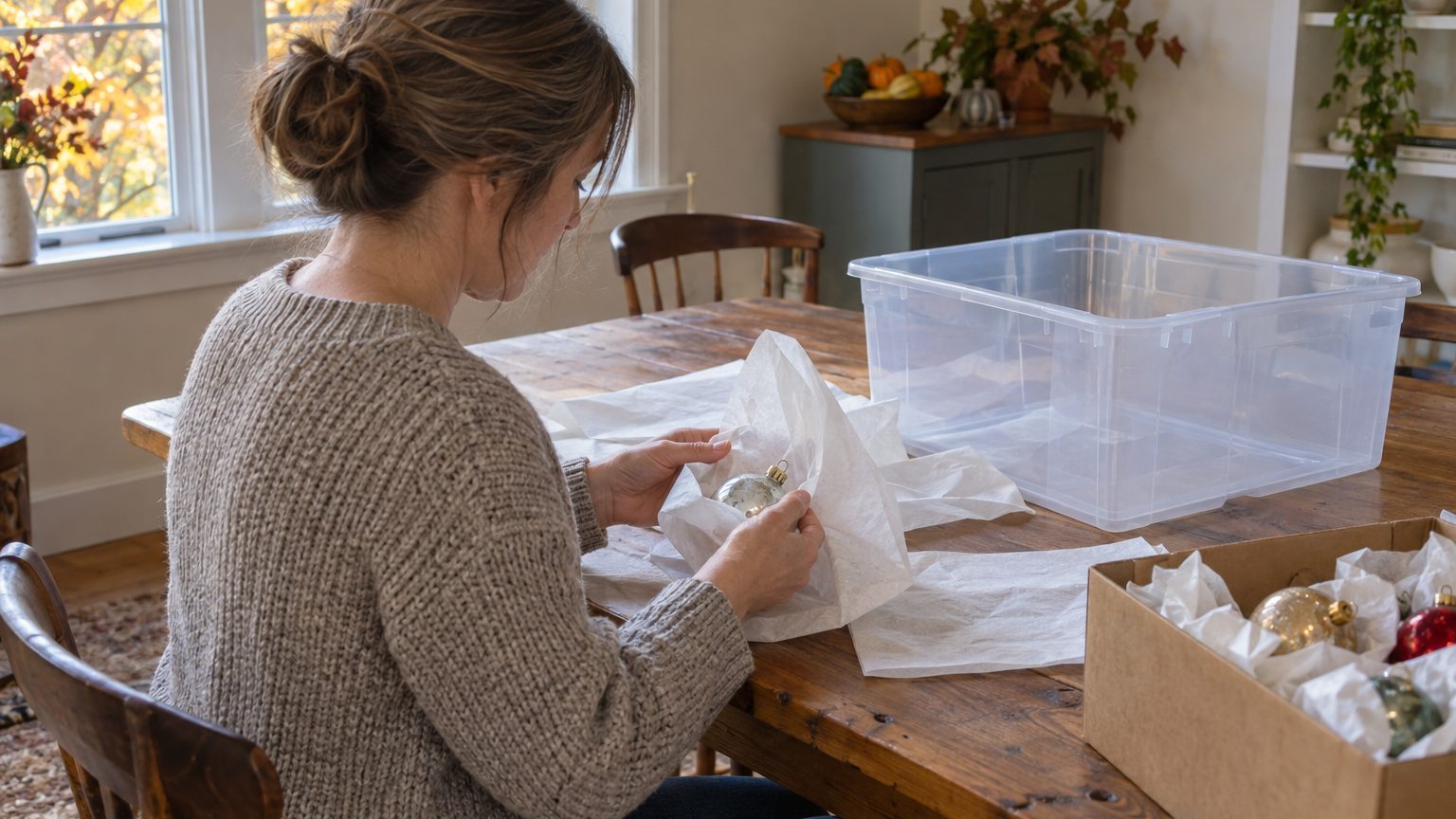
The best way to handle how to store Christmas decorations comes down to three habits. Test and clean everything before it’s packed, give each fragile piece its own cushioned spot, and label bins by where things get used rather than just by type. Do that and unpacking next year takes an afternoon, not a weekend.
Most holiday frustration starts with a box nobody checked.
Do the boring part first
Plug the light strands in before storing them to make sure they’re still functioning. A dead strand found in January costs nothing, while one found on a December evening costs you a trip to a crowded store. Look closely as you go, too: check for frayed wires, bare spots, gaps in the insulation, broken or cracked sockets, and excessive kinking or wear. The Consumer Product Safety Commission is blunt about what comes next, advising that you throw out damaged sets.
Then wipe things down. A microfiber cloth works on faux garland, artificial greenery, and both glass and shatterproof ornaments. Pull the batteries out of anything battery-powered as well, because old batteries can leak and damage the item during long-term storage.
Sorting belongs here too. Anything broken, missing pieces, or unloved for three Decembers running goes into a donate pile. Every item you keep claims shelf space for eleven months, so be ruthless.
Ornaments, garlands, wreaths and the tree
Glass ornaments are where most of the heartbreak happens. One tried-and-true method is a sturdy plastic tub with each ornament in a separate plastic cup, the six-ounce party size, and cardboard between each layer so you can stack several tiers safely. Flat paper and wooden ornaments do better in old cookie tins lined with tissue. Wine boxes do the trick for larger ornaments, since their built-in dividers do the work for you.
Heavy goes on the bottom, always.
Wrapping material deserves a second thought. Acid-free tissue suits heirlooms and delicate pieces, but newspaper placed directly against ornaments can transfer ink to some surfaces. Hooks go in a labeled bag, and if an ornament has small removable parts, keep them in a labeled bag inside the same compartment. Few things are more annoying than a reindeer with no antlers and no idea where they went.
Garland is simpler. Wrap it around a cardboard post or wind it into a tidy roll and tuck it into a bin. Artificial wreaths are the diva of the group: remove ribbons and bows before bagging them, and don’t stack them. A crushed wreath rarely springs back, no matter how much you fluff it.
For an artificial tree, strip off ornaments and ribbon, then gently fluff the branches back into place before packing. A tree storage bag works like luggage, and it beats wrestling a fluffed tree back into its original carton. If yours is pre-lit, the strands are usually embedded within the artificial branches, so they’ll stay put and need a quick plug-in test before the tree goes away. Some people leave a decorated, unlit tree wrapped upright in a bag and skip the whole teardown, which is a fair trade if you have a closet tall enough.
Lights without the knot
Tangled lights are the most common storage failure, and the fix costs almost nothing. Wrap standard strands around a piece of cardboard, a clothes hanger or a reel. Fold net lights flat and store icicle lights on a long board. Keep the wrapping loose, because tight wrapping and sharp bends are what stress the wire.
Keep the accessories with the strand they belong to. Store roofline-light clips with roofline lights and tree-light accessories with tree lights. That includes timers, spare bulbs and the extension cord, which matters for more than convenience. The CPSC says to use no more than three standard-size sets of lights per single extension cord, and a cord that stays paired with its strand makes that rule easy to follow next year.
Outdoor strands call for a little patience. Take them down on a dry day, and for anything running along a roofline, use caution when removing outdoor holiday lights (a wobbly ladder is a bigger risk than a tangle). Local fire authorities also suggest you bring outdoor electrical lights inside after the holidays, which keeps them from weathering in a shed all year.
Where the bins should live
The container matters less than the room it sits in. A cool, dark space with minimal humidity is the target, and clear plastic bins beat cardboard because they resist moisture and let you see what’s inside. A shed can work, as long as the space is cool, dark, and dry. Otherwise you risk opening the lid to mildew, or to evidence that mice found the felt stockings.
Think room by room. Attics and garages swing wildly between summer heat and winter cold, and a bathroom closet is humid after every shower. A bedroom closet shelf, a space under the bed or a hallway closet near the entryway is usually steadier, and it keeps the bins close for next November.
Labels are where the system either pays off or falls apart. Skip “Christmas stuff” and go with something like “Mantel,” “Front porch” or “Tree lights.” One organizer suggests storing by how you use decor, rather than by type, so the mantel box holds the mantel garland, its lights and its stockings. If you prefer sorting by type, a color code works: red bins for tree ornaments, blue for outdoor decorations, and green for garlands and lights.
Pack in reverse order of need. The tree stand, the lights and the first-out bin go in last, so they sit on top when you open the closet next year. Tape an index card inside each lid listing the contents and any quirks (this strand needs the timer, this ornament is Grandma’s), and the person unpacking, even if that’s you with a short memory, will thank you.
Sources : publicstorage.com | homesandgardens.com