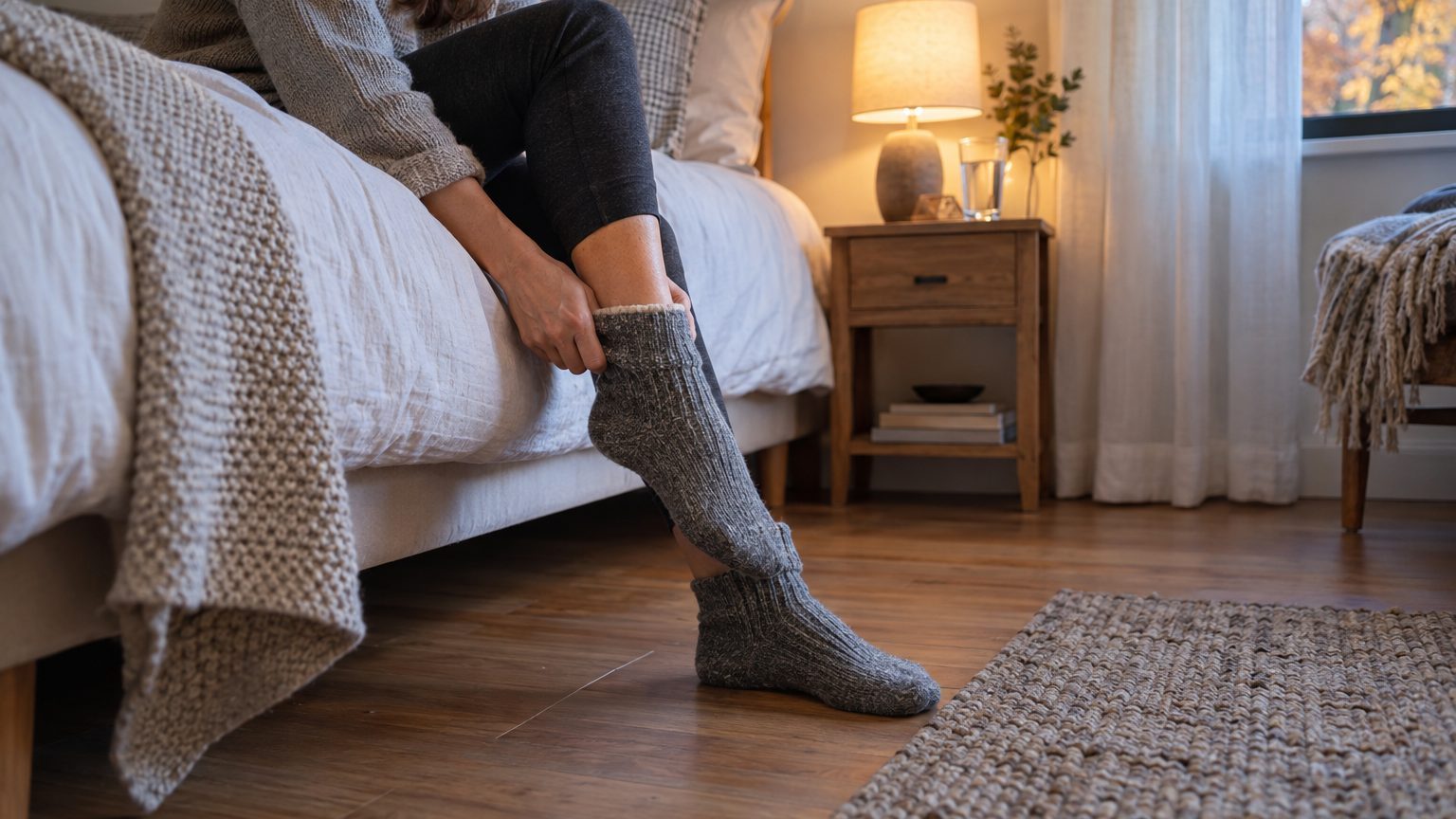
Loose wool or wool-blend socks, pulled on before you get under the covers, are the simplest fix. If your feet are already ice cold at lights-out, warm them first with a short soak or a pre-heated bed. The room and the blankets matter too, because feet lose heat quickly in a cool bedroom. Below: what the research says about socks, why some people’s feet stay cold, and which sock features are worth paying for.
Should you wear socks to bed
For many people, yes. The main controlled evidence comes from a 2018 study in the Journal of Physiological Anthropology, run in a room held at 23 °C (about 73 °F).
Volunteers wearing bed socks fell asleep 7.5 minutes faster on average and slept 32 minutes longer over a 7-hour night. Their sleep efficiency was 7.6% higher.
Their foot temperature also stayed about 1.3 °C higher than without socks.
That is a small study.
Researchers at Seoul National University put six young men through two sleep sessions each, once with socks and once without.
Six men in their early twenties don’t represent everyone. A 7.5-minute head start is also a modest gain, not a cure for insomnia. Still, the direction matches how sleep works.
Warm feet widen the blood vessels, which helps lower core body temperature, a key signal for falling asleep.
The researchers found that
bed socks had no significant influence on core body temperature
. Socks seem to help by making you comfortable and keeping heat flowing out through the feet, not by overheating you.
The study’s authors added a practical point. They suggested that
wearing bed socks might allow a bedroom air temperature 2 to 3 °C below the usual optimum
, which could trim heating use overnight. That is about 4 to 5 °F. If you’re trying to heat a bedroom less, a pair of socks is cheap compared with turning up the thermostat.
There’s a flip side. If your feet are already warm at bedtime, you may not need socks, and some people wake up too hot with them on. A sensible routine is socks on at lights-out and off whenever you start to feel clammy. Two cautions apply. Skip compression socks in bed unless a doctor has told you to wear them.
Cleveland Clinic advises against them for sleeping unless recommended by a physician.
And any sock that leaves a red band around your ankle is too tight (more on that below).
Why are my feet always cold in bed
Feet are at the end of the line.
They have less muscle mass than the rest of your body and rely on blood flow that the body naturally redirects inward at night.
In the cold, your feet and hands are often the first to chill while your chest and torso stay warm.
Lying still for eight hours, with no walking to push blood down to the toes, makes it worse. Night-only cold feet usually trace back to
inactivity and cooler bedroom temperatures
.
Some everyday habits add to it.
Smoking damages blood vessels throughout the body, narrows them, and can contribute to cold fingers and toes.
Small amounts of caffeine aren’t likely to cause a problem, but large amounts can affect circulation and lead to cold feet.
Stress works the same way:
the fight-or-flight response constricts blood vessels in your extremities so more blood can go to vital organs.
A tense evening can leave you with cold feet at 11 p.m. for a reason that has nothing to do with the thermostat.
Then there are medical causes, which are worth knowing about because they change what you should do. Raynaud phenomenon is the best-known.
It causes fingers and toes to become cold and numb when you get cold or stressed.
Toes may turn white when the arteries close, then blue or purple, then red as they rewarm.
The primary form is usually harmless, but
the secondary form is usually caused by another disease or problem, such as lupus or scleroderma.
Other possibilities include
moderate to severe anemia
, an underactive thyroid, and nerve damage.
Peripheral neuropathy is a common cause, especially for people with diabetes.
Nerve problems can make feet feel icy even when they
aren’t cold to the touch
.
Book an appointment if your feet are cold all day and not just at night. Do the same if you notice numbness, color changes, or sores, or if one foot is clearly colder than the other.
If a foot suddenly turns cold, pale, or bluish, call 911.
If you have reduced feeling in your feet, avoid direct heat sources in bed altogether (see below), since you may not notice a burn building.
Best socks for sleeping
Three things matter most: fiber, cuff, and thickness. A brand name matters much less.
On fiber, merino wool and merino blends are the usual recommendation.
Merino wool is naturally moisture wicking and breathable
, which means it keeps insulating if your feet sweat a little overnight. Blends with nylon or other synthetic fibers are common.
Merino mixed with synthetics gives enough insulation for moderate cold while staying light and breathable.
If wool itches, a blend with a softer fiber such as Tencel is a reasonable workaround.
The cuff is an easy place to go wrong.
Too-tight socks can restrict blood flow, which cancels the benefit of wearing them.
Look for
socks that are loose but snug enough to stay on
. One test is to take them off in the morning and check your ankles.
A cuff that leaves red marks can impair circulation and make cold feet worse.
Fit matters as much as thickness:
anything tight enough to leave a mark belongs in the shoe drawer, not the bed.
That’s a hint to leave the ribbed athletic socks where they are.
On thickness, match the sock to the room. A light merino blend suits a bedroom that’s merely cool. For a genuinely cold room, a heavier boot-style merino sock makes sense, though bulky pairs can feel clumsy under blankets. Reinforced heels and toes help them last through repeated washing. And socks aren’t the only layer: a bedroom that’s heated unevenly will keep working against you. The guides on how to keep a room warm without a heater and how to keep heat in a room cover the drafts, windows, and floors that drain warmth from the whole space.
Warm your feet before you get in
If your feet are cold when you climb into bed, socks alone just trap the cold. Warm them first. A few minutes of brisk movement does it:
a brisk walk, a bike ride, or some stretches boost circulation everywhere, including the feet.
A warm foot soak or a warm bath an hour or so before bed works too. Whichever you pick, put the socks on while your feet are still warm, so the fabric holds the heat in instead of slowly cooling it.
Hot water bottles are a classic. They are also one of the tools to treat carefully, because low-temperature burns happen when skin sits against a warm object for hours. Use one to pre-heat the foot of the bed, then take it out. Don’t fill it straight from a boiling kettle,
check the temperature before putting it in bed
, and
inspect it for damage, leaks, or wear first
. Never rest bare feet directly on it overnight.
Deep sleepers who fall asleep with their feet on one can suffer mild to moderate burns.
Electric heating pads call for more caution. Federal regulators have long warned against using them on a sleeping person.
The FDA and the CPSC issued a joint public health advisory on heating pad hazards in 1995
, and typical warnings on the products say not to use them while sleeping. A heated mattress pad or electric blanket is a different product, and some models are designed for overnight use, but check that yours is. Follow the manufacturer’s instructions, don’t fold or bunch it, and replace it if it’s frayed.
Dress the rest of you too. A cold torso makes the body pull blood from the extremities, and the feet lose out first. A warm base layer, a quilt that tucks in at the foot of the bed, and a floor-level draft stopper all help. The article on how to stay warm at night without a heater covers more ways to keep warm overnight.
One last detail: cold feet can wake you at 3 a.m. Leave a spare pair of socks on the nightstand. Putting them on takes ten seconds, and it’s easier than fighting a chilled foot for the next hour.
Sources : time.com