Forty-five percent of consumers plan to spend less on holiday décor this year, and 30% aren’t buying any new decorations at all. Prices explain part of it: tariffs and rising diesel costs have pushed Artificial tree prices up 10% to 15% over two seasons, and holiday décor overall is up about 10%.
A festive house doesn’t need a big receipt.
Knowing how to decorate for Christmas on a budget starts with a realistic benchmark. Most Americans are spending under $100 on Decorations this season, according to a national survey conducted by Ipsos. The glossy images online set the bar far higher than your neighbors actually clear it. Spend on one or two spots people see first, and let the rest stay simple.
Start with the boxes in your closet
Before you buy anything, pull out every box, bag and tangled strand you own and lay it all on the living room floor. Most households discover duplicates, half-forgotten ornaments and a few pieces that feel tired but could be rescued with a new ribbon. Sort into three piles: use, repair, donate.
Shop your own house before you shop anywhere else.
Then look past the Christmas bin. A wooden bowl filled with pinecones, white pillar-style LED candles grouped on a tray, glass jars packed with a short strand of lights, a plaid flannel shirt knotted around a basket handle: none of it was bought as holiday décor, yet all of it reads that way. Fabric you already own does heavy lifting, too, whether that’s a red scarf draped over a mantel or a white bedsheet spread under the tree as a snow-colored skirt. Last year’s gift wrap, ribbon and kraft paper make good tags and ornaments.
Each room can borrow from this logic. In the entryway, one wreath on the door and a tray of evergreen clippings by the boot mat set the tone before a guest steps inside. The kitchen needs only a bowl of clementines and a few sprigs on the windowsill. In the bedroom, a warm string of lights over the headboard and flannel sheets do more for winter coziness than any shelf of figurines.
Forage, bake, fold
Free materials are everywhere in late fall. Fallen pine boughs, cedar and holly branches from your own yard, spruce tips pruned from a hedge: bundled with twine, they make a garland that smells better than anything sold in a store. Ask a friendly neighbor before you clip, and rinse off sap before bringing branches inside.
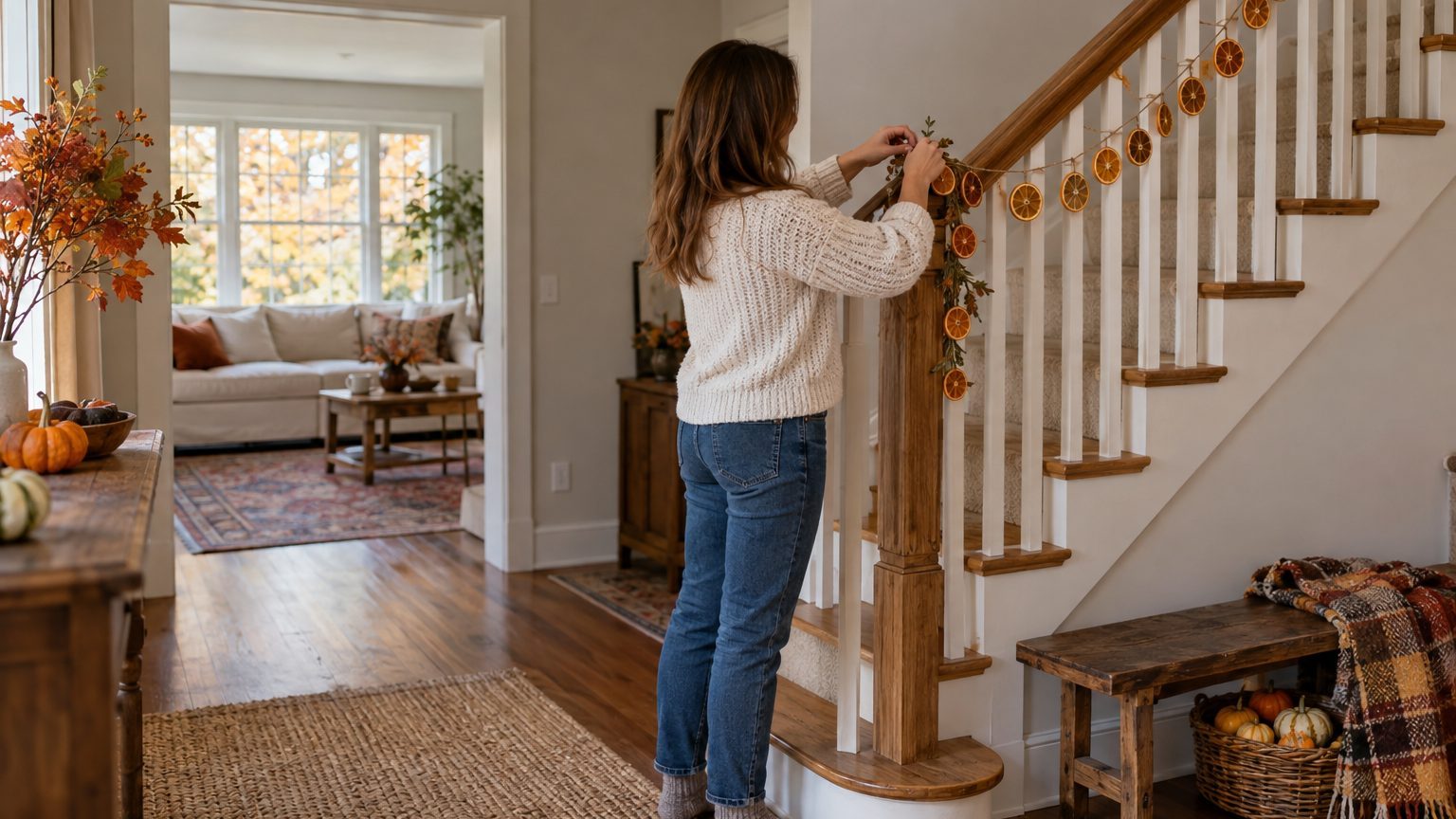
Dried orange slices are the old standby for a reason. Slice them thin, bake them in a low oven (around 200°F) for a few hours until they feel papery, then thread them onto twine for a garland or tie them onto the tree. A bag of oranges costs a few dollars and fills the house with a scent no candle matches. Popcorn strung on thread works too, though it has a short shelf life, and squirrels will fight you for any that make it outdoors.
Paper is the cheapest material of all. A stack of printer paper becomes a cloud of snowflakes taped across a window, and a few pages of old sheet music or a paper-bag grocery sack, cut into stars, turn into ornaments in an afternoon. Kids can handle most of it, which turns the whole project into the activity rather than the cost.
One caution for pet owners: holly and mistletoe are toxic if chewed, so keep those branches out of a curious dog’s or cat’s reach, or skip them for cedar and fir.
Where it’s worth spending: the tree and the lights
The tree is usually the biggest line in a holiday decorating budget, and the math is worth doing per year rather than per receipt. One projection puts the average artificial tree at $126.20. Owners tend to keep one for roughly 10 years, which works out near $12.62 per December. A good secondhand tree, or one bought on clearance the week after Christmas, drops that number further.
Lights give the best return on any dollar. A single strand wrapped around a mirror, a bookcase or a window frame changes how a room feels at 5 p.m. in December, when darkness arrives early. LED mini strands run well under $10 at big-box stores, and they stay cooler than old incandescent bulbs, which matters for the next section.
Skip the matching sets of ornaments. A tree that mixes handmade paper stars, dried oranges, a few glass balls from a thrift store and ribbon bows looks deliberate and personal. Ten mismatched pieces that mean something beat a box of 50 identical plastic spheres.
Cheap shouldn’t mean risky
Saving money on lights and trees carries one trap: bargain-bin cords and dried-out branches. Between 2020 and 2024, US fire departments responded to an average of 143 home fires per year that started with Christmas trees. Electrical distribution or lighting equipment was involved in two in five of them. Inspecting every strand costs nothing and takes ten minutes.
The living room is where the risk concentrates, since almost half (48%) of home Christmas tree fires started there. Fire-safety guidance says to keep the tree at least three feet away from heat vents or lights (think fireplaces, radiators and space heaters), and to keep a real tree’s stand filled with water. Never use lit candles on the tree. Set the lights on a timer or unplug them before bed or before you leave the house.
Thirty-five percent of tree fires happen in January.
That figure comes from the same fire-protection data, and the explanation is straightforward: many trees have had time to dry out by then. A tree left standing until mid-January because taking it down feels like a chore is the riskiest tree of all. Get a tree out of the house when it dries out, and look for a local recycling program rather than leaning it against the garage.
The week after Christmas offers a last budget move. Retail clearance racks fill with ornaments, ribbon, lights and wreaths at deep markdowns, and buying then for next December costs far less than buying in November. Label the box, tuck in the receipts, and next year’s decorating budget is already half spent.
Sources : firstalert.com | auto-owners.com