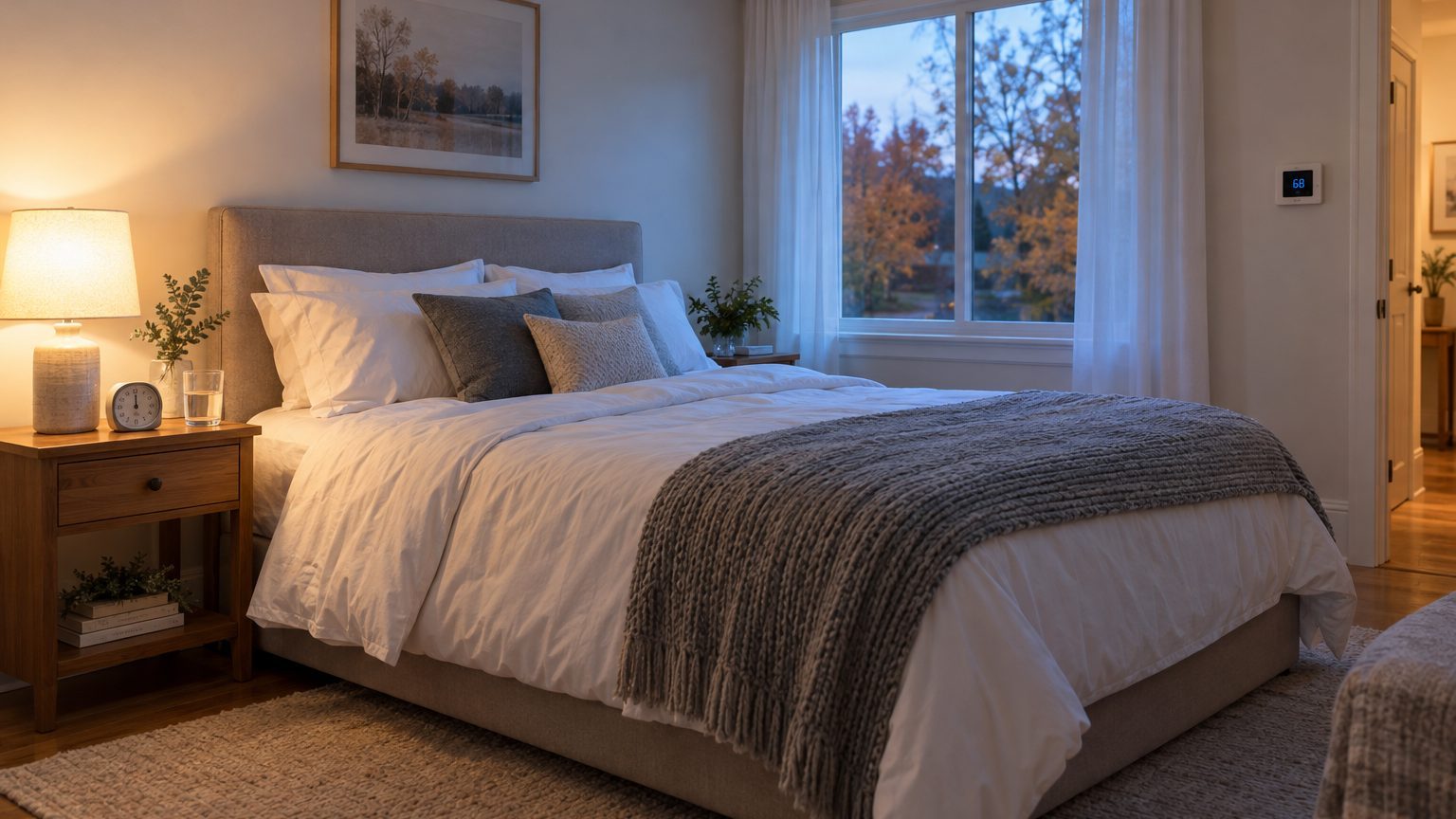
Aim for about 65°F. The National Sleep Foundation’s current guidance
puts the best room temperature for sleep at approximately 65 degrees Fahrenheit
, and its thermostat range runs
from 65 to 68°F
. The older range you will still see quoted everywhere is 60 to 67°F.
That version says a bedroom between 60 and 67 degrees helps promote sleep.
Treat 60 to 68°F as the working window and 65°F as the bull’s-eye. Where you land inside it depends on your bedding, your age and how dry your air is.
Best room temperature for sleeping in winter
Winter creates a small conflict in the house. The U.S. Department of Energy’s baseline for heating season is 68°F while you’re awake and home. For sleeping,
it suggests lowering the thermostat by 7 to 10 degrees for eight hours a day
, and it says that habit
can cut annual heating and cooling costs by up to 10%
.
Do the arithmetic, though. Knock 7 to 10 degrees off 68 and you get 58 to 61°F. The deeper setbacks land below the 60°F floor of the sleep window, and only the mildest ones end up inside it. So a bedroom set at roughly 62 to 65°F at night is a compromise: it saves less than the full setback but stays inside the sleep window. A Columbia University Irving Medical Center researcher quoted by the American Heart Association,
suggests a slightly cooler range of 60 to 65 degrees
, so that target has company.
Timing matters as much as the number.
The drop in body temperature starts about two hours before you go to sleep, coinciding with the release of melatonin.
A thermostat that starts easing down in the early evening cooperates with that process instead of fighting it. A warm bath beforehand also fits: the National Sleep Foundation lists
a warm bath as one option for a relaxing bedtime routine
, and the cooldown afterward does the rest.
Going from 68 to 65 overnight feels abrupt if you’ve slept warm for years. One HVAC contractor’s advice is sensible here:
lower the setting slowly over a few days and sleep with more blankets or thicker pajamas
. Dropping it a degree every night or two is a gentle way to let your body adjust.
If the bedroom refuses to hold that number, the fix is usually the room, not the thermostat. Drafty windows, a cold exterior wall and a gap under the door all leak the warmth you paid for. Our guide on how to keep heat in a room covers sealing and insulation. If you’d rather avoid cranking the furnace, how to keep a room warm without a heater goes through the low-energy options. And for the hours between lights-out and sunrise, how to stay warm at night without heater deals with bedding and sleepwear.
Is 60 degrees too cold to sleep
For most healthy adults, no. Sixty degrees is the floor of the long-standing recommended range, not a danger zone. Sleep science has leaned toward cooler rooms because
your body temperature naturally decreases to initiate sleep
, and a cool room helps that along.
The two directions of error aren’t equal either. According to the Sleep Foundation,
a cold bedroom isn’t considered as detrimental as an overly warm one, though it can cause discomfort and may have ramifications for REM sleep and blood pressure
. Heat is the bigger offender.
Being too hot while sleeping is linked to less time in the restorative sleep stage
, and
for most people, 75 degrees is too hot to sleep
. If you must err, err cool.
Your bedding changes the verdict more than most people expect. A study of sleepers under different duvets, reported in the Journal of Thermal Biology, found that
with a thinner duvet the optimal bedroom temperature range was relatively small
. Good sleep held as long as the microclimate in the bed stayed
between 86 and 91 degrees
. The authors also noted that
heavier duvets gave sleepers a wider range of comfortable bedroom temperatures
. So a 60°F room under a thick comforter can feel better than a 66°F room under a single sheet. The Sleep Foundation’s own advice for people who find 65 too chilly is simple:
add a layer or two to your bedding
.
Where 60 can genuinely be the wrong call is with older adults. A 2023 study published in Science of the Total Environment
tracked nearly 11,000 nights of sleep across 50 older adults
. It
suggested sleep was most restful when nighttime temperatures ranged from 68 to 77 degrees
, and
sleep efficiency dropped 5% to 10% when the temperature rose from 77 to 86
. That’s a small group, and the Sleep Foundation’s takeaway was measured:
the ideal room temperature appears to vary among sleepers
. But if you’re over 65 and wake up chilled at 60°F, the research gives you permission to run the room a few degrees warmer.
Babies are a separate case.
A bedroom that is too warm may increase the risk of sudden infant death syndrome (SIDS).
Ask your pediatrician for a specific target rather than copying an adult number.
What humidity is best for sleeping
Between 30% and 50% relative humidity. That’s the Environmental Protection Agency’s indoor range, and the Sleep Foundation cites it too:
the best indoor relative humidity falls between 30% and 50%, and it should stay below 60%
.
Both ends of the scale cost you sleep, in different ways.
Air that’s too dry can contribute to dry skin, nasal irritation, sore throats and nighttime coughing, while excessive humidity makes it harder for sweat to evaporate and creates a stuffy sleeping environment.
Damp air brings a second problem: that range
helps reduce the risk of mold, dust mites and overly dry air
. A bedroom that’s perfect on the thermometer can still wreck a night if the air is wrong.
Winter pushes the needle toward dry. Heating warms incoming outdoor air without adding moisture, so readings in a closed-up bedroom tend to slide toward the bottom of the range, or below it, on the coldest weeks. Running a humidifier in the bedroom without checking the numbers can overshoot just as easily, and that’s how condensation ends up beading on cold window glass.
Checking the humidity is cheap.
A hygrometer to monitor humidity, plus a humidifier or dehumidifier when needed, can help maintain a comfortable bedroom environment.
Put the hygrometer on a nightstand, not near a radiator or a bathroom door, and read it for a few evenings before you buy anything else. If you land under 30%, add moisture. If you sit above 50% and the room feels clammy, that’s a ventilation or dehumidifying job, and it’s worth fixing before mold gets a foothold.
One detail ties the two numbers together. Humid air makes a room feel warmer than the thermometer says, and a bedroom at 65°F with 55% humidity will not sleep like 65°F at 35%. If you’ve set the thermostat right and still wake up sweating or stuffed up, check the hygrometer before you touch the dial again.
Fine-tuning is easier if you change one thing at a time. Hold the thermostat at 65°F for a week with your usual bedding, note how you wake up, then shift it by two degrees or change a layer. The 2023 study of older adults and the duvet research both point to the same conclusion: sleepers differ, and the range is a starting line rather than a finish line.
Sources : newsroom.clevelandclinic.org | beautyrest.com | thesleepcharity.org.uk