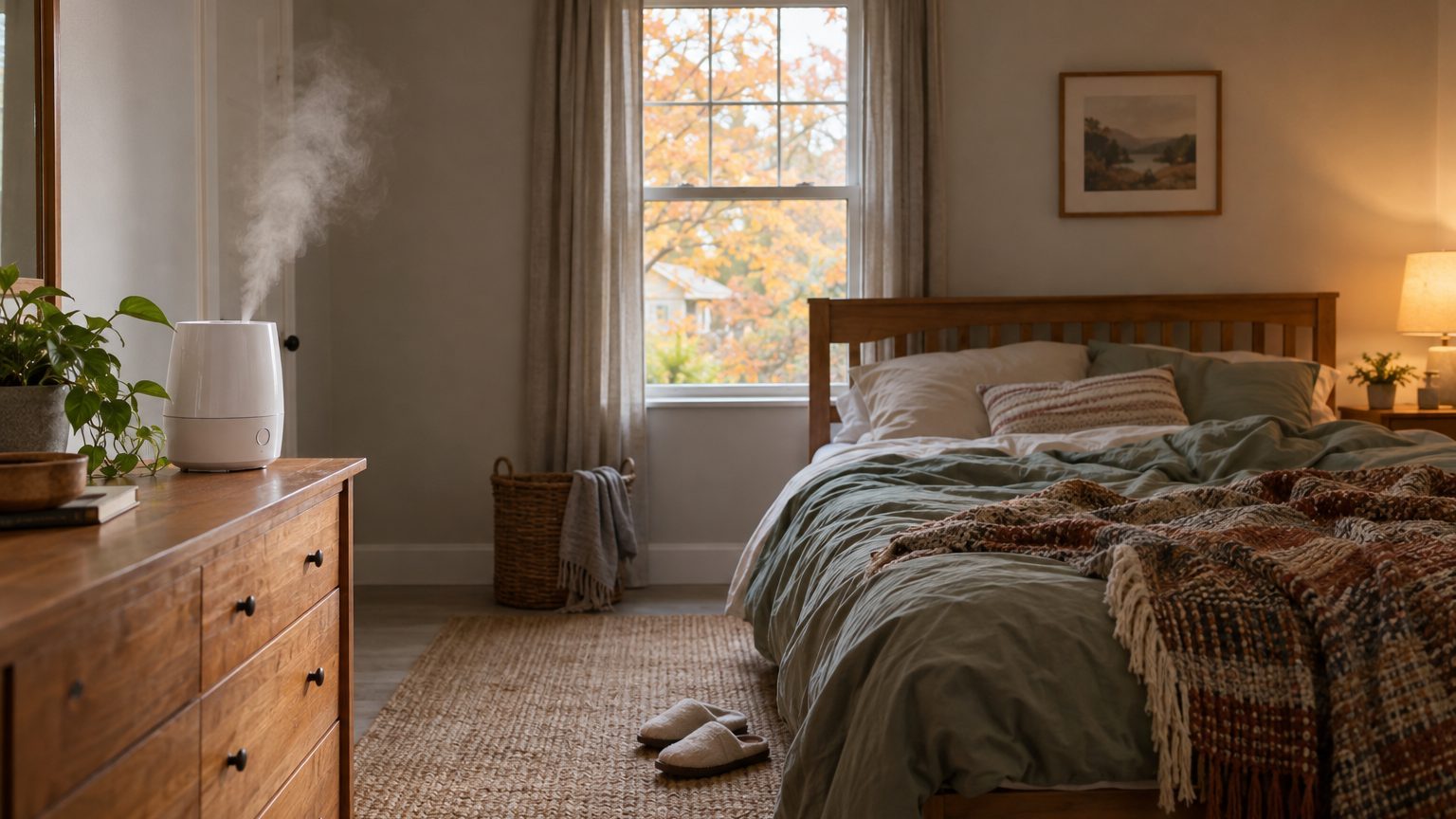
The best answer to where to put a Humidifier in a bedroom is a flat, stable surface 3 to 6 feet from the bed and at least 2 feet off the floor. Aim the mist into open air, not at a wall, a curtain or your pillow. Most placement guides settle on that range, and the reasons behind it explain how to adjust for your own room.
- The best spot is 3 to 6 feet from the bed and at least 2 feet off the floor.
- Aim the mist into open air, never at a wall, curtain or pillow.
- Keep indoor humidity between 30 and 50 percent, and mold can start within 48 hours above 65 percent.
The 3-to-6-foot rule, and why the nightstand often fails
Three feet is the usual minimum.
That’s roughly the width of a twin mattress. At that distance the mist is less likely to dampen bedding and has space to disperse before it reaches your breathing zone. If your room is large for the unit’s size, you can move it as far as 3 to 10 feet from the bed. Closer than 3 feet, you’re gambling on damp sheets.
The nightstand is where most people go wrong. In most apartments one indoor-air site has seen, the humidifier sits on the nightstand and sends mist straight at the pillow at face level. The same source adds a useful caveat: 3 feet works in a large master bedroom with good airflow, but not in a cramped 100-square-foot room. In tight spaces, direction matters more than distance, so angle the nozzle toward the center of the room or upward. A humidifier aimed at the ceiling from 3 feet beats one aimed at your head from 5.
There are exceptions. A small unit bought to help you sleep and prevent a dry throat in the morning can go on the bed stand. When you have a cold, congestion or sinus trouble, moving it temporarily closer than 3 feet is reasonable.
Height, walls and the spots that breed damp
Elevation gets overlooked. A humidifier on the floor releases mist at the lowest point in the room, and carpet or hardwood often absorbs it before it can circulate. A nightstand or dresser 2 to 4 feet high works well.
A humidifier on the floor mostly humidifies the carpet.
Walls, windows and clutter cause the next set of problems. Keep the unit at least 12 inches from walls, furniture and electronics. A central, open spot away from curtains and windows is preferred. Your room will tell you when the spot is wrong: fogged glass, damp bedding or wet furniture all mean it needs to move. And if you share the house with a curious cat or dog, keep the unit out of a pet’s reach.
Placement also depends on what’s already in the room. A dresser across from the bed, with the nozzle pointing toward the middle of the floor, is the setup I’d reach for first. It clears the bed by a few feet, sits at a good height and keeps mist off the wall behind it.
Cool mist, warm mist and the number to watch
Warm mist units need more distance, and more caution. UF Health notes that they can cause burns if someone gets too close, and a unit within elbow range of the bed is easy to knock over, hot water and all. UF Health advises cool mist for children in particular.
Placement only gets you halfway, because the room’s humidity is what counts. The EPA recommends keeping indoor humidity between 30 and 50 percent and suggests a humidity gauge, sold at most hardware stores, to check. One manufacturer’s tip is to put the gauge across the room from the unit, not next to it, since a reading taken beside the mist tells you nothing about the air where you sleep. In winter, aim for the lower end, 30 to 40 percent, to avoid condensation on cold windows.
Too much humidity does real damage.
Mold can germinate within 24 to 48 hours when relative humidity stays above 65 percent. A bedroom is a closed room with a sleeper breathing out moisture for eight hours, so it can drift up faster than you’d expect. If the window glass is wet when you wake up, turn the humidity setting down or shorten the run time.
What goes in the tank matters as much as where it sits
The right spot won’t help if the mist is dirty. The EPA notes that humidifiers can release minerals and microorganisms into the air, where they may be inhaled. Ultrasonic models can turn the minerals in tap water into tiny particles that reach deep into the lungs, and distilled or demineralized water largely solves that. A white film on the dresser around the unit is the visible version of the same problem.
Health experts recommend changing the water daily and cleaning the unit regularly. White vinegar and 3 percent hydrogen peroxide are common household cleaners for the job. Follow the manufacturer’s instructions for your model.
Cold weather adds one more wrinkle. A chart published by one humidifier brand suggests capping indoor humidity as the outside temperature falls, at 40 percent above 20°F, down to 30 percent between 0°F and 10°F, and 25 percent below zero. That’s one company’s guideline, not an EPA standard, but it explains why a setting that felt right in October can leave your bedroom windows streaming by January.
Sources : instacuppastore.com | greenwashingindex.com