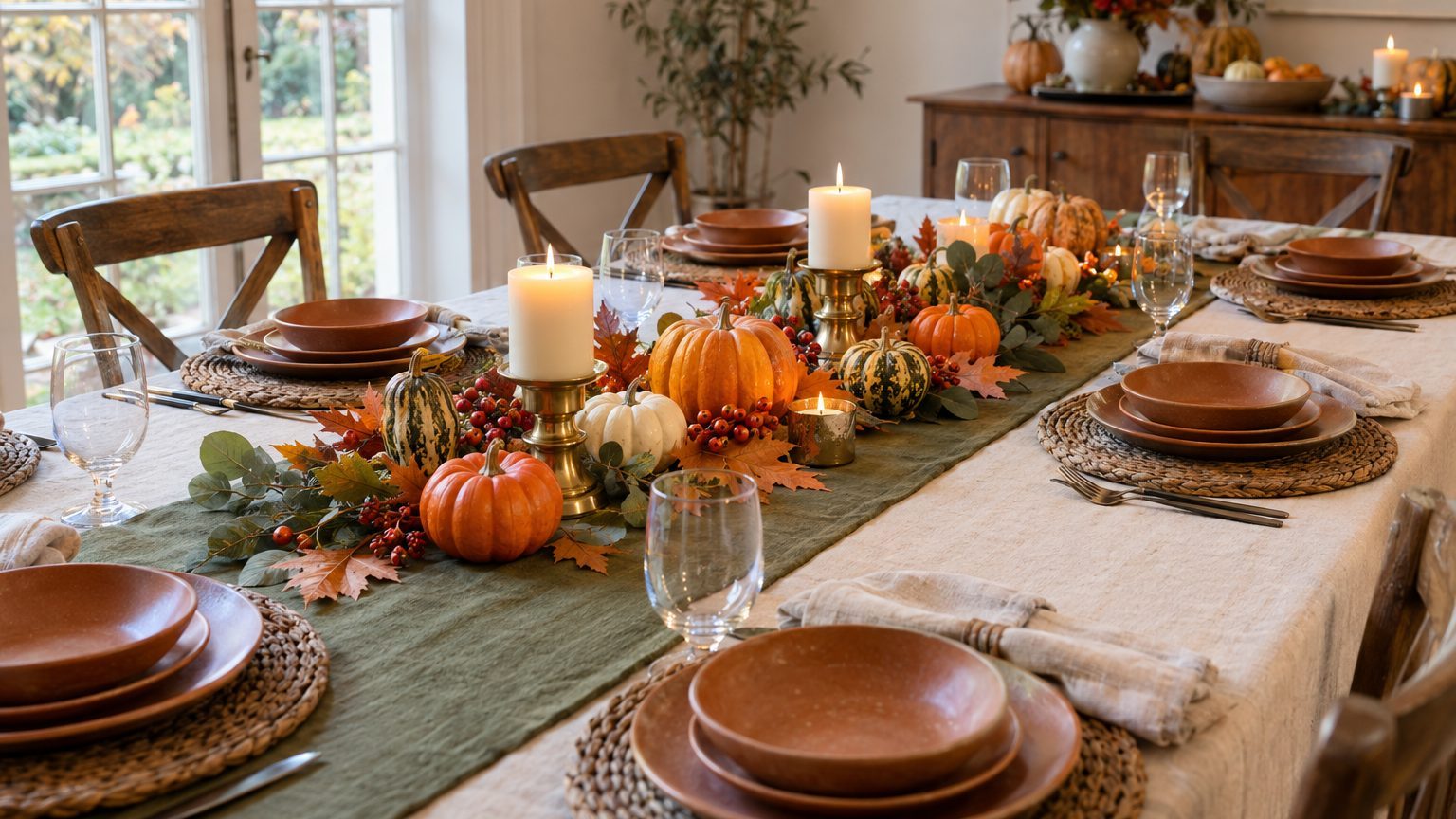
Pick two or three main colors and add one metallic or natural accent. Burnt orange, cream and brass works, and so does sage, terracotta and wood. Layer a few seasonal pieces (mini pumpkins, gourds, leaves, candles) down the middle, keep all of it low, and keep leaves and other dry pieces at least 12 inches from any flame. Spend money only on things you’ll use again, such as linens and candles, and gather or borrow the rest. Details on where the fork, glass and bread plate go sit in the thanksgiving table setting guide. This page covers the decorative layer only.
Thanksgiving table colors
Classic palettes: burnt orange, deep red, gold and brown
Harvest colors work because guests recognize them instantly. Burnt orange and rust carry the warmth, deep red adds depth, gold or brass supplies light, and brown comes free from wood, wheat and burlap. The risk is overload. Four warm colors at full strength can read as a craft-store aisle, so let one color lead and treat the others as supporting notes.
Modern palettes: sage, cream, terracotta and navy
Quieter schemes lean on sage green, cream and neutral tones, with terracotta as the one warm voice. Navy suits an evening dinner, especially with brass and candlelight. Editorial tablescapes show both directions, so neither is “the” trend. Choose the one your room can support.
How to pick a palette that works with your dishes and tablecloth
Start with what’s already fixed: dishes, tablecloth or bare wood, and wall color. Let the busiest item set the palette. A patterned cloth already has two or three colors, so pull from those rather than adding more. Plain white dishes work with most schemes.
| Palette | Colors to draw from (let two or three lead) | Accent materials | Overall mood | Best table or dish pairing |
|---|---|---|---|---|
| Classic harvest | Burnt orange, deep red, gold, brown | Brass, wheat, dried leaves | Warm, traditional, generous | White dishes on a plain cloth or wood |
| Modern neutral | Cream, white, soft tan, touch of terracotta | Linen, pale wood, ceramic | Calm, airy, understated | White or stoneware dishes, light wood |
| Earthy green | Sage, olive, cream, terracotta | Foraged branches, wood slices, greenery | Fresh, organic, quiet | Cream dishes, natural wood or a solid cloth |
| Moody jewel tone | Navy, deep red, plum, gold | Brass, glass, taper candles | Dramatic, evening, formal | Dark wood or a solid dark cloth with white plates |
| Rustic wood | Brown, tan, rust, cream | Wood slices, burlap, dried grasses | Casual, homey, relaxed | Bare wood table, mixed ceramic plates |
Thanksgiving table decor on a budget
What to buy, what to borrow and what to gather outside
Sort every item into one of three piles before you shop. Aim to keep the “buy” pile the smallest.
- Buy to reuse: neutral linen napkins or a runner, taper candles and sturdy holders, one brass or wood piece that works in any season.
- Borrow: extra trays, lanterns, a wooden bowl or cake stand from a neighbor or relative. Return them the following week.
- Gather: branches, leaves, dried grasses and wheat stalks from outdoors, plus mini pumpkins and gourds from a grocery store or farm stand.
Dollar-store and thrift-store finds that look expensive
Plain glass votives, small trays, wooden bowls and brass-toned candlesticks are the usual wins, because shape and material matter more than the label. Prices vary by store and region, so compare locally instead of trusting a number. Skip anything with glitter, a strong printed pattern or a plastic sheen, which tends to look cheap beside real wood and fabric.
Where not to cut corners: candles, linens and food-safe items
Candles need stable holders. Fire departments advise holders that are sturdy and won’t tip over easily. Linens touch food and get washed, so they should survive laundering. Anything near the dishes, such as a serving board or a bowl for rolls, should be food-safe, not a decorative piece that was never meant for dinner.
Fall table decor
Natural elements: gourds, mini pumpkins, leaves, branches and dried grasses
Seasonal materials do most of the work for little money. Mini pumpkins and gourds give color and shape, foraged branches add height at the table’s ends, and dried leaves and grasses fill gaps. A word on gourds: ornamental gourds are not bred for eating, and they can contain bitter cucurbitacins, so treat them as display only, never as cooking ingredients. Eucalyptus is a popular filler, but the ASPCA lists it as toxic to dogs and toxic to cats, so households with pets should choose another green.
Candles, lanterns and warm lighting
Taper candles, votive candles and lanterns add the glow that makes a table feel finished. Safety rules are short. Fire officials advise keeping lit candles at least 12 inches away from anything that can burn, which rules out dried leaves, paper decor and linen tails. That matters on a holiday when cooking already runs hot: NFPA estimated about 1,139 home cooking fires on Thanksgiving Day 2024. Candles can also start fires on their own, and in 60% of home candle fires, something combustible was too close. Never leave flames unattended, and consider flameless candles near dried material.
Faux versus real: what holds up for a week of prep
Estimates for fresh produce vary. Sound, uncut mini pumpkins can stay attractive for several weeks, and fresh ornamental gourds may last a few weeks, though cool storage stretches that. Cut flowers and berries are the fragile part. Faux leaves, wheat and picks survive a week of prep and return next year, so they suit the early layers, with fresh items added last.
What do you need to decorate a Thanksgiving table?
Fewer items than most shopping lists suggest. Pick a handful from each layer.
- Base: a tablecloth, runner or bare wood, plus linen napkins.
- Middle: a low run of mini pumpkins, gourds, branches or a wooden tray, with candles in sturdy holders.
- Accents: one metallic (brass, gold or copper), a few dried leaves, wheat stalks or wood slices.
For a centerpiece alternative, scatter those middle-layer items along a runner or set a few mini pumpkins at each place. Step-by-step centerpiece and napkin builds are outside the scope of this guide.
How do you mix textures and layers without crowding the table?
Pairing linen, wood, ceramic, glass and metal
Elegance comes from restraint and contrast. Pair soft linen with hard glass, rough wood with glazed ceramic, and brass with matte stoneware. Use no more than three or four materials, and let one of them (usually the wood or the cloth) dominate. Burlap works as a runner in rustic schemes, but it sheds, so keep it away from plates.
Keeping decor low enough to see across the table
Keep the main body of decor at or under about 12 inches, a figure many design guides repeat. Seated guests’ eyes fall roughly between 12 and 24 inches above the table, so anything in that band blocks conversation. Sit in a guest chair before dinner and check that you can see every face. If you want height, put narrow branches or tapers at the ends of the table, not in front of a seat.
How far ahead can you decorate the table for Thanksgiving?
Sturdy items can go on early, and perishable ones should wait.
- One week out: wash and iron linens, test candles and holders, gather branches and dry them indoors.
- Two to three days: lay the cloth and runner, add faux elements, and place mini pumpkins and gourds if the room is cool.
- The day before: add dried leaves and wheat, and arrange the candles without lighting them.
- Morning of: add fresh flowers, greenery and berries.
- Just before guests: light candles and do the sit-down sightline check.
Cover the table with a clean sheet if pets or kids roam the room.
How much space should you leave for the food?
A good rule is to keep decor within the center third of the table width, so plates, glasses and serving dishes have a landing zone. On a table about 36 inches wide, that means roughly a 12-inch strip. A runner with scattered small pieces takes less room than one large arrangement.
Decor to skip when serving family-style
Family-style service puts dishes where the decor usually sits, so move the middle layer to a sideboard once the food arrives. Unlit lanterns, loose leaves, wheat stalks and small gourds should be the first to go, since they collect crumbs and spills. Keep candles only if they stay stable and well away from reaching arms. With buffet service the table stays clearer, so more of the middle layer can stay in place.
Frequently Asked Questions
Can you use real pumpkins and gourds as table decor around food?
Yes, if they are clean and intact, and kept away from serving surfaces. Treat ornamental gourds as non-food, since they naturally produce bitter compounds called cucurbitacins. Use them only for display, never in the kitchen.
How do you decorate a small Thanksgiving table?
Cut the middle layer to a single low element, such as one tray with a few mini pumpkins and two tapers. Skip the runner if it eats up plate space. Put branches or taller pieces on a nearby sideboard instead.
Is it okay to use faux leaves and flowers on a Thanksgiving table?
Absolutely. Faux pieces last through days of prep and can be reused next year at no new cost. Mix them with a few real items, such as mini pumpkins or branches, so the table doesn’t look flat. Keep faux paper pieces well away from candles.
What colors go with a dark wood dining table at Thanksgiving?
Cream, sage, terracotta and brass stand out against dark wood. Burnt orange and gold also look rich. Add a light runner or linen so the wood doesn’t swallow the whole table.
Should Thanksgiving decor match the rest of the dining room?
It should coordinate, not match. Pick one tone from the room, such as the wood, wall color or rug, and echo it in a napkin or candle. Seasonal color can then be the contrast, and the room’s own finishes keep it from feeling like a separate set.
Sources: cosumnescsd.gov | daviess.mgcafe.uky.edu | fieldreport.caes.uga.edu