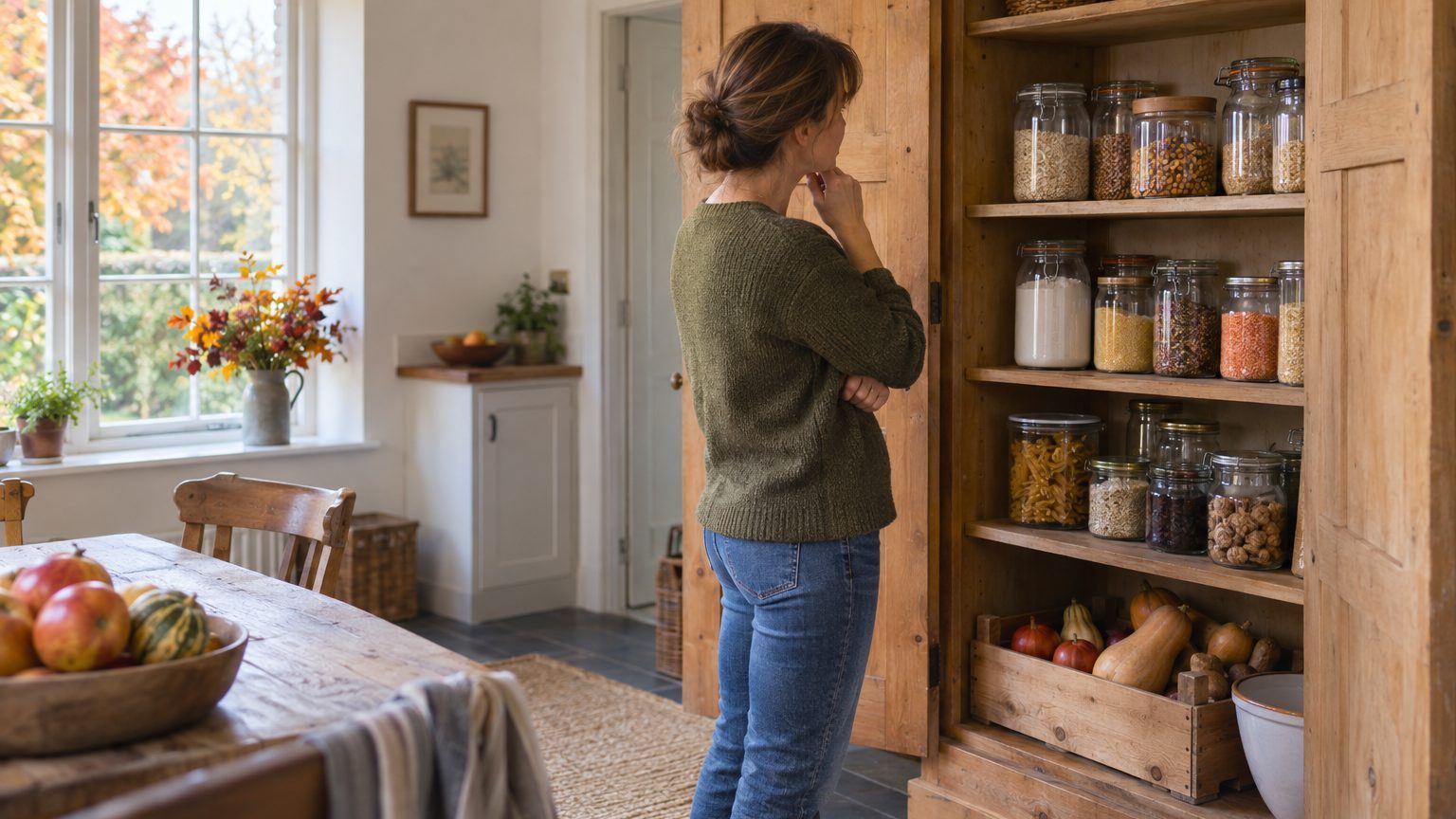
Learning How to Organize pantry shelves by category takes one long afternoon, and it pays off the first time a holiday recipe calls for evaporated milk and you find it in ten seconds. The weeks before Thanksgiving are the best window, because the shelves are still manageable and the shopping hasn’t started. Do it in early November and you’ll buy only what’s missing.
Holiday cooking is a pantry stress test.
A single festive menu can pull from five or six shelf zones at once: baking staples for pies, canned pumpkin and broth for sides, spices for the stuffing, oils, sugar, and a pack of toothpicks you’ll never find. Cooks working from a cluttered pantry tend to buy a second bag of sugar, a third can of cream of mushroom soup, and a fourth jar of cinnamon. That’s money sitting on the shelf, and it’s why the sorting comes before the shopping list.
- Emptying the pantry and sorting it by category takes about one afternoon.
- Commercially canned low-acid foods stay safe for 2 to 5 years if the can shows no dents, rust, or swelling.
- Ground spices should be replaced once their aroma fades, typically after six months, while whole spices last beyond two years.
Empty everything, then decide what stays
Take every item off the shelves, one shelf at a time, and check dates as you go. Consumer Reports quotes a professional organizer who says setting a whole day aside is more realistic than squeezing the job into an hour, and finishing early is a bonus. With the shelves bare, wash them with hot soapy water, rinse, and let them dry completely before anything goes back. Food can attract unwanted pests, and a pantry that hasn’t been wiped down in years usually has crumbs in the corners to prove it.
Dates need some judgment. Commercially canned low-acid foods such as beans, corn, and soups last 2 to 5 years and stay safe past the printed date as long as the can shows no dents, rust, or swelling, according to University of Nebraska–Lincoln extension. Flour is touchier: white flour keeps 6 to 8 months once opened, and whole wheat is shorter.
Flour opened last Thanksgiving has had its moment.
Spices deserve a sniff test before any recipe gets them. Penn State Extension suggests evaluating ground spices and all herbs after six months, and if the characteristic aroma has faded, replace the jar. Whole spices hold up far better; whole cloves, nutmeg, and cinnamon sticks maintain their quality beyond two years. If your nutmeg is whole and your cinnamon is a decade-old shaker, you already know which one to replace before you bake.
Keep a separate box for unopened items you won’t use. Consumer Reports recommends a separate donation pile for those, and November is when food banks need it most.
Sort into categories that match how you actually cook
Start with broad groups: baking, canned goods, grains and pasta, breakfast, snacks, and oils, sauces, and condiments. Food Network’s pantry guide suggests designating areas for different types of food, from breakfast items and grains to stocks, condiments, and oil and vinegar. Some organizers go further and group by habit (pasta night, baking day, lunch packing) rather than by package type. That version works better in practice, since you cook by meal and not by food group.
Placement comes next. The usual rule is that eye level holds the most-used items, top shelves hold rarely used ones, and bottom shelves take heavy or bulk goods. Consumer Reports’ expert adds that the shelf directly above and below eye level should hold things used daily or a few times a week.
Here’s where I’d bend the rules for the holidays. Build a temporary holiday zone on your baking shelf: canned pumpkin, evaporated milk, sugar, extracts, chocolate chips, and the spices the recipes demand. Add broth and canned vegetables for the savory side. A shelf like that turns recipe-gathering into a thirty-second job, and in January it dissolves back into the regular categories. Keep the whole pantry cool, too. University extension guidance puts the ideal storage range at 50 to 70°F, which rules out the cabinet beside the oven.
Onions and potatoes should never share a basket.
Food Network’s tips note that storing them together makes them spoil faster, so give each its own ventilated bin. Take them out of plastic bags first. Garlic and shallots do well in a paper bag punched with air holes, a trick the same guide recommends for longer keeping.
Containers, labels, and the rule that keeps it tidy
Clear containers are worth the money, mostly because they stop duplicate purchases. One organizing guide puts it plainly: if you can see you’re running low on rice, you add it to the list instead of buying a third bag. Grains, pasta, oats, and cereal are the best candidates for decanting. For items that don’t stack well, shallow bins or baskets work, and a turntable on a high shelf stops things from disappearing in the back.
Pour carefully, though, and keep the original package’s date. Michigan State University Extension suggests a bold marker to write the date on top of the package, which makes the oldest item easy to spot. That feeds the first-in, first-out method: newer purchases go behind older ones, so the oldest can or box is always at the front. MSU adds that FIFO saves money in the long run by reducing the amount of food you discard.
Labels on the shelf edge matter as much as labels on jars. Organizers quoted by Consumer Reports say each category should have a home that’s kept for that purpose alone, even if it’s temporarily empty. Without that discipline, the pantry stays organized only until the next grocery trip. Put the label where the family sees it, and teenagers and relatives helping in the kitchen will put the cranberry sauce back where it belongs.
One last tool is free. The USDA’s FoodKeeper app lets you look up a food and see its typical storage life by condition, and Michigan State’s food-safety team points out that it’s free and works on a computer or a phone. Keep in mind that those storage times are quality ranges, not hard safety guarantees, so a flat-smelling jar of paprika is a flavor problem rather than a hazard. Check one item from each category every week, and the pantry you build this month will still be working in March.
Sources : lovegreatfinds.com | thewholefork.com