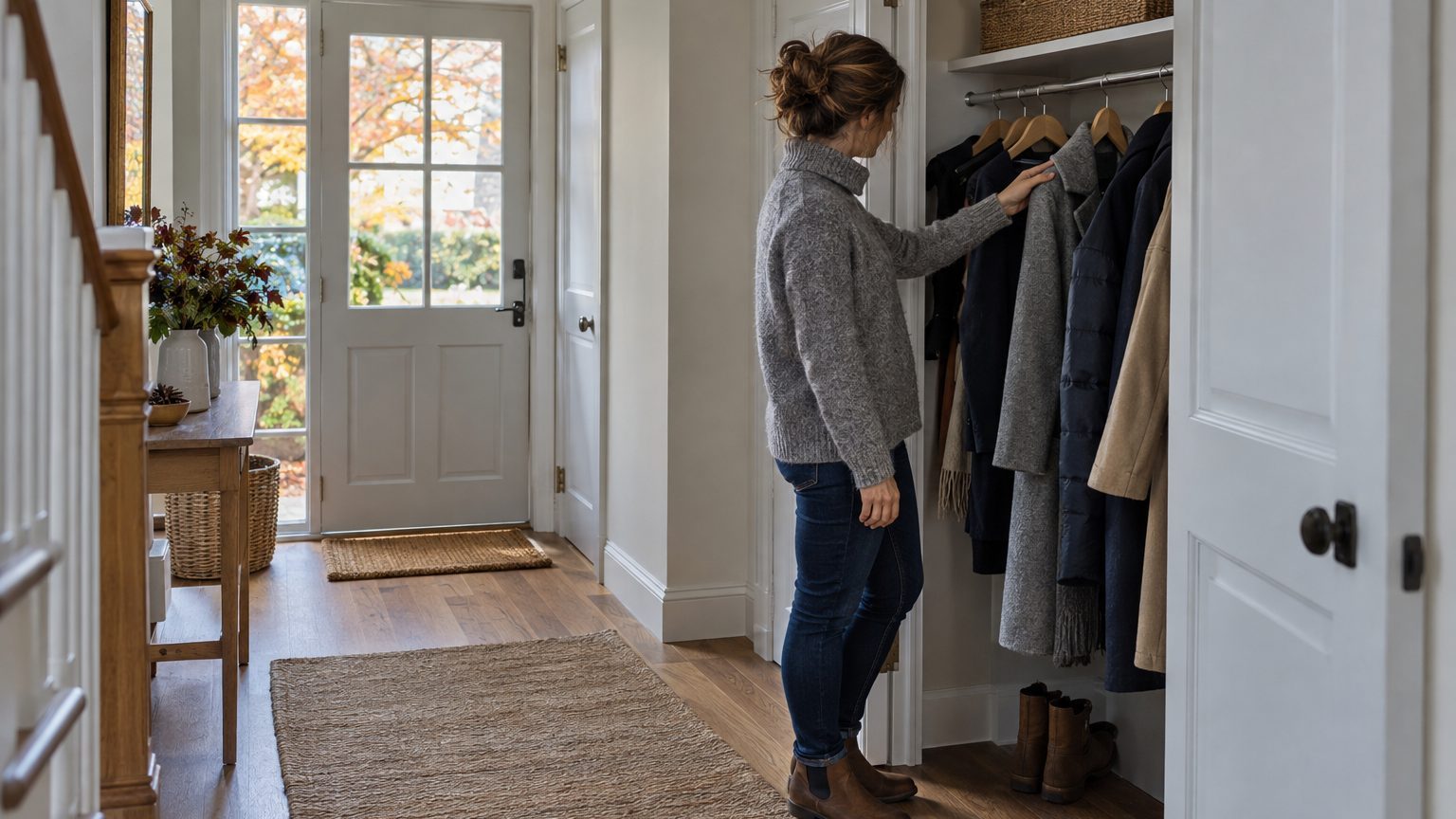
Anyone wondering how to organize a coat closet before winter should start with the same move: empty it completely, cut the contents hard, and only then decide what hardware to buy. Late October is the right moment, because the first cold snap exposes every flaw in a hallway closet at once. A jammed rod, a heap of single gloves, a boot tray nobody can reach.
Containers come last, never first.
- Empty the closet completely before buying any storage hardware.
- Hang coats longest on one far side and shorter jackets toward the middle.
- Keep 15 to 20 percent of the rod open for guest coats.
Empty everything, then cut hard
Pull every item out and sort it into clear groups, such as everyday coats, dress coats, hats and gloves, bags, shoes, and bulky gear. Then eye the leftover pile with suspicion. Sports equipment, toys, snow shovels and gift wrap rarely belong in a coat closet, and bins in the garage or basement are a better home for them. While the space is bare, give it a quick wipe-down and a sweep or vacuum.
Next, hold every coat, hat and glove up to three questions. Is it in good condition, does it still fit, and did anyone wear it this past season? Anything stained, torn or in disrepair goes, and whatever else fails the test goes into the donation bag after you check the pockets.
Leave a donation bag standing on the closet floor all season, so a too-small parka has somewhere to go the moment someone notices. When it’s nearly full, schedule a charity pickup or drop it at a thrift store. With children, jackets that sit between sizes can be packed away and labeled for later. A closet that sheds a little all winter never needs a dramatic purge.
Orphan gloves get one last search, then the bin.
Give every coat a zone
Think of the rod as a runway with a sensible landing order. Hang coats by length, with the longest on one far side and shorter jackets toward the middle. That leaves wall space for shelves on one side and floor space under the short coats for bins. Measure from the bottom of the hanging items to the floor before you buy anything, because a drawer system might fit across the whole width or just one side.
Hangers matter more than they look. Wooden ones are sturdy enough for heavy winter coats, while velvet ones suit lighter jackets, and thin wire hangers can damage clothing over time.
Leave breathing room, too. One guide suggests keeping 15 to 20 percent of the rod open for guest coats, which is the gap between a closet that survives a holiday party and one that spits coats onto the floor. Everyday pieces belong front and center, and formal coats, snow gear and other occasional items can go on higher shelves.
Wet outerwear complicates the picture. Sturdy hooks can help bulky coats dry faster than they would shut inside a closet. A hook rail near the door, plus a waterproof mat and some airflow for wet coats and boots, keeps dampness from settling into everything you’ve just sorted.
A home for gloves, hats and scarves
The back of the door is the best real estate you have. One professional organizer uses inside-door hanging baskets for hats, gloves, scarves and compact umbrellas, while another prefers hooks for grab-and-go items like dog leashes, umbrellas and reusable bags. Her rule is that anything on the door should be used often and easy to remove without disturbing the rest of the closet.
An over-the-door shoe organizer works like a cubby wall. The pockets are the right size for scarves, gloves and winter hats, and clear plastic lets you see what’s where. A tension rod or slim towel bar on the back wall or door can hold belts and scarves. The top shelf takes the rest: smaller items like umbrellas, hats or mittens can live in bins there, and if the shelf is hard to reach, it suits seasonal accessories better.
Households with kids do better with assignments. Give each family member a drawer labeled with their name, and mount hooks low so little hands can reach their own things. Nobody has to dig through a communal pile at 7:40 a.m.
Labels cost almost nothing and do most of the work.
Keeping it that way until spring
Treat the closet as a rotation, not a one-time project. Keep the current season’s coats, shoes and accessories in the most accessible spots, and store off-season pieces in labeled bins on higher shelves or in another closet. Swapping twice a year keeps the whole system from clogging.
Sorting hats and gloves at the start and end of each season catches items that no longer fit, are worn out or go unused. A quick weekly tidy prevents buildup, and a checklist hung on the door can remind the household to put things back.
One caveat applies to any system. A shelf only counts as storage if you can reach it without a struggle, so keep anything you need daily in winter between knee and shoulder height, and let the top shelf hold what you touch a few times a year. If a step stool is the only way to reach your hats, they’ll end up on the floor by January.
Sources : inspire.homebyames.com | moth-prevention.com