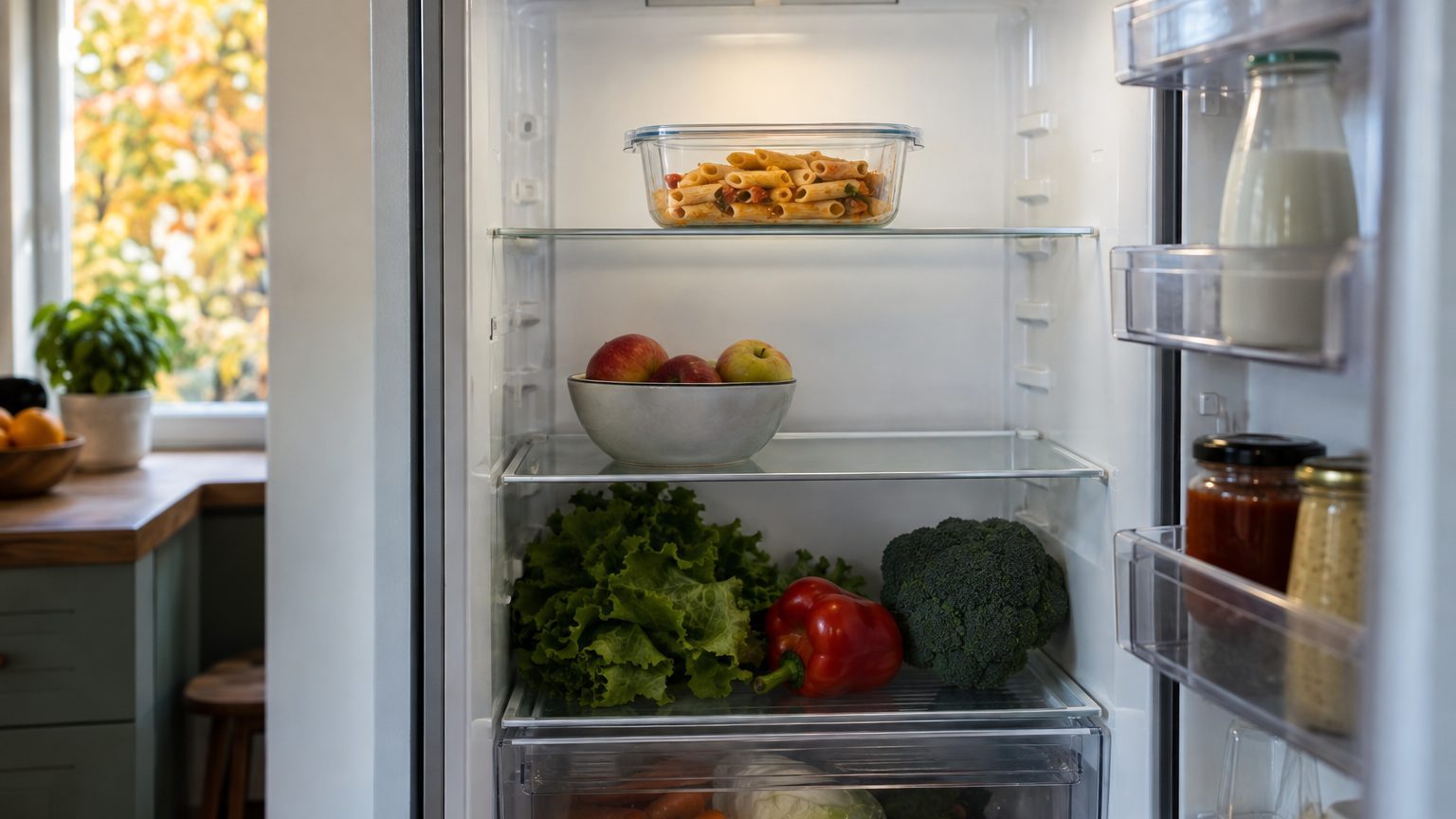
Here is How to Organize a fridge in one rule: ready-to-eat food goes up high, raw meat goes low, and anything raw goes in a sealed container. Everything else is fine-tuning. Juices from raw foods can drip onto foods stored near or below them, so the order of your shelves decides what gets contaminated when something leaks. A tidy fridge that ignores this rule is only tidy-looking.
Gravity doesn’t care how neat your shelves are.
On temperature, USDA guidance is blunt: the unit should stay at 40°F or below throughout, so that any place is safe for storage of any food. That makes “cold zones” less dramatic than the internet suggests. Still, the door swings wide and warms up with every opening, and the back of a middle shelf sits steadier than a bin by the hinge. Zones come down to risk, and temperature is secondary.
- Ready-to-eat food belongs on the top shelf.
- Raw meat and poultry belong on the bottom shelf in sealed containers.
- The fridge door is the warmest spot and should not hold perishable foods like milk.
The shelf-by-shelf map
Start at the top, where the food gets no second chance. Leftovers, prepared salads, washed produce and desserts all live here because nothing will cook the bacteria out of them before they reach your plate. Extension specialists at North Carolina State suggest leftovers on the top shelf, good for 2 to 3 days, in clear containers labeled with dates. Get them in the fridge within 2 hours of sitting out, and the date label becomes your alarm clock.
Middle shelves suit dairy, eggs and cooked items you plan to reheat. Keep eggs in their original carton, on a shelf and not in the door. USDA’s advice is simply to store eggs in the carton on a shelf, and the carton also keeps them from picking up odors from the onions next door.
The bottom shelf belongs to raw meat, poultry and seafood. Put them in a sealed container or wrap them tightly, because raw juices must not reach other foods. A rimmed plate or shallow tray under the package adds a second line of defense. Some food-safety guides take it one step further and stack by cooking temperature: whole cuts of beef, pork and lamb above ground meats, with poultry lowest of all.
Poultry needs the highest cooking temperature, so it sits lowest.
Raw ground chicken and turkey keep only 1 to 2 days in the refrigerator. If you aren’t cooking it by then, freeze it. A bottom shelf full of forgotten packages is the quickest way to undo the whole system.
Drawers and door: the two spots people get wrong
Crisper drawers do more than hold vegetables. Most have two humidity settings, and they work in opposite ways. Low humidity suits produce that ripens quickly, such as apples, pears and avocados, while high humidity suits things that wilt, such as leafy greens and fresh herbs. Keep the two groups in separate drawers, since the drawer with wilting spinach is not the place for a bag of pears.
The door is the warmest, least stable spot in the fridge. It is opened frequently and exposed to room-temperature air each time, and USDA’s guidance on door storage is plain: don’t store perishable foods in the door. That rules out milk, which sees more temperature swings in the door than deeper inside. Many people assume the milk slot was designed for milk, but that’s a design convenience and not a safety feature. Condiments, on the other hand, are stable and have long shelf lives, so mustard, hot sauce and jam can take the hit.
The door is for ketchup, not milk.
Keeping the system working through the seasons
An overstuffed fridge undermines even a perfect layout. Cold air can’t circulate properly when the shelves are packed too tightly, which creates warm pockets where bacteria grow faster. Leave gaps between containers, and don’t push items against the back wall where the air vents are. If you can’t see the back of a shelf, you’ve loaded it too heavily.
Late November is the real stress test. Casseroles, pies, a thawing turkey and a week of leftovers all show up at once. Clear a shelf ahead of time, move drinks to a cooler or the garage if the weather is cold enough, and put the turkey on a tray on the bottom shelf. In summer the pressure comes from big grocery hauls and warm kitchens, so unpack the cold items first and keep the door shut.
Cleaning belongs in the routine too. Listeria can keep growing at Refrigerator temperatures, down to about 32°F, which is why a weekly wipe-down and a toss of anything past its date matter as much as shelf order. A fast Sunday-night reset takes ten minutes: pull out expired items, wipe any drips, and put things back by zone.
Check the number, too, because the dial on your fridge isn’t a thermometer. A setting of “5” on a 1-to-9 scale doesn’t tell you the actual temperature inside, and FDA recommends keeping an appliance thermometer in the unit. Set it on a middle shelf, read it after a few hours without opening the door, and adjust until it reads 40°F or lower. Once that number is right, the shelf layout only has to handle the leaks.
Sources : lifetips.alibaba.com | 123foodscience.com