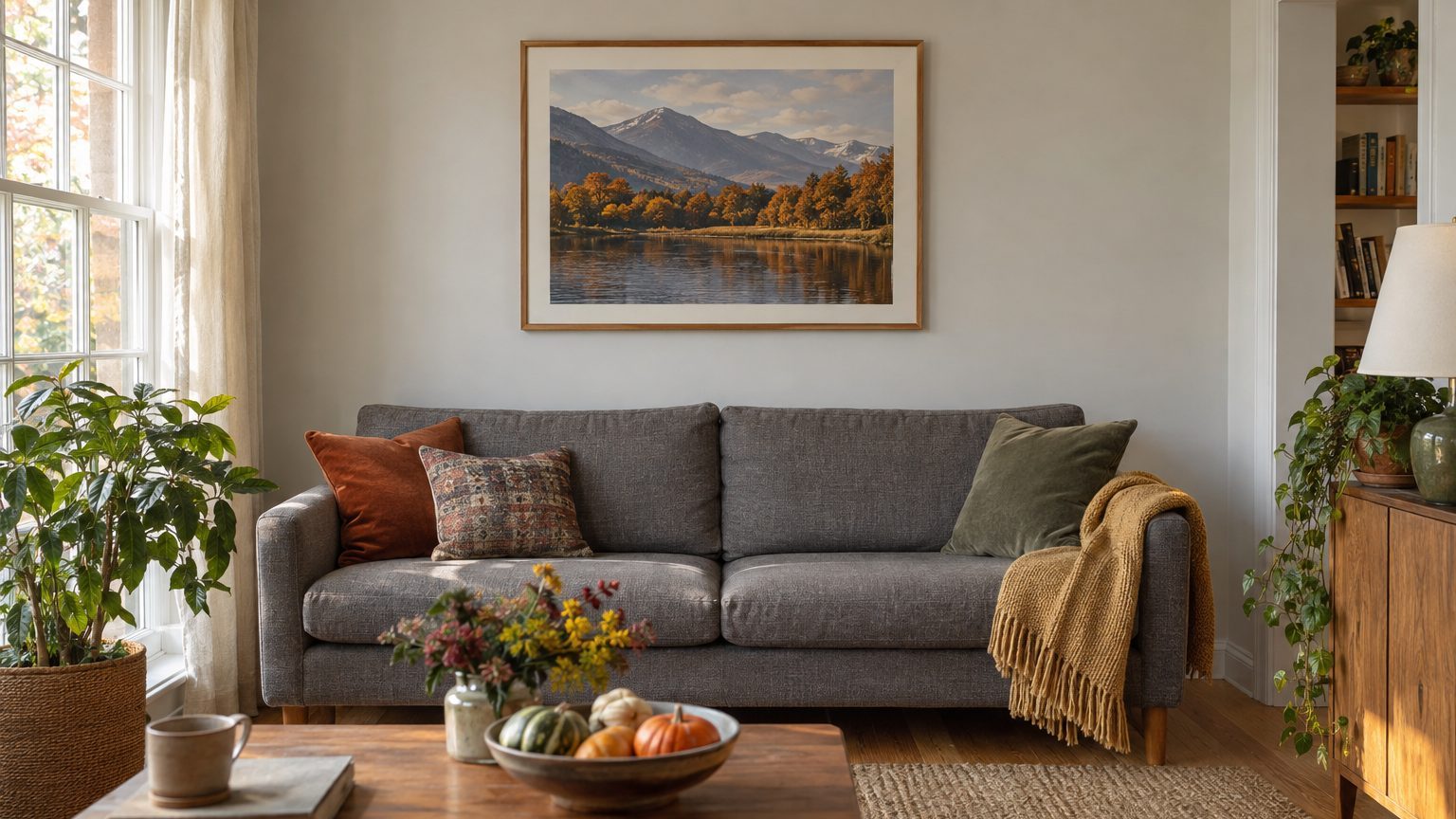
Leave 6 to 10 inches between the top of the sofa back and the bottom edge of the frame. Eight inches is the safe default, and it works in most living rooms.
Most people hang art too high.
The habit comes from a rule that is correct in the wrong place. Galleries and designers center artwork about 57 inches off the floor, close to average eye level, and that number works well in a hallway. Above a sofa it can leave a picture floating like a balloon that slipped its string. Here the gap between frame and furniture matters more than the distance to the floor.
- The bottom edge of a picture should sit 6 to 10 inches above the sofa back, with 8 inches as the safe default.
- Art spanning about two-thirds of the sofa’s width looks balanced.
- A wire hook sits a few inches below the frame’s top edge, so measure to the peak before marking the wall.
Where the bottom edge belongs
Advice varies a little. Some designers say 4 to 8 inches, others 8 to 10, and a few stretch to 12. The spread is narrower than it looks, because nearly everyone lands between 6 and 10, and anything past about 12 inches starts to feel disconnected from the sofa.
Run the numbers with a real sofa. Take a back that stands 32 inches tall and a frame 24 inches high. Leave 8 inches of space, and the bottom edge sits at 40 inches, the center at 52, the top at 64. That center falls about 5 inches below the gallery standard, and nobody walking in will notice.
Now apply the 57-inch rule to that same sofa. The frame’s bottom edge lands at 45 inches, which leaves 13 inches of bare wall above the cushions. The picture and the couch stop reading as one arrangement.
Test before you trust the tape measure.
Sit on the couch, lean back, and have someone mark where your head touches the wall. If the sofa is low, or your household runs tall, hanging closer to 10 inches keeps foreheads away from the frame.
When the room changes the math
Ceiling height shifts the answer. Under an 8-foot ceiling, 8 to 10 inches keeps proportions comfortable. A 14-foot ceiling can take 12 to 15 inches before the art feels crowded, and tall rooms tend to reward vertical prints or stacked pieces over one wide frame.
Sectionals and sofas with uneven backs complicate things. Measure from the highest point, since that’s where a head or a throw pillow will meet the frame first.
The same 6 to 10 inches applies over a mantel or console.
Going too low is the opposite error, and it’s easy to make when you’re nervous about holes. A frame crowding the sofa back gets knocked by cushions and makes the seating look squeezed. If you can’t decide, start at the low end of the range and move up if it feels tight.
Width matters as much as height
A perfectly placed frame that is too small still looks wrong. The usual guide is art spanning about two-thirds of the sofa’s width. On an 84-inch sofa, that means a piece, or a tight group of pieces, around 56 inches wide.
Groupings follow the same logic. Treat the whole cluster as a single piece and center it on the sofa. Keep about 2 to 3 inches between frames. A gallery wall above a couch adds personality when it’s done well, and the bottom row of the group keeps the same gap above the sofa as a single frame would.
Large blank walls offer another option, which is one big print or a triptych. Three matching panels read as a single unit, so the two-thirds guideline still holds, and the spacing between panels does the work a gallery wall would.
Mark the wall before you drill
Paper templates beat guesswork. Cut paper to the size of the frame, tape it up with painter’s tape, and live with it for a day. Walk past it at different times, because afternoon light in a Living Room can change how high a piece appears to sit.
A large frame hangs directly above people’s heads, so use wall anchors rated for its weight and find studs where you can. A lone nail won’t do.
One detail trips up even careful hangers: the nail rarely sits at the top of the frame. With a wire, the hook is usually a few inches below the top edge. On that 32-inch sofa, a 30-inch-tall piece hung with 8 inches of clearance tops out at 70 inches, so its nail goes at 66, a 4-inch drop. Pull the wire taut, measure from the top of the frame to the peak, and subtract that figure before you mark the wall.
Sources : thecalcs.com | buywallart.ca