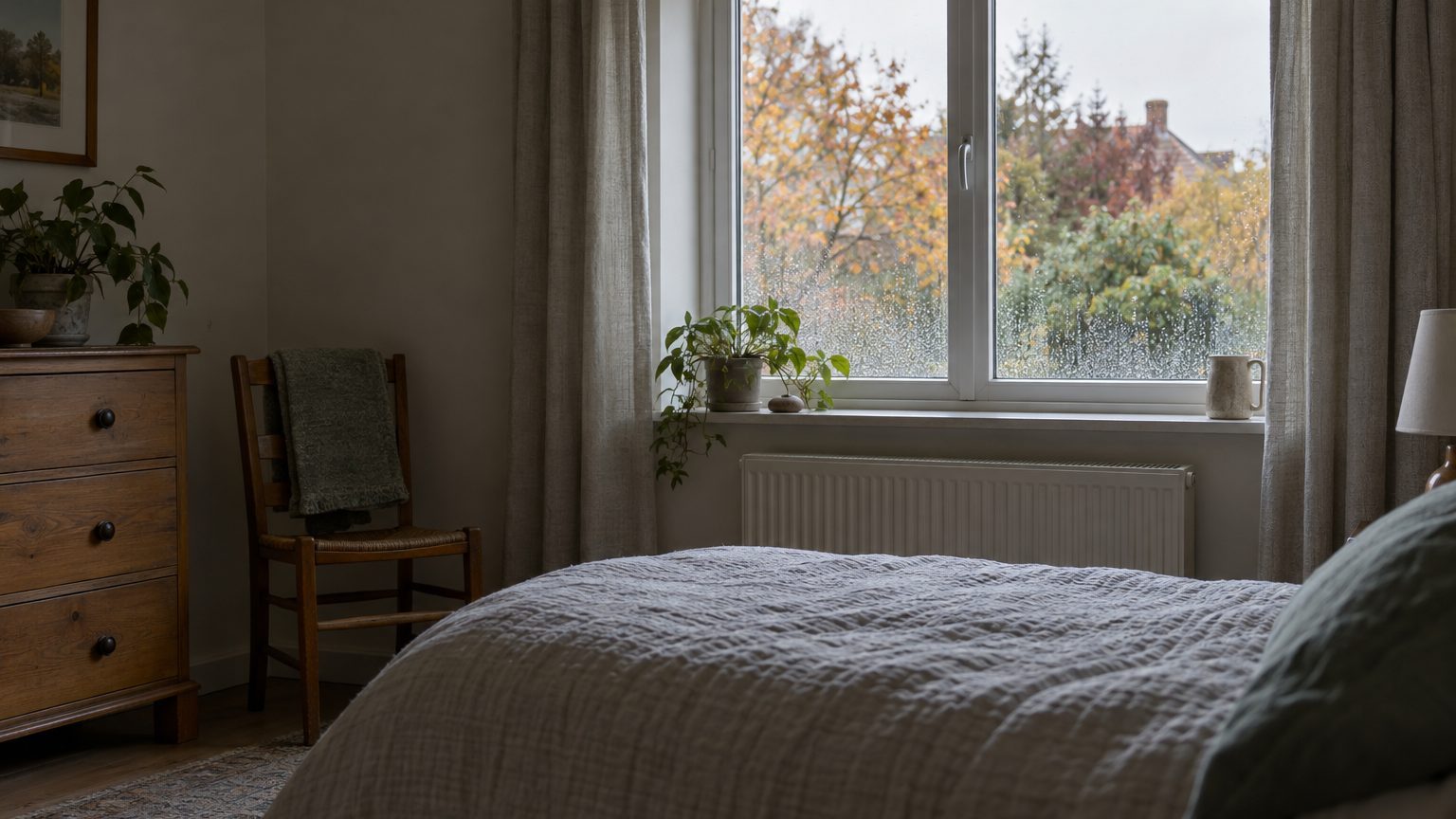
A sleeping adult releases roughly a pint of water into the air overnight, through breath and skin alone. In a closed bedroom, that moisture has nowhere to go but the coldest surface in the room, which is usually the window glass.
Wipe it off in the morning and it returns the next night.
Why the glass gets wet
Air holds moisture in proportion to its temperature. Warm air carries a lot; cold air carries far less. When humid bedroom air touches glass that sits below the air’s dew point, the excess vapor turns to liquid on contact. A window pane at 40°F next to room air at 68°F and 50% relative humidity is a textbook setup, since the dew point of that air is around 49°F.
Bedrooms are particularly prone to this because of how we use them. Doors stay shut for seven or eight hours, often with the heat turned down, and the only moisture source is the people inside. Add a pet, a second sleeper, or a damp towel draped over a chair, and the load climbs.
Single-pane glass is the worst offender. Its inner surface tracks the outdoor Temperature closely, so on a 25°F night it can drop well below the dew point of even fairly dry indoor air. Older double-pane units with failed seals behave similarly, and you can spot those by a permanent haze or droplets trapped between the panes.
Reading the clues before you buy anything
Where the condensation appears says a lot. A light film along the bottom edge of the glass is common and mostly a nuisance. Water streaming down the pane and pooling on the sill is a different story, because it soaks into wood, stains paint and feeds mold.
Check the corners and the window frame first. Black speckling in the lower corners, peeling paint, or a musty smell near the curtains tells you the moisture has been persistent for a while.
A cheap hygrometer, usually under $15, removes the guesswork. The EPA recommends keeping indoor relative humidity between 30% and 50%, and below 60% at the very least to discourage mold. Put one on the nightstand and read it at bedtime and again at wake-up. If it climbs ten points overnight, you have your answer about the source.
Outdoor temperature matters too. The colder it gets, the lower the humidity your home can tolerate before glass starts to sweat. Many people find that 40% is comfortable in November but too high in January, so the target moves with the weather.
Practical fixes, from free to fairly involved
Start with air movement. Cracking the bedroom door overnight lets moist air mix with the rest of the house, where it dilutes. Pulling curtains fully open during the day, and keeping furniture a few inches off the window wall, lets warm air actually reach the glass instead of leaving it as a cold pocket behind fabric.
Ventilation is the next lever. Opening a window for five to ten minutes each morning exchanges a large volume of damp air for dry winter air, which, once warmed indoors, has a very low relative humidity. It costs a little heat and saves a lot of moisture. Bathroom and kitchen fans matter here too, because vapor from a hot shower drifts into adjoining rooms if it isn’t exhausted outside.
Look at what’s adding water to the room. Humidifiers are the usual culprit in winter bedrooms, and plenty of people run them on high without ever checking a gauge. Drying laundry on a rack in the bedroom can release a gallon or more of water into the air over a day. Move either one elsewhere, or at least keep the door open.
Dehumidifiers work when ventilation isn’t enough.
A small desiccant or compressor model rated for a bedroom-sized space can hold humidity near 40%, and desiccant units tend to perform better in cool rooms where compressor types struggle. Expect to empty a tank every day or two at first. Place the unit away from walls so air can circulate, and run it for a few hours before bed rather than all night if noise bothers you.
Improving the glass itself
If the window is the weak point, raise its surface temperature. Window insulation film, the shrink-to-fit plastic kits sold at hardware stores, creates a sealed air layer over the glass and can make a noticeable difference for under $25 per window. Heavy thermal curtains help with comfort but can worsen condensation if they trap cold air against the pane, so open them during the day.
Weatherstripping and caulk matter more than most people expect. Drafts pull cold air across the frame, and gaps let humid indoor air reach cold cavities inside the wall, where it condenses out of sight. A tube of exterior-grade caulk and a roll of foam tape address both.
Replacement is the long game. Modern double-pane windows with low-e coatings and insulated spacers keep the inner glass much closer to room temperature, and ENERGY STAR-rated units are designed for exactly this. A full replacement runs into the thousands, so it makes sense only after the cheaper steps have failed or when seals are visibly broken.
When wet glass signals something bigger
Occasional light fog on the coldest mornings is normal. Persistent streaming, repeated mold on the frame, or humidity that stays above 55% despite your efforts points to a building-level issue. Tight, newly sealed homes often trap moisture because they lack adequate mechanical ventilation, and a heat recovery or energy recovery ventilator may be the proper fix.
Clean existing mold with a detergent solution and dry the area thoroughly. Small patches on a sill are a DIY job, but growth covering more than about ten square feet, according to EPA guidance, warrants professional help.
One last detail: condensation on the outside of a modern double-pane window in clear, cold weather is actually a sign the glass insulates well, because the outer surface stays cold while heat remains indoors.