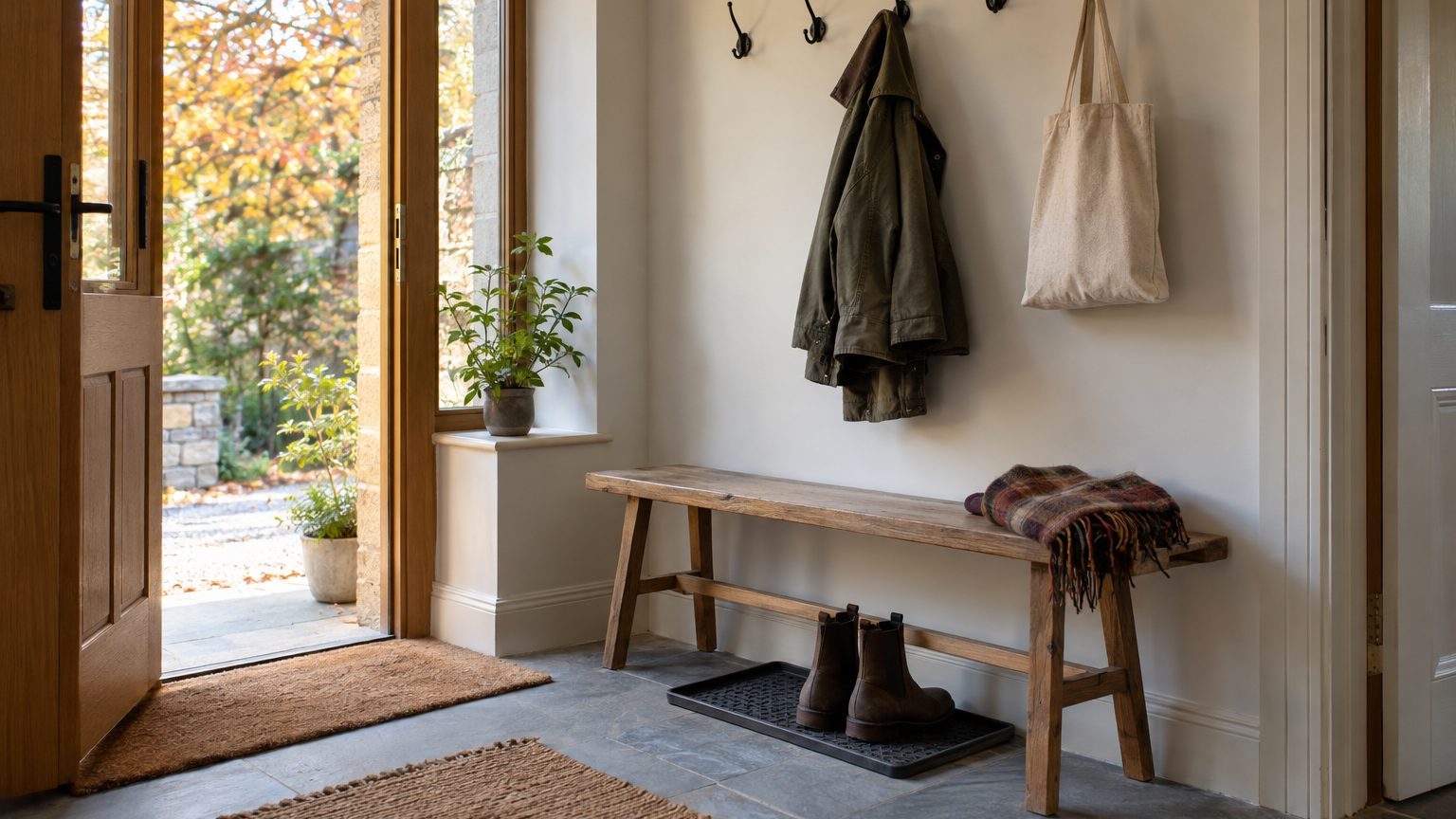
A mudroom doesn’t need a room. A 3-foot stretch of wall is enough for a slim bench, a couple of sturdy hooks for bags or coats, and a mirror to open things up. Most of the mudroom ideas for small spaces that work come down to that same short list, applied with discipline.
Start with the wall, not the furniture.
- A three-foot stretch of wall is enough for a bench, hooks and a mirror.
- A bench 12 inches deep still provides a seat with cubbies underneath.
- Over-the-door organizers can hold twelve to twenty-four pairs of shoes.
Build one wall that does three jobs
The most dependable layout stacks the functions vertically. Hooks go up top for coats and bags, a bench sits in the middle where you can actually pull boots off, and shoe storage tucks under or beside the seat. It works in entries where the wall is interrupted by a light switch, a radiator or a second door, because each tier takes only the space it needs.
Depth is where small entries are won or lost. A bench just 12 inches deep still gives you a seat, with cubbies underneath for footwear. An all-in-one hall tree typically projects 14 to 18 inches, which is a lot to ask of a hallway where two people already have to turn sideways to pass. Measure the walking path first, then choose the piece.
Hook height deserves more thought than it gets. Set the row high enough that a long coat clears the seat. If kids live in the house, install hooks at different heights so a second-grader can hang up a backpack without help, which is the difference between a system that runs itself and one you maintain by nagging.
Anchor anything tall to the wall.
Narrow, tall units look efficient, but tall and narrow also means tippy. A coat-laden hall tree on a hardwood floor, with a toddler nearby, is not a hypothetical risk. Wall anchors take ten minutes and settle the question.
Borrow space you already own
Look at the coat closet before you buy anything. Take off the door, swap out the rod and shelf, add a bench, install hooks at a few heights, and use the upper section for off-season storage. The closet becomes an open alcove that reads as larger, and the bench turns dead floor into a seat.
The front door itself is the next target. An over-the-door organizer with clear pockets can hold twelve to twenty-four pairs of shoes, plus hats, gloves, dog leads and chargers. A simple rack handles bags, umbrellas and the leash. Add a door stop so the knob never meets what you hung, and skip heavy hooks on a hollow-core door, which won’t hold them.
Your door is prime real estate.
Shallow beats deep in a tight entry. Cabinets around 10 to 12 inches deep hold daily gear without eating into walking space. A shaker peg rail projects only 3 to 5 inches, and a floating shelf for keys and mail needs 8 to 10. Those few inches, multiplied across a six-foot wall, decide whether you can still carry in groceries.
Plan for wet boots and the change of seasons
Mud arrives in November and February, and the entry has to cope with both. Floors and walls take the abuse first, which is why designers favor easy-to-clean flooring and panelling that protects the walls. A washable mat and a lipped boot tray cost little by comparison, and they keep meltwater from traveling into the rest of the house.
Sort storage by how often you reach for things. Keep everyday items between waist and head height, and send spare bags, seasonal coats and less-used kit higher up. In practice, that means the rain shell and the work tote live at hand level, while the heavy parka stays on the top shelf until the first hard freeze.
Rotate twice a year. When temperatures drop, swap sandals and sun hats upstairs and bring down mittens, scarves and insulated boots. In spring, reverse it. Ten minutes, two times a year, and the entry never silts up with gear from the wrong season.
Before buying anything, write down what actually piles up by your door. A household’s list usually covers coats, shoes, bags, keys, mail, hats and gloves, and sometimes pet supplies. Then match storage to the list. A family of four with two dogs needs leash hooks and a towel. A single commuter needs a key tray and one good umbrella stand.
One more trick: light and reflection. A mirror at the end of a narrow run doubles the sense of depth, and a plug-in sconce warms a corner that rarely gets daylight. Neither adds storage. Both make a cramped strip feel like a deliberate space, and people tend to keep tidy the places that look cared for.
On budget, the numbers are friendlier than you might expect. Slim hall trees with hooks, a bench and a shoe shelf were listed online at roughly $99 to $200, and some were under 24 inches wide. Prices shift by retailer and season, so treat that range as a starting point and compare before you commit.
Sources : urbannookcreations.com | hazleybuilders.com