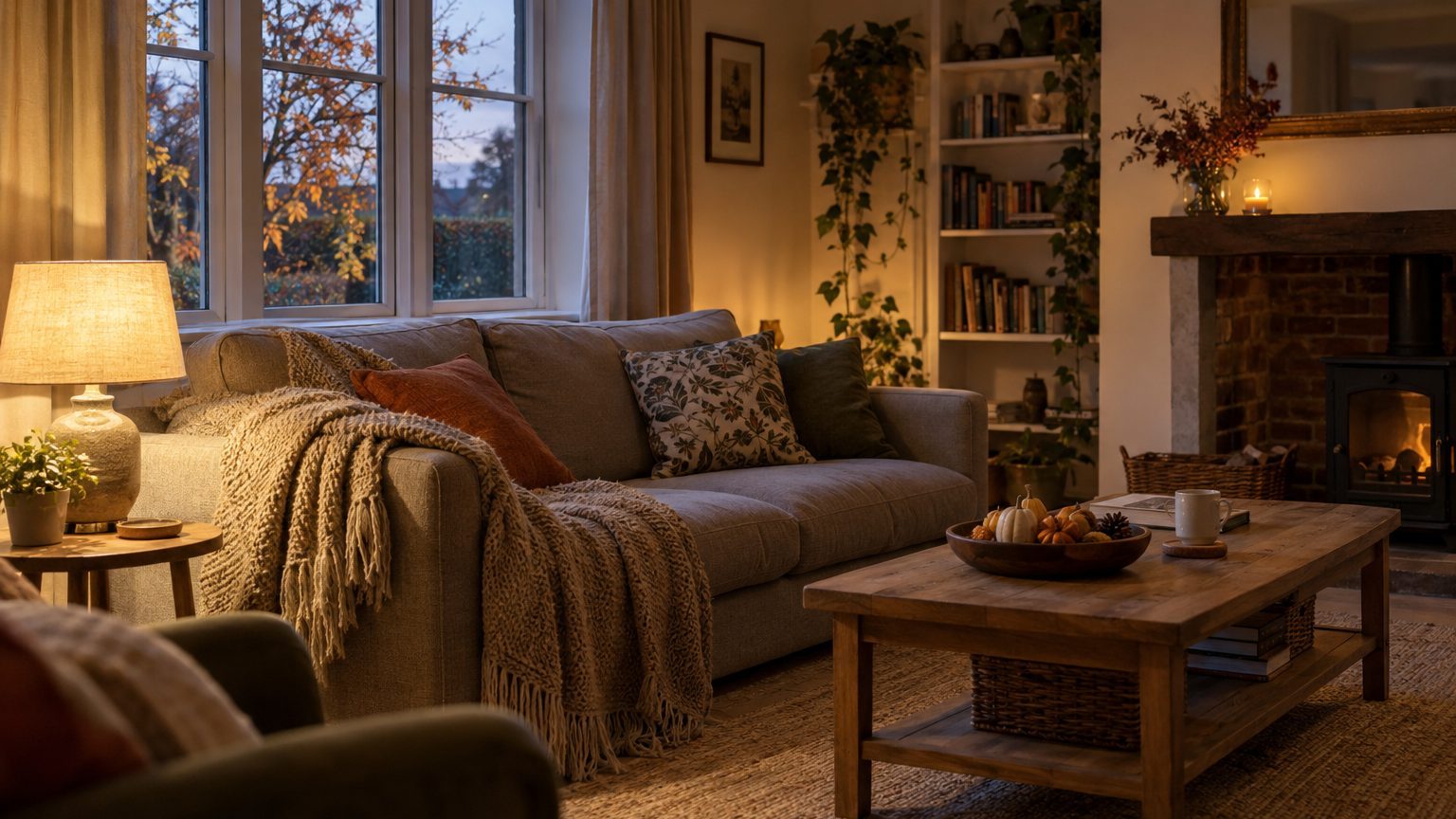
Most living rooms are lit by one ceiling fixture, and that is the problem. One lighting guide recommends five to 10 light sources at different heights, warm white bulbs (2700 to 3000K), and dimmers on the major fixtures. In winter, when dark arrives before dinner, that advice stops being decor trivia. It decides whether the room feels like a place to unwind or a waiting area.
The ceiling light should stop being the star.
- Warm bulbs between 2700K and 3000K mimic sunset and support evening wind-down.
- A dimmer on the overhead fixture is the cheapest upgrade in the room.
- Three light heights, overhead, eye level and hand level, make a room feel brighter and more comfortable.
Demote the overhead fixture, don’t delete it
Designers describe layered lighting as multiple light sources in the same space, each serving a different purpose. The ceiling fixture is the foundation layer, the one that lets you find the remote and cross the room without stubbing a toe. Daytime is easy because window light carries most of the load. After dark, the balance flips: evening lighting should lean on the task and accent layers, with the ambient layer turned low. A glaring overhead light at 6 p.m. in January works against every other lamp you own.
The fix is control. Lighting specialists suggest putting recessed lights on a dedicated dimmer circuit and decorative fixtures on a second circuit, which gives you independent command of the baseline and the accents. Renters who can’t touch the wiring have a workaround in smart bulbs, which save scenes such as a bright morning setting, a warm dim evening one, and a reading scene with the task light emphasized.
A dimmer is the cheapest upgrade in the room.
When you shop for replacement bulbs, size them by lumens rather than watts. One practical guide puts it bluntly: use lumens to size output, not watts. Watts measure energy consumed, and with LEDs that number has almost nothing to do with how bright the room will feel.
Let lamps do the real work at seating height
Floor lamps are the workhorses of a winter living room. They serve double duty as task and ambient light depending on placement and shade, and a spot behind or beside the sofa gives the best reading light. For rooms without much overhead light, one retailer’s guide recommends at least two floor lamps at opposite ends of the room so the glow spreads evenly rather than pooling in one corner.
Table lamps add the pools of light that make a room feel lived in. Warm-toned shades produce a candlelight-like glow, and a bulb around 40 to 60 watts equivalent keeps things comfortable rather than harsh. Reading is the exception to the cozy rule. The same guide advises cooler 3500 to 4000K in task lighting where you need to see clearly, though another recommends keeping the general warmth consistent within a single room so the bulbs don’t look mismatched. My own compromise: warm bulbs everywhere, and a task lamp aimed squarely at the page rather than a cooler bulb.
Think in three heights. A pendant or ceiling fixture sits overhead, a wall light or tall lamp at eye level, and a table lamp at hand level. This spread often works better than adding wattage to one fixture, and a layered room feels brighter and more comfortable even when each light is soft.
Add the accent layer that winter rooms miss
Accent light is what rescues a flat room. It can be a small spotlight on a piece of art, a sconce washing light across textured plaster, or a plug-in light tucked behind a plant. If the room still feels dull, one lighting guide suggests aiming that light at vertical surfaces like a textured wall, curtains, or built-ins. Lit curtains alone can make a window feel cozy instead of like a black mirror.
Outlets are the usual obstacle, and plug-in wall lights and cordless lamps get around them. A cordless lamp can add both task and accent light, depending on where it is placed. Park one on a console or bookshelf and the far wall stops disappearing at dusk.
Keep accents quiet, though. Accent light should usually be softer than task light, adding contrast and shape rather than overpowering the room. The most common error is making it as bright as the main source, which erases the very depth you were trying to create.
Then group everything into scenes.
One home-lighting guide offers a movie-night formula: ambient at 5 to 10 percent, a night path at 10 percent, and a single lamp at 20 percent near the sofa. Those numbers are a starting point, and your room will want its own. Write down the settings that feel right for reading, hosting, and TV, then recreate them with a smart bulb scene or just a habit of which switches go first.
Warm, then warmer: what evening light does to sleep
The living room is where most households spend the last hours before bed, so its bulbs matter more than the bedroom’s. Sleep-focused sources recommend warm light between 2700K and 3000K because it mimics sunset. One often-cited finding says Harvard researchers showed that people exposed to warm evening light fell asleep 19 minutes faster than those under cool light. Nineteen minutes is roughly one episode of a sitcom, handed back to you for free.
Color temperature alone doesn’t settle it. Some sources point out that even bulbs rated at 2700K still contain enough short-wavelength light to affect melatonin production at typical room brightness. That’s why dimming matters as much as the Kelvin number, and why lowering the overhead light, the brightest source in the room, helps more than swapping one warm bulb for another.
The research on young people adds a caution. In a study of 22 children and 20 adults, 6200K light suppressed melatonin more than 3000K light in children, but not significantly in adults. If kids share Your Living Room after dinner, that is one more reason to keep every bulb in the warm range once the sun is down.
Sources : wellnessmama.com | hitlights.com