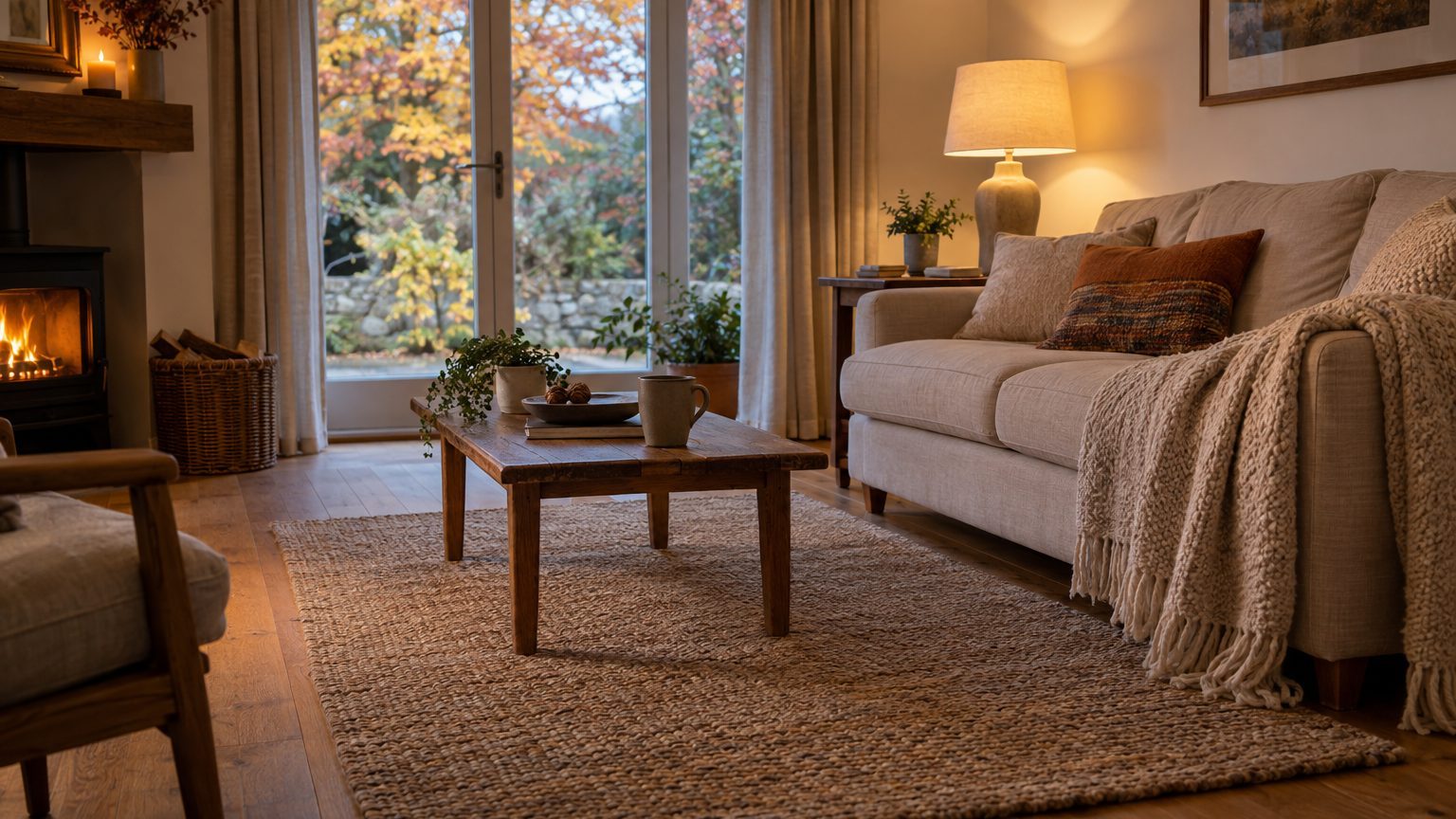
How to make living room cozy for winter comes down to three levers: light, textiles and layout. Design guides keep landing on the same conclusion, that lamps, rugs and blankets change a room more than new furniture does. That helps if you’re stuck with the sofa you have until spring.
Start with the light, because it’s the fastest fix.
- Bulbs at 2700K to 3000K give a warm amber glow that cool daylight bulbs cannot.
- A wool or wool-blend rug feels warmer underfoot than synthetic rugs at the same room temperature.
- Pulling seating closer together makes a conversation circle small enough for a normal speaking voice to carry.
Light that stays low and warm
Winter shortens daylight, so the living room runs on artificial light for most of its working hours. Designers advise using several smaller light sources instead of relying on one ceiling light. That means table lamps beside sofas and consoles, floor lamps near reading chairs, and wall sconces when floor space is short. A room lit from three or four points at different heights has depth, and a room lit from the ceiling alone has glare.
The bulb itself matters as much as the fixture. For living rooms, lighting guides consistently recommend 2700K to 3000K, and the lower end gives a softer, more amber glow similar to traditional incandescent lighting. Check the box before you buy, since “daylight” bulbs sit at 5000K and above and will make a winter living room feel like a dentist’s waiting area.
Harsh overhead light can flatten a room in seconds.
If your ceiling fixture is the only option, install a dimmer switch and swap in warm bulbs around 2700K. There’s a sleep angle too. Cooler light of 4000K and above suppresses melatonin, the hormone that tells your brain to wind down, so a bright cool living room at 9 p.m. works against the evening you’re trying to create.
Shades matter as well. Fixtures with matte finishes and fabric shades diffuse light gently, while hidden LED strips can help eliminate harsh shadows. Candles add a flicker that no bulb quite matches, though flameless versions are the smarter pick if pets or toddlers roam the room.
Textiles: layers, not piles
Begin at the floor, since the rug is the largest textile in the room. Wool has a real advantage here: wool and wool-blend rugs have natural insulating properties and feel warmer underfoot than polypropylene synthetics, even at the same room temperature. Size counts as much as material, and the rug should be large enough to anchor the furniture. A postage-stamp rug floating in front of the sofa does little for warmth or looks.
Next comes the sofa, which works best with a simple three-tier system. One design guide describes it as a base of mid-weight textured upholstery, a heavier throw folded loosely so the texture shows, and two or three cushions in contrasting materials and scale. A concrete combination: a velvet cushion with a knitted pillow and a simple linen cover. The contrast gives the sofa depth without making it look overdressed.
Rotate in one throw that does real work. A weighted or fleece-backed throw keeps you warm and not merely styled for it. Then keep the blankets visible and within reach, in a basket beside the sofa, because a throw buried in a closet never gets used.
Color deserves a quick audit. Several guides argue that winter is not the season for icy whites and cool grays, though you don’t need to repaint to fix that. Bring in deeper tones through cushions, blankets, artwork, vases, curtains or rugs, and if the walls and sofa are white or gray, natural wood and warm brown textiles make the space feel less cold.
Restraint is the other half of the job. Too many blankets, pillows, candles, baskets and decorative objects can make a room look cluttered, and a cluttered room doesn’t read as cozy to anyone but the person who bought the stuff. Three good throws beat nine mediocre ones.
Layout: pull the room inward
Summer living rooms tend to spread out, with seating pushed toward the walls and open floor in the middle. Winter calls for the opposite. Try to pull seating closer together, angle chairs toward the sofa and keep side tables within easy reach. The goal is a conversation circle small enough that a normal speaking voice carries across it.
Mix seat heights if you can. Designers suggest varied seating heights for visual interest, with furniture aligned to keep eye contact while preserving pathways. A low ottoman or a pouf beside a taller armchair breaks up the flat line of a standard sofa-and-two-chairs setup, and it gives tired feet somewhere to land.
One small zone can do a lot of the work. A reading corner follows a simple formula: one chair, one light source, one surface, one textile. Put a heavier wool throw over the chair arm, a lamp at shoulder height and a side table for the mug. Such a corner takes about twenty minutes to set up.
You can begin without spending a cent.
The advice from one recent guide is practical: rearrange the seating, move lamps closer to the sofa and gather your existing throws in one basket. Only then choose one warm textile or one rug instead of replacing several pieces at once. Renters have options as well. Tension rods, removable hooks and freestanding lamps let you add curtains and lighting without touching the walls or wiring.
A sensible order of operations
If you only have one weekend, the sequence below gives the biggest return first:
- Swap cool bulbs for 2700K to 3000K and add at least two lamps at seating height.
- Lay down a wool or wool-blend rug sized to hold the front legs of every seat.
- Layer the sofa with one heavy throw and cushions in three different textures.
- Pull the seating inward and place a side table within arm’s reach of every seat.
The order matters because each step makes the next one look better. A lovely knit throw under a 5000K ceiling light still looks like a showroom, and a warm-lit room with a bare floor still feels drafty. Do light and floor first, and the smaller touches have something to build on.
One nuance on bulbs: if the living room doubles as a late-night TV room, the base of 2700K can drop lower. Lighting guides suggest the hour or two before bed calls for warm, dim light in the 1800K to 2200K range, which smart bulbs and dimmers can handle without a second set of lamps.
Sources : quietminimal.com | roomwaves.com