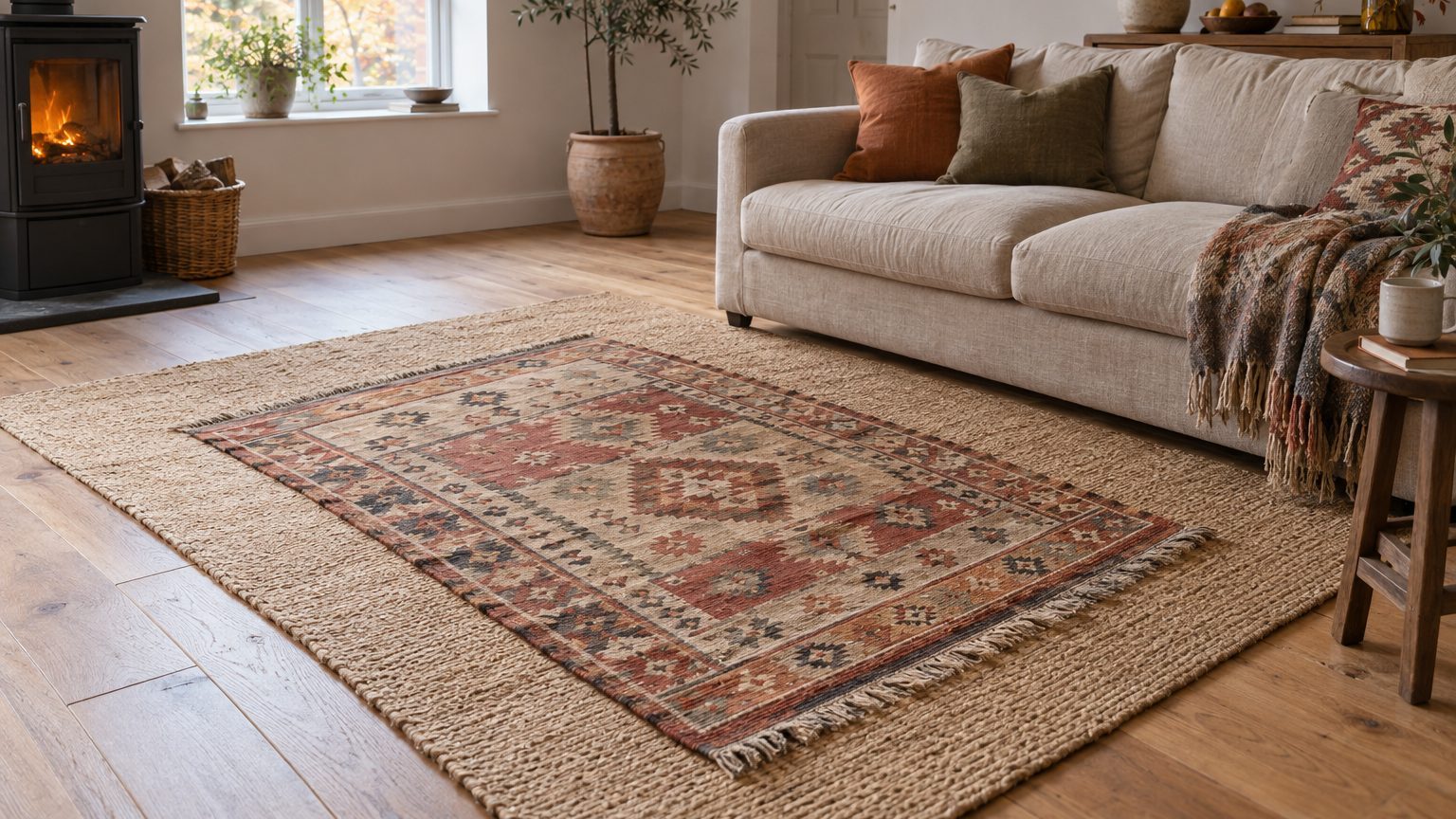
The classic formula for how to layer rugs is simple: the top rug covers roughly 60 to 70 percent of the base rug’s surface, leaving the base visible on all sides. That visible border creates the contrast that makes both rugs readable.
Everything else is refinement.
The appeal is practical as much as decorative. A vintage rug found at a flea market may be the wrong size, and layering it over a neutral area rug solves that. In an oversized room, a standard 8′ x 10′ rug on top of an extra-large sisal or jute rug makes the space feel cozier. And if you aren’t ready to commit to a bold rug, a smaller one on a neutral base lets you try the color first.
- The top rug covers roughly 60 to 70 percent of the base rug’s surface.
- A 9×12 base pairs well with a 5×8 or 4×6 top rug.
- Flat natural-fiber bases such as jute, sisal, seagrass and cotton are the most dependable choice.
Sizes that look intentional
Numbers help here. On a 9×12 base, a 5×8 or a 4×6 works. An 8×10 natural fiber rug with a 5×8 kilim on top often looks balanced, while a 9×12 base with a 3×5 top rug can look too small unless you treat it as a clear accent area. Designers also talk in margins: at least 12 to 18 inches of base showing on each side, though one guide allows as little as 6 inches.
Bedrooms follow the same logic. The bottom rug should extend beyond the edges of the bed, while the top rug is smaller and centered in front of it.
The base is where most people go wrong. A base rug that’s too small makes the whole setup look like it’s floating.
In a living room, anchor the base to the furniture. Lay it so at least the front two legs of your sofa sit on it, and put the top rug centered under the coffee table. Then break the symmetry a little. A top rug perfectly squared on the base reads like a showroom display, while one offset toward the seating or set at a slight angle looks deliberate.
Materials: flat under plush
The most dependable base is a flat, natural-fiber rug. Jute, sisal, seagrass and cotton are widely considered the best choices because they’re flat, durable and neutral, so the top rug sits evenly. They also tend to cost less, which makes sense for a layer that will be largely covered. Spend your budget on the rug people will actually see.
Pile height is the rule that can’t bend. Put flat under plush, never plush under anything, because a thick base makes everything above it unstable and lumpy. A too-poufy rug stacked on an already thick base can become a tripping hazard or leave furniture off-kilter. I’d add a seasonal angle: in winter, a wool or high-pile top layer over cool jute gives your feet a soft landing without turning the whole floor into a shag pit.
For the top rug, a vintage-style Persian, a hand-knotted wool piece, a kilim or a high-pile accent rug all layer well. The contrast is the point. A soft, fuzzy top rug over a natural-material base gives you a pairing of soft and coarse textures that complement each other.
Patterns need a referee. If one rug is loud, the other should be quiet. Pair a large-scale pattern with a smaller, subtler one, or with a tone-on-tone texture. Whatever you choose, the rugs should share at least one anchor color that ties them to the room’s palette. Warm and cool undertones should agree too.
Stop at two layers.
The temptation to add a third is real, especially with a bare-looking arrangement, but adding a third full-size rug breaks down the proportions. If the setup feels flat, a natural-fiber runner or a sheepskin throw over the top rug adds texture without adding another competing rectangle.
Keeping the stack flat and safe
Two rugs slide more than one. Put a non-slip pad between the base rug and the floor, and a thinner gripper pad between the two rugs if the top one tends to shift. One guide recommends sizing the pad 1 inch smaller than the base rug on all sides so it doesn’t show. Skip this step and you’ll be straightening the top rug every time someone walks across it.
Weight matters as well. A top rug should be heavy enough to sit flat on its own, because very lightweight rugs tend to buckle and curl at the corners, especially on higher-pile bases. Before you buy, pick up a corner. A flimsy accent rug that curls in the store will curl at home.
Test the whole arrangement before the furniture goes back. Walk across it, drag a foot over the edge of the top rug, and look at it from the doorway. It should look like one designed moment, not two separate rugs.
The same logic extends outdoors. For a patio, use a larger, durable base and a smaller decorative top rug, and choose UV-resistant materials that are easy to hose down. Polypropylene and recycled plastic are the workhorses for that job.
Sources : giantfloor.com | atlantadesignerrugs.com