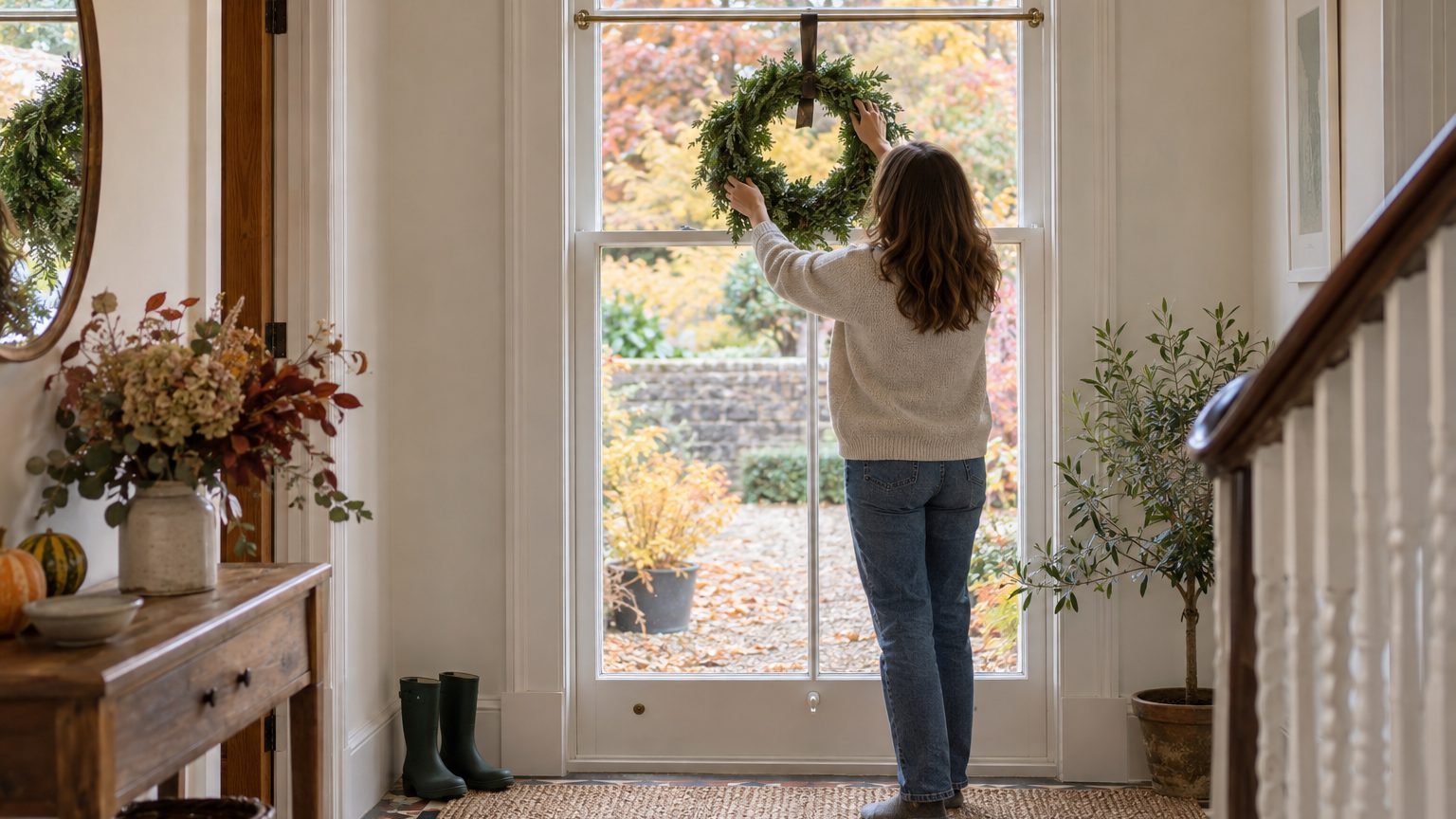
You can hang a wreath on the inside of a window in about five minutes, and you don’t need a hammer. A tension rod, a loop of ribbon over the top sash, or a suction hook on the glass will each do the job. The right one depends on your window type and your wreath’s weight.
Skip the nails.
Match the method to the window you actually have
Start by looking at how your window opens. A double-hung window makes it easy: pull the top sash down and hang the wreath with a piece of ribbon. A deep frame, common in older houses and in many modern vinyl windows, suits a spring-loaded rod. Fit a small tension rod across the top of the frame and hang the wreath from it with ribbon. A fixed pane that never opens leaves you with the glass itself.
For that fixed pane, a magnetic hanger or a heavy-duty suction cup grips the glass without any frame access. Adhesive hooks also work on smooth surfaces. They suit a wreath you want sitting flush against the window. If you have blinds or curtains, hang the wreath on a ribbon or fishing line from a hook above the frame, so the wreath clears the fabric.
Weight settles the question faster than looks do. Adhesive and suction hooks carry a rated load printed on the package, and a real evergreen wreath with pinecones and berries weighs more than it looks. One retailer’s outdoor-rated window hooks, for example, are listed at 2 pounds for the medium size and 4 for the large. Weigh your wreath on a kitchen scale, then pick a hook rated well above that number.
Heavy wreaths belong on a rod or a ribbon.
Size matters too, and most people get it wrong. A wreath covering roughly half to two-thirds of the window width frames the glass instead of swallowing it. Go bigger and the room loses daylight in the shortest weeks of the year.
Three setups, step by step
The tension rod is the one I’d reach for first. Measure the inside width of the frame and buy a rod that fits. Tie a ribbon through the wreath, slip the rod through the knot, then push the rod all the way to the top and back of the window. The rod presses against the frame, so nothing gets drilled and nothing gets scratched. Pressure mounts can slip on slick painted trim, so give the rod a firm tug before you let go of it.
The ribbon-over-the-sash approach costs almost nothing. Cut a length of ribbon about twice the drop you want, plus a little extra for the knot. Loop it through the back of the wreath and tie the ends together. Then lower the top sash, drape the ribbon over it, and raise the sash again to pinch it in place. If you’re hanging several wreaths, cut every ribbon to the same length first so they hang evenly.
That sash trick has one catch. A ribbon trapped in the track can keep the window from closing tightly, which matters in January when you’re fighting drafts. Use a flat, thin ribbon, not a bulky bow, and test that the sash still locks. If you can feel cold air coming through where the ribbon sits, switch to the rod.
Suction cups and adhesive hooks take the least effort. Clean the glass with rubbing alcohol first, because fingerprints and window-cleaner residue ruin adhesion. Press the hook flat for the time the instructions say, which is usually around 30 seconds, and wait before hanging anything. Then hang a lightweight wreath on it. When the season ends, you pull the tab and the hook typically lifts off without damage to the surface.
Fishing line deserves a mention for the floating look. Clear line works well if you have an interior curtain rod to anchor to. The wreath seems to hover in front of the glass, and from across the room the line disappears.
Keep it from swinging, scratching, or dripping
Wreaths wobble. A warm radiator under the window pushes rising air against the wreath, and every time someone opens the door, the whole thing sways and taps the glass. Small pieces of clear fishing line can tether the bottom of the wreath to the window frame or a nearby sill. One short loop at the bottom is usually enough to hold it still.
Protect the glass at the contact points. Wire frames, floral picks and stiff twigs can leave fine scratches, particularly when the wreath rubs back and forth. Small pieces of felt or foam glued to the back of the wreath where it touches the window act as a buffer. Craft stores sell self-stick felt dots for furniture legs, and those work just as well.
Fresh greenery brings its own problem. Cold glass in winter collects condensation, and a damp wreath sitting against it can drip onto the sill, stain painted wood, or leave a film on the pane. Hang a real wreath an inch or two away from the glass, not flat against it, and wipe the sill every few days. Artificial wreaths skip this issue completely, which is a good reason to choose one for a bathroom or kitchen window where steam is a daily fact.
Light is the payoff of hanging indoors. A wreath on the inside of the glass can be paired with interior lighting to create a glow at night. A warm-white lamp on a nearby shelf or a battery string woven through the greenery does the work, and no extension cord has to snake out into the weather. Battery lights with a timer are the easy choice, since you won’t need to remember to switch them off.
Interior hanging also protects the wreath. Delicate wreaths hold up better when they sit behind a protective layer, with hardier ones saved for spots with no overhang. A window pane counts as that layer, so the dried hydrangeas and silk flowers you’d never trust outside can sit safely indoors.
Check the wreath after the first night. If the rod has crept sideways or a suction cup has let go slightly, you will see it by morning, and a fix takes thirty seconds. Past that first night, most setups stay put until you take them down in January.
Sources : windowworldtricities.com | homeadvisor.com