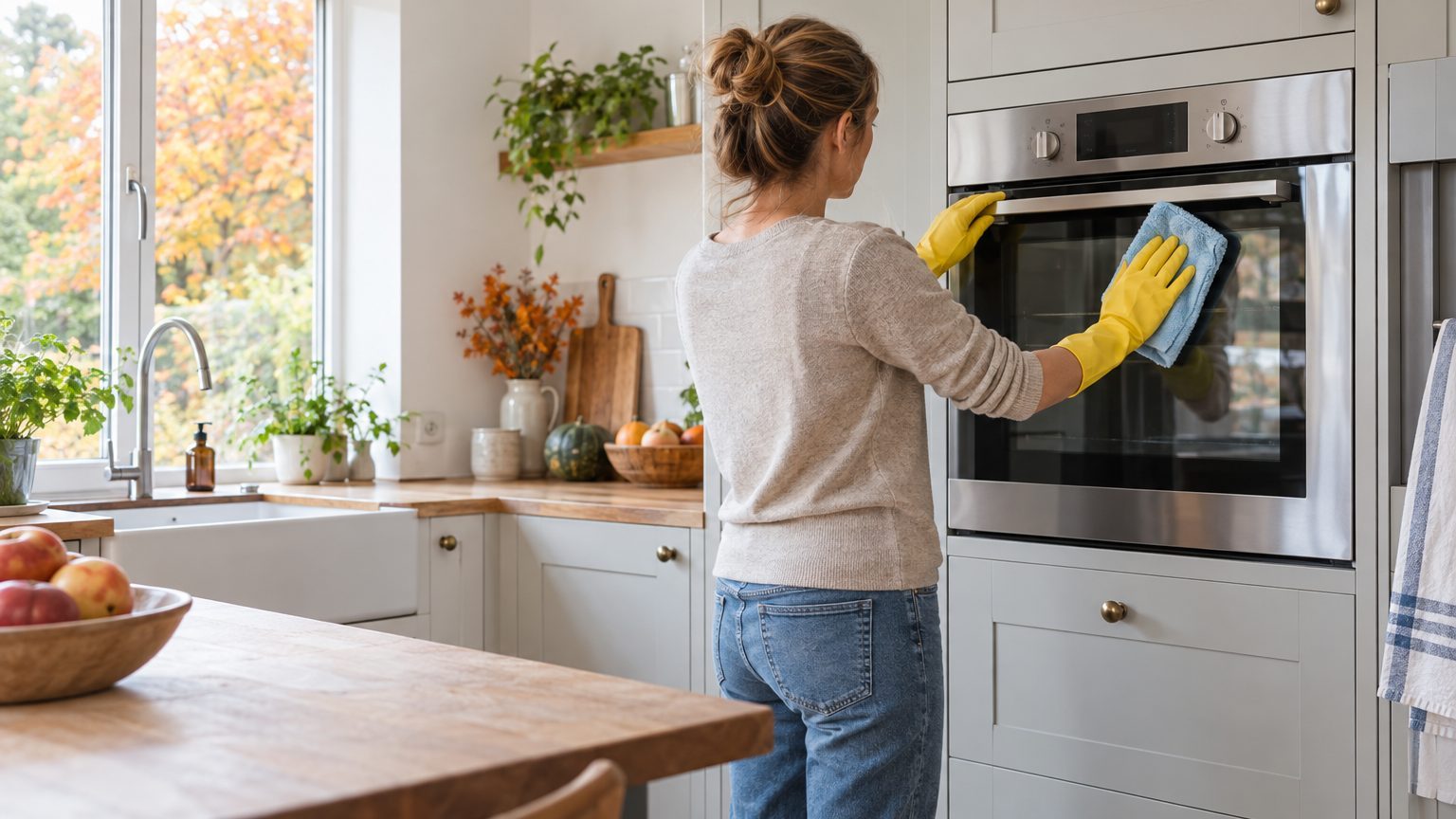
Most oven doors are built from two panes of glass, sometimes three, and the brown haze you notice while the roast cooks often sits in the gap between them. Wiping the outside does nothing for it. Clean glass takes two stages: scrub the surfaces you can touch, then reach the cavity, either through the vent slots or by taking the door apart.
- Oven glass clouds because grease and steam bake onto the inner window each time the oven runs.
- A baking soda paste left for 20 minutes to an hour loosens baked-on residue without scratching.
- A microfiber cloth on a stick can reach the gap between panes through the vent slots.
- Metal blades and scouring pads permanently scratch oven glass.
Why oven glass clouds over in the first place
Sugar, sauce and starch land on the warm inner window and bake again every time the oven runs. That repeated heat drives off moisture and leaves a darker, stickier film, which a damp rag tends to smear instead of lift.
The outer pane has an easier life. It meets far fewer spills than the inner glass, so light smudges usually give way to a spritz of white vinegar or lemon juice and a dry microfiber cloth. Between the panes, the culprit is usually grease vapor and steam drifting in through the vent slots, then settling as a thin brown film that gets thicker with every casserole. Nothing in your normal wipe-down routine reaches it.
Start with a completely cool oven.
Lay old towels on the floor in front of the door to catch drips. You will also want a few clean microfiber cloths, a spray bottle, a bowl for mixing, and a plastic scraper or flexible spatula. Skip the metal blades and scouring pads, because glass scratches more easily than people expect, and a scratch is permanent.
How to clean oven door glass you can reach: the baking soda method
Baking soda does the heavy lifting here, and it does it without scratching. Mix roughly half a cup with two to three tablespoons of water until you have a thick paste, one that clings to vertical glass without running into the seams or vents. Spread it over the stained areas with a brush or spatula.
Then wait. Light residue needs about 20 minutes, while thick, baked-on grease may need an hour or more. If a spot refuses to soften, lay a warm, damp cloth over the paste for a few minutes before you wipe. The soaking is the whole trick, because it replaces scrubbing with patience. Use the plastic scraper only to lift crusty edges, never to grind at the glass.
Vinegar comes last, not first. Add too much at the start and it neutralizes the paste before the paste has done anything. Once most of the paste is wiped off with a damp cloth, mist the glass lightly with white vinegar. The fizz is normal, and it helps loosen the last gritty traces. Rinse your cloth often, since a dirty cloth just moves residue around.
Buff dry with a fresh cloth.
That final pass is what separates clear glass from streaky glass. Keep the cloth damp but never soaked, and keep liquid away from the vents, the gasket and the control panel. If you would rather use a commercial oven spray on the inner window, read your manual first, because some manufacturers restrict harsh chemicals near the glass and seals.
Reaching the gap between the panes
Here is where people get ambitious and regret it. Some manufacturers discourage opening the door, and taking it apart on your own can void the warranty, so treat disassembly as the last resort rather than the first move.
Try the slot method first. With the oven off and cool, remove the bottom drawer if your model has one, get down on the floor, and look up under the door for a narrow opening between the panes. Wrap a microfiber cloth around a yardstick, a thin flexible duster handle or a straightened wire hanger, and secure it tightly with rubber bands. Dampen it with soapy water or a half-and-half water and vinegar mix, then slide it in gently. Never force it, and take care around the seals. Skip paper towels, which shed lint inside a space you cannot easily get back into.
Sometimes the slots are too narrow, or there are none, and the door has to come off. Manufacturer instructions for many ranges describe the same basic move: close the door until it sits about three inches open, roughly a 75-degree angle, then lift it up and out until both hinge arms clear their slots. Wear sturdy work gloves, because the door is heavier than it looks. Lay it handle side down on a thick towel set on a table or the floor.
With the door flat, work the damp, cloth-wrapped stick through the opening at the bottom. Wet the stains thoroughly and let the soapy solution sit for two to three minutes before you scrub. Rinse with a clean wet cloth until no soap film remains, then dry with a lint-free cloth. Hang the door back the same way you removed it, one hinge arm at a time, making sure each is fully seated.
Some ovens ask for more. Their doors are held together with screws, and getting at the glass means separating the front and back of the door. If yours does, keep the screws in a small dish and support both panes the moment the panel comes free, since loose glass slips quickly. A second person makes the job safer, and so does a quick read of the manual for your exact model.
Never rush this part.
Keeping the glass clear between deep cleans
A quick glance after each meal catches splatter while it is still soft. Wipe the inner window once the oven has cooled, and the baked-on film never gets a chance to form. A liner on the oven floor catches drips that would otherwise burn and send grease up toward the door.
One last point in favor of the baking soda route: poison control specialists list it as a non-toxic alternative to commercial oven cleaners. Even so, wipe away every trace of residue before you turn the oven back on, because leftover powder can scorch and leave a new haze behind.
Sources : lilicooks.com | bakeitgood.com