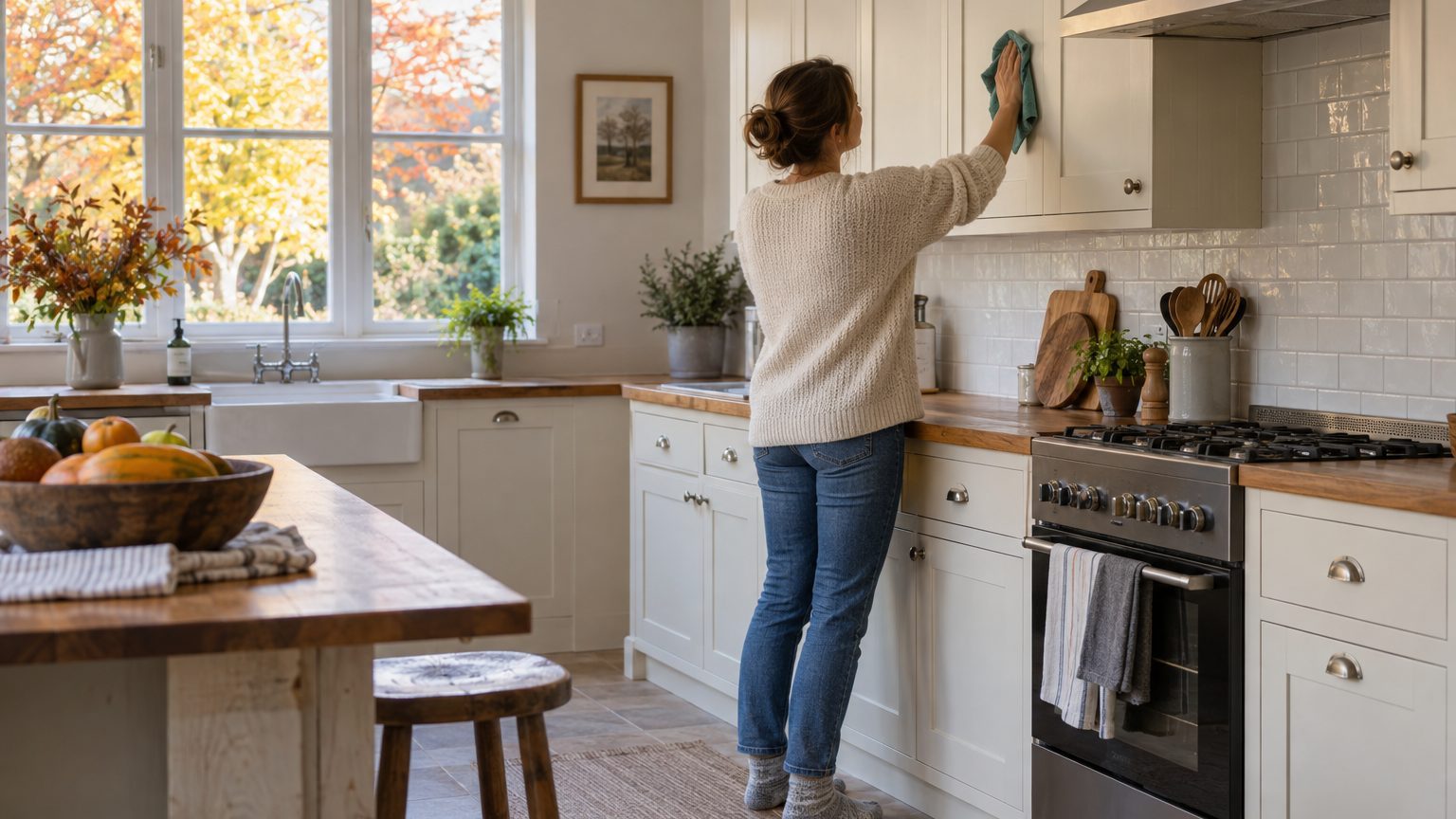
Grease on kitchen cabinets is rarely a spill. It is a slow film of airborne cooking oil that settles, bonds with dust, and turns tacky within a few weeks. The cabinets nearest the stove, especially the doors and the area around the handles, collect the most.
The fix depends on the finish. A method that works on laminate can dull a painted door or strip the sealer from old wood.
Start with the same prep, whatever the finish
Dry-dust first. Wiping a greasy door with a wet cloth smears the dust into a paste, so run a dry microfiber cloth or a soft brush over the surface and along the edges of any panels.
Then test. Pick a spot you rarely see, such as the inside edge of a door or the underside of a bottom rail, and try your cleaner there. Wait until it dries completely, because some finishes only show cloudiness or color transfer once the moisture is gone.
Warm water and a few drops of dish soap are the baseline for every surface. Dish detergents are formulated to break down oils, and they are gentle enough that you can use them again and again without harming most finishes. Use two cloths, one damp with soapy water for cleaning and one damp with plain water for rinsing, and keep both wrung out well.
Never soak a cabinet.
Water that lingers at seams, hinges and the bottom edges of doors is what lifts veneer, swells particleboard and darkens wood. Work in small sections, wipe, rinse, then dry immediately with a clean towel. A cabinet that feels damp to your palm a minute later has had too much water.
Painted cabinets: gentle chemistry, light pressure
Paint is the most vulnerable finish, particularly if it is a matte or chalk-style product, or if the cabinets were painted without a hard-curing topcoat. Scrubbing a flat finish can leave shiny patches, a bit like rubbing a pencil mark with the wrong eraser. Glossier, enamel-type paints tolerate more.
Begin with the soapy-water method using a soft cloth, not a sponge with an abrasive side. If a sticky layer remains after one pass, don’t scrub harder. Let the soapy cloth rest on the spot for about 30 seconds so the detergent has time to loosen the film, then wipe again.
For stubborn buildup, a paste of baking soda and water can help, but apply it with a damp cloth and almost no pressure. Baking soda is a mild abrasive, and on a satin or matte paint it can still burnish the surface. Test it first, and if the test spot looks even slightly different, stay with soap and patience.
Skip ammonia-based sprays and heavy degreasers on paint. Many are made for ovens and range hoods, and they can soften latex paint or pull pigment onto your cloth. If the cloth comes away with color, stop.
Wood cabinets: protect the finish, not just the grain
Most wood cabinets are not bare wood. They carry a varnish, lacquer or polyurethane coating, and that coating is what you are cleaning. When it is intact, soapy water works well, and you should wipe along the grain rather than across it so residue doesn’t settle into the texture.
Distilled white vinegar diluted with water is a common household option, usually about equal parts, and it cuts light grease nicely. But acid and a worn finish are a poor pairing. Use it sparingly on sealed wood, never let it sit, and avoid it altogether if the finish looks cracked, hazy or thin near the handles.
Older cabinets often have a built-up layer of grease, cooking residue and wax that has hardened over years. In that case, a commercial wood-cleaner or a product designed to remove wax and oil buildup is a safer choice than escalating to harsher household chemicals. Follow the label, and work on a small area at a time.
Finish the job with a dry towel, then, if the wood looks dull, a small amount of furniture polish or cabinet conditioner. Apply it to the cloth rather than the door. A thin coat is enough, and a heavy one just attracts the next round of kitchen dust.
Laminate and thermofoil: tough surface, delicate seams
Laminate is the most forgiving surface in the kitchen. The plastic layer resists oil, moisture and most household cleaners, so soapy water or a diluted vinegar solution will usually do the work. A nonabrasive scrub sponge can handle sticky spots, and a baking soda paste is acceptable on smooth, standard finishes.
The weak point is not the face of the door but its edges. Laminate is bonded to a core of particleboard or MDF, and when water creeps into a seam or a chipped corner the core swells and the surface begins to peel. Keep your cloth damp, not wet, and dry along every edge.
Thermofoil, a vinyl film that is heat-molded over a fiberboard door, is stricter. Heat from a nearby oven or a dishwasher venting steam can make it bubble, and strong solvents can cloud it. Mild soap and a soft cloth are the right tools here, and abrasive pads should stay in the drawer.
High-gloss laminate shows every streak.
For a clear finish, wipe with a cloth lightly dampened with plain water after cleaning, then buff with a dry microfiber cloth. Fingerprints and streaks usually come from leftover soap, not from leftover grease.
Keeping the film from coming back
A monthly wipe of the cabinets above and beside the stove takes about ten minutes and prevents the buildup that demands heavy cleaning. Grease that has sat for a week comes off with a damp cloth, while grease that has sat for a year can need three rounds of cleaner and a lot of patience. Cooking with the range hood fan on, and running it for a few minutes after you finish, captures a good share of the airborne oil before it reaches the doors.
Check the hood filter too. Metal mesh filters are often dishwasher-safe, and a clogged one stops pulling air effectively, so the oil goes to your cabinets instead. Cleaning it every month or two is one of the cheapest ways to protect every finish in the room.
Also check the hardware. Knobs and pulls collect the greasiest fingerprints, and a cotton swab dipped in soapy water reaches the crevices around them that a cloth misses.
One last detail: if a cleaned door still feels slightly tacky, the film is probably polymerized oil, which has chemically hardened and no longer wipes away like fresh grease. Repeat the soap step with a longer dwell time rather than switching to something stronger, since that is how most cabinet damage begins.