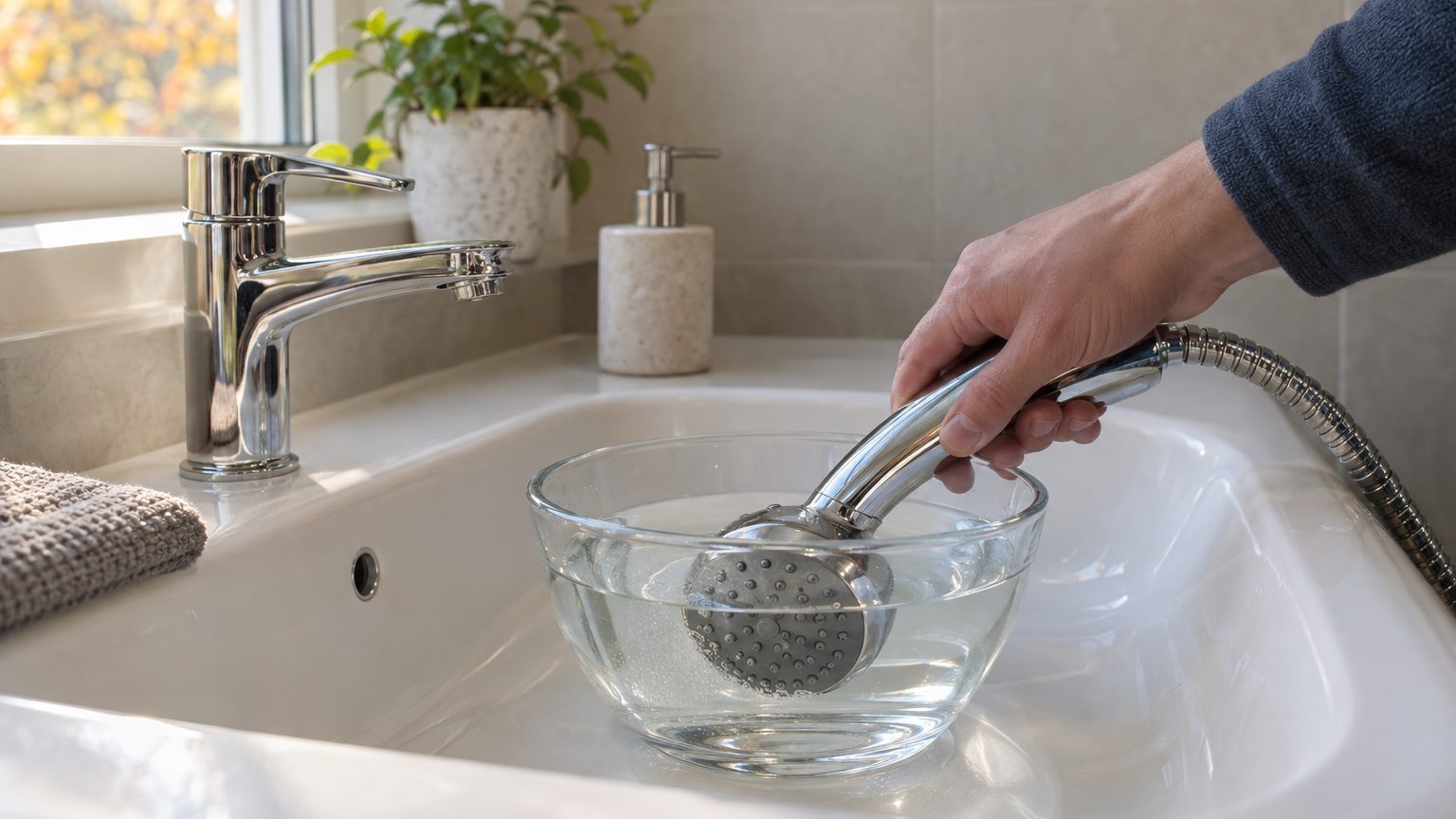
A shower head clogged with mineral scale can lose a noticeable share of its flow, and the fix usually costs less than a dollar: white vinegar, a plastic bag, and about an hour. The method differs slightly depending on whether you can unscrew the head or not, but the chemistry is the same in both cases.
Hard water leaves calcium carbonate behind as it evaporates. Vinegar’s acetic acid dissolves it.
Why shower heads clog, and why it matters
More than 85 percent of American homes have hard water, according to the U.S. Geological Survey, which defines it as water carrying meaningful levels of dissolved calcium and magnesium. Every time the shower shuts off, a few droplets stay in the nozzles and dry out. Over weeks, those chalky rings narrow each hole until the spray splits sideways, sputters, or dwindles to a dribble.
Scale isn’t the only tenant. The damp interior of a shower head can host biofilm, a slimy layer of bacteria that forms on wet surfaces. Researchers at the University of Colorado Boulder, in a study of shower head biofilms across the U.S., found that some contained Mycobacterium avium, a group of bacteria that can bother people with weakened lungs or immune systems. For most healthy people it is a non-issue, but a regular descaling does no harm.
Plan on cleaning every one to three months in hard-water areas.
If your water is soft or you have a filter, twice a year is plenty. The signal to act is simple: uneven spray, white crust around the holes, or water that squirts off at odd angles.
The removable method: a full soak
If the head unscrews, this is the better route, because the vinegar reaches every surface. Turn the head counterclockwise by hand first. If it resists, wrap it in a dry cloth (to protect the finish) and use an adjustable wrench with gentle pressure. Check the rubber washer inside the connection, since it tends to fall out and vanish down the drain.
Fill a bowl or pot with enough white vinegar to submerge the face of the head. Distilled white vinegar at the usual 5 percent acidity works fine, and there’s no need to buy “cleaning vinegar” unless you already have it. Soak for 30 minutes to an hour for light buildup, and up to eight hours or overnight for heavy crust. Warming the vinegar slightly speeds things up, but don’t boil it.
After soaking, scrub the face with an old toothbrush, working into each nozzle. Poke any stubborn hole with a straight pin or toothpick (not a metal skewer, which can scar the openings). Rinse under running water, reattach with fresh plumber’s tape on the threads, and run the shower hot for a minute to flush loosened grit.
Never leave brass, nickel, or gold-tone finishes in vinegar for hours.
Acid can strip or dull plated and “living” finishes such as oil-rubbed bronze. For those, limit the soak to 15 or 20 minutes, or check the manufacturer’s care instructions. Chrome and stainless steel generally tolerate longer exposure, and plain plastic faces handle it without trouble.
The fixed method: the bag trick
Some heads are stuck to the arm by corrosion, or installed so tightly that forcing them risks cracking the pipe fitting inside the wall. Don’t fight it. Pour vinegar into a sturdy plastic bag (a gallon-size freezer bag is about right), lift it up so the shower head sits fully in the liquid, and secure it around the pipe with a rubber band, twist tie, or strip of tape. Make sure the nozzles are covered and the bag isn’t leaking.
Leave it for one to two hours. For heavy scale, some people go overnight, though the same finish warning applies: plated surfaces deserve a shorter stay. Remove the bag, run hot water for a couple of minutes, and wipe the face with a cloth or brush.
A bag that sags tends to drag the vinegar level down, leaving the top half of the head dry. Prop the bottom with a small cup or a folded towel on a shelf if needed, or switch to a smaller bag that hugs the head more closely.
Here’s a point worth knowing before you start: vinegar won’t help with every kind of buildup. If the grime is orange or brown, you may be dealing with iron deposits, which respond better to a citric-acid cleaner. Black spots near the rubber nozzles are often mold, and a diluted bleach wipe or a dedicated bathroom cleaner handles those better, applied separately and never mixed with vinegar, since combining the two can release chlorine gas.
Keeping it clear longer
Silicone-tipped nozzles, found on many modern heads, are the easiest to maintain. Rubbing them with your thumb after a shower flicks off new deposits before they harden, and takes five seconds. Keep an eye on the filter screen too: many heads contain a small mesh disk at the inlet that traps sediment, and rinsing it during each deep clean restores flow better than the soak alone.
Pair the habit with the rest of your bathroom routine. Vinegar on a cloth also handles the faucet aerator and the glass door while you’re at it, which makes a monthly “descale day” efficient. Wipe the head dry after a soak so the vinegar smell clears faster, and let the bathroom fan run for ten minutes.
If scale returns within a few weeks no matter what you do, a shower-head filter or a whole-house softener addresses the cause instead of the symptom. A softener runs several hundred dollars at minimum, though, so most households do fine simply setting a phone reminder for the first of each month.
One last detail: vinegar is safe for septic systems in these small amounts, so the leftover liquid can go straight down the drain.