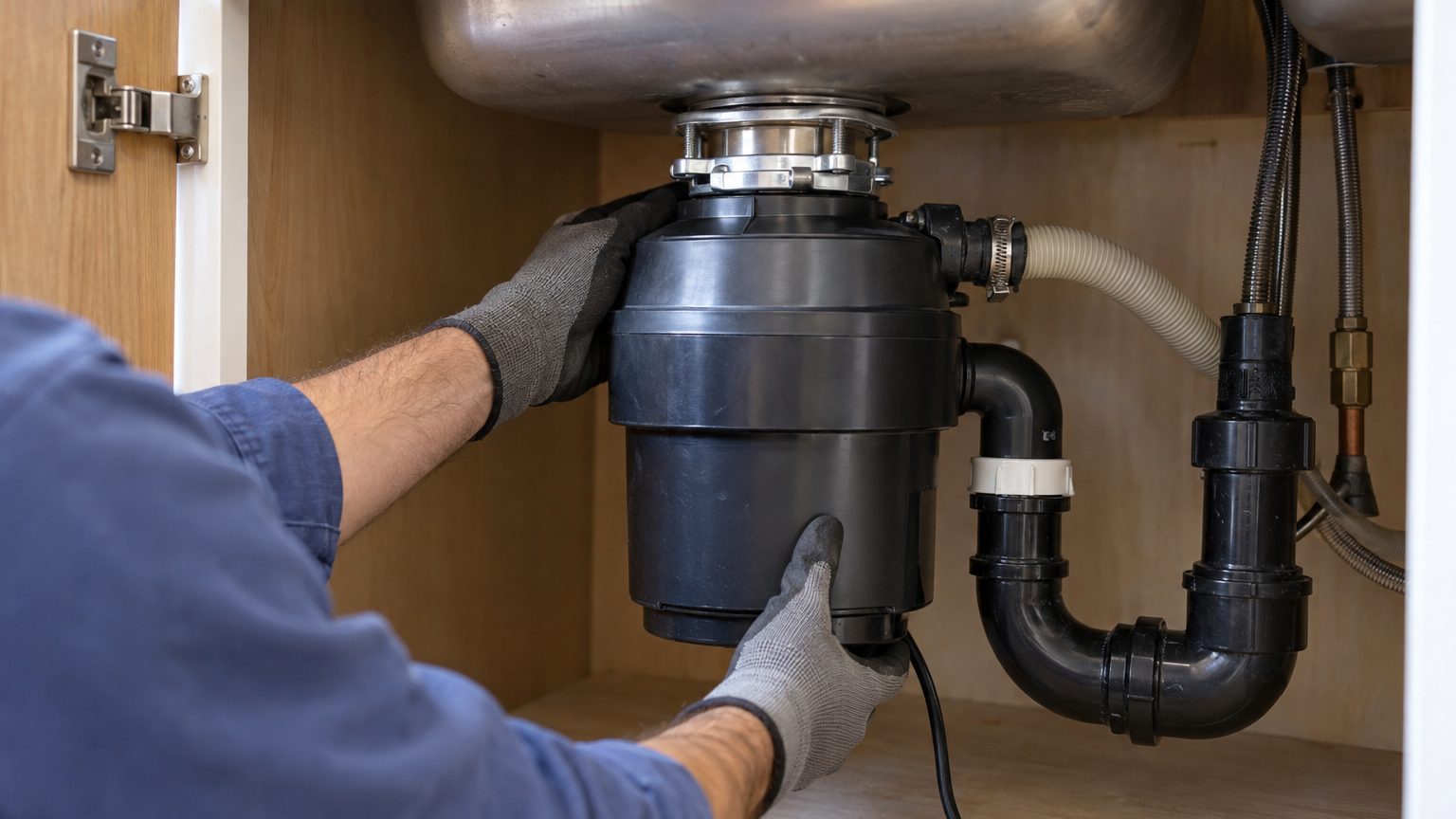
Most garbage disposal odor comes from food trapped under the rubber splash guard. The blades and motor get blamed, but they’re rarely the source. That changes where you should start.
Start under the rubber flaps, and the rest takes about fifteen minutes.
A holiday dinner is a stress test for the kitchen sink. Potato peels, gravy-streaked plates and pan scrapings all land on a drain that may already smell like last month’s breakfast. Knowing how to clean a garbage disposal the day before the feast is cheap insurance, and it costs almost nothing.
- Most disposal odor comes from food trapped under the rubber splash guard.
- Ice, kosher salt and cold water scour the impellers in about half a minute.
- Grease, starchy foods and stringy vegetables are the items that most often jam or smell up a disposal.
Start with the part you can see
Kill the power first, by flipping the breaker or unplugging the unit if it has a cord. Pull on gloves and grab a scrubber. Dust some baking soda on and under the rubber splash guard, add a splash of white vinegar, and scrub both sides of every flap. The splash guard can quickly become disgusting, and it’s where most of the odor is probably coming from.
The underside is the problem area. It’s the part you never see, and it sits right where food splatter lands every time the disposal runs. A small brush works better than a sponge, since a sponge can’t reach into the folds. Expect a film of grayish slime, and don’t be surprised if the smell fades before you’ve touched the chamber below.
Keep your hand out of the opening, even with the power off.
The fifteen-minute deep clean
Now for the inside. Fill the unit with ice cubes to the brim, tip one cup of kosher salt on top, then run cold water with the power on until the ice is processed. The ice acts like a scouring pad: this helps scrub the impellers clean. The salt adds grit. Expect a loud, gravelly racket for about half a minute, which is normal.
Next comes the fizz. Pour in half a cup of baking soda, add a cup of white vinegar, and let it bubble for ten minutes. Don’t get generous with the quantities. Overusing these substances can cause a fizzy overflow, which is a mess you don’t want to mop up the night before guests arrive. Then flush with cold water.
Cleaning guides split on how much work the fizz does. I’d treat it as the deodorizing step and let the ice and the scrubbing do the mechanical cleaning.
Finish with citrus. Grinding some lemons in the disposal gets rid of the vinegar smell. Orange and lime peels work too, if that’s what’s in the fruit bowl.
You can also prep ahead. Put five or six small pieces of citrus peel in an ice cube tray and fill it with vinegar. Freeze it, then place a couple of these cubes down the disposal with water running. Make a tray this weekend and you’ll have a one-step refresh ready for the morning after.
Store-bought cleaners are a judgment call. Many won’t perfectly clean a disposal, and some can even damage it. Harsher products deserve extra caution, since chemical drain cleaners can damage your pipes and disposal unit.
Keeping it fresh through the feast
Cold water is the quiet hero of disposal care. Run the water before, during and after each use, so food and splatters don’t sit in the top of the disposal. Cold also matters because it helps avoid grinding or overheating and moves the particles through the drain.
Feed it a little at a time. Don’t put more than a handful of food waste in at once, and grind larger amounts gradually. Scraping a whole platter into the sink in one go is how a disposal ends up with a plug of mush in the trap.
Holiday menus are full of things a disposal handles badly. Stringy vegetables like celery, asparagus and corn husks can wrap around the blades and jam the unit. Pasta, rice and other starchy foods expand when exposed to water, and that can cause clogs as they accumulate. Potato peels belong in that category, as do turkey bones, which the blades will not entirely chop. Eggshells deserve a mention too, since the membrane inside can stick to the blades and create buildup.
Pour the gravy fat into a can, not the sink.
Grease, oil and fat may be liquids when warm, but they solidify as they cool, potentially clogging your pipes. Let them cool and put them in the trash. That coating inside the pipes is also a reliable source of the sour smell you’re trying to get rid of.
Coffee grounds are a disputed case. One camp says they won’t harm the disposal and may actually help eliminate odors. Another warns that they tend to build up and not wash away completely. Given the choice, I’d send them to the compost bin and skip the argument.
The disposal isn’t built for volume, either. The unit shreds food waste into pieces small enough, generally under 2 mm, to pass through plumbing. About half of US homes have one, and food scraps make up 10% to 20% of household waste. That’s a lot of leftovers for a small grinder under the sink, and the smell tends to show up when it’s asked to do too much.
How often, and what if the smell stays
Schedules vary. Some guides suggest cleaning at least once a week, while others say at least once a month is enough. If your household cooks daily, weekly is the safer bet. Once a month works for a couple who mostly eats out.
If a smell lingers after the full routine, something is probably lodged where your brush can’t reach. Switch the power off at the breaker and look into the chamber with a flashlight. Never reach in with your fingers. Use tongs or pliers to lift out anything you spot, such as a bottle cap, a fruit pit or a clump of stringy peel.
A last nuance on ice. Grinding a little ice every so often breaks up food buildup. It won’t disinfect or freshen the disposal, but it can reduce how often you need a deep clean. Think of it as a quick rinse between full cleanings.
Sources : reencle.co | stansac.com