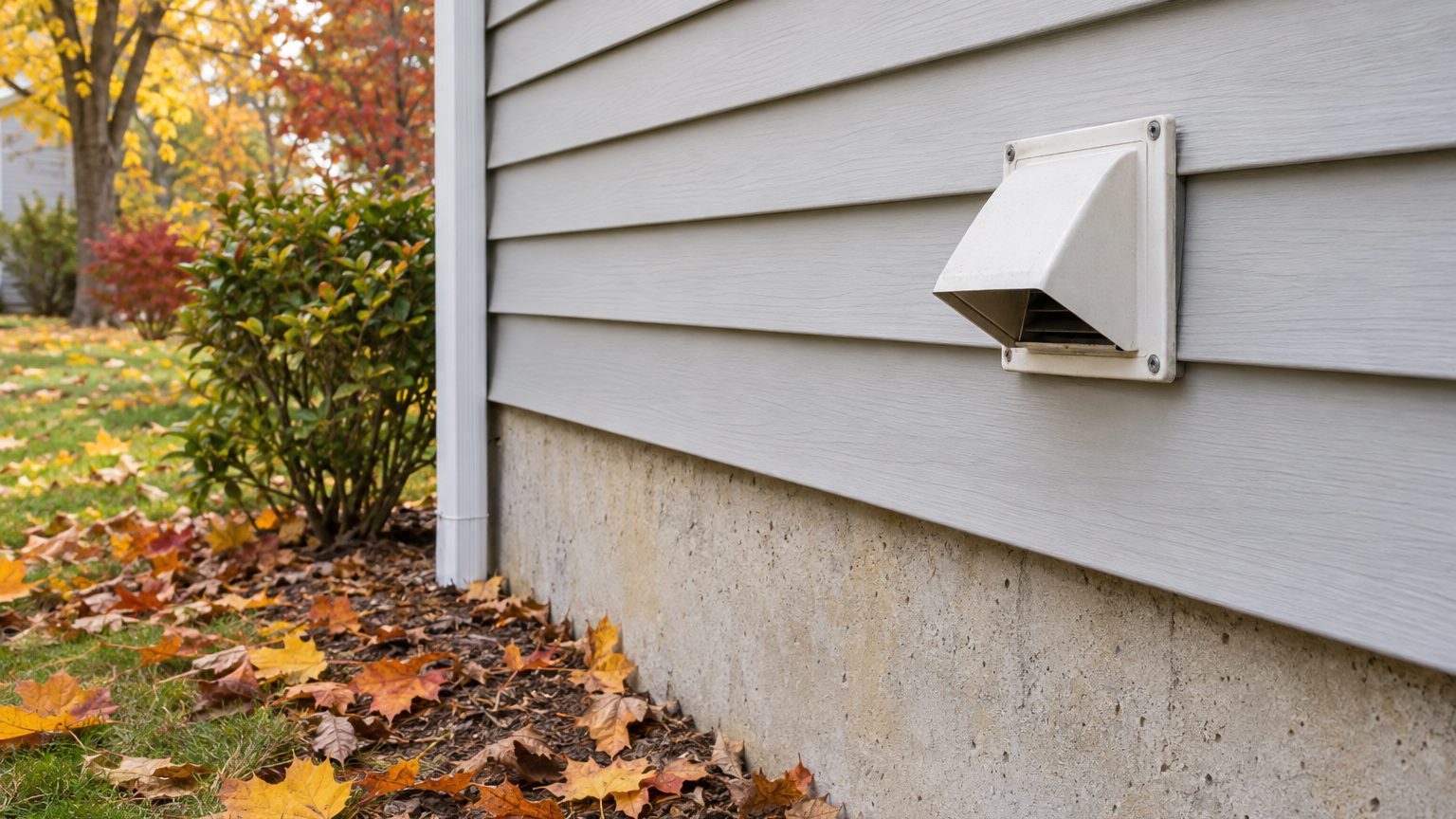
Late fall is when a dryer works hardest: bulky blankets, guest towels for the holiday weekend, and an outdoor vent hood that collects wet leaves now and will collect snow soon. The baseline for the duct, which is the pipe that carries hot, damp air from the dryer to the outside, is at least once a year. That’s the baseline from both the National Fire Protection Association (NFPA) and the U.S. Fire Administration (USFA). If clothes are taking longer than normal to dry, check the vent now, whatever the calendar says.
Once a year is the floor, and six months suits busier laundry rooms
The lint screen is not a complete filter. Some lint always slips past it and is blown into the duct, where moisture from the dryer makes it stick to the duct walls, a little more with every load. That is why a screen emptied after every load still leaves a duct that fills slowly. The USFA lists “failure to clean” as the leading factor (31%) in home dryer fire ignitions from 2018 to 2020.
Several things pull the interval below twelve months. Heavy laundry volume, pets, and long or winding duct runs with many elbows all let lint pack faster, and these households are usually told to clean about every six months. A rarely used dryer in a vacation home may need only the yearly cleaning. Massachusetts fire officials, for their part, advise clearing the vents outside the home twice a year.
Some appliance makers now make annual cleaning a condition of the warranty, so a claim on a burned-out heating element can be refused if you can’t show the duct was maintained. Check your manual before assuming the schedule is optional.
The five-minute airflow test at the outside hood
You can check the duct without tools. Clean the lint screen first so it can’t be the culprit, run the dryer on a heated cycle, and walk outside to the vent hood. You should feel a strong, warm stream of air and see the flap open. Little or no air means a blockage somewhere between the dryer and that flap. The Consumer Product Safety Commission (CPSC) gives the same core advice: look at the outside vent while the dryer runs to confirm exhaust air is escaping.
The slowest sign to ignore is the drying time. When a normal load needs two cycles, moist air has nowhere to go, so the clothes keep tumbling in warm humidity. Towels and jeans show it first. One heavy comforter needing a second round proves nothing, but ordinary loads that used to finish in one cycle and now never do point at the duct.
The other signs are easy to blame on the machine. A laundry room that turns muggy during a load means the exhaust is backing up into the house. Lint on the floor behind the dryer or caked on the outdoor louvers means the duct is not clearing it, and the visible amount is usually smaller than what sits inside. Clothes that smell musty straight out of a warm dryer point the same way, since damp lint and trapped moisture hold odors.
If the airflow outside is strong but clothes still come out damp, the vent is probably fine. In that case the likelier culprits are a worn heating element, a bad thermostat or a failing sensor.
Burning smells, hot cabinets and the ducts a brush kit can’t reach
A few signs mean the dryer stays off until someone has looked at it. These are a burning or scorched smell, a cabinet or nearby wall too hot to rest a hand on, a dryer that shuts off mid-cycle, a flap that never opens, and any trace of smoke. The shutoff is the machine’s thermal cutoff tripping on a restriction, which is a safety backup and not a fix. A burning smell does not always come from the vent, since a damaged belt or a motor problem can smell similar, but the response is identical: stop and have it inspected before another load.
The stakes are not abstract. NFPA data for 2014 to 2018 puts home dryer fires at an average of about 13,820 a year in the United States. Those fires caused around seven civilian deaths, 344 injuries and $233 million in direct property damage annually. Failure to clean was a factor in roughly 32% of them.
Doing it yourself works for a short, straight run, such as a dryer sitting against an exterior wall. Pull the dryer out, disconnect the duct, vacuum the lint from both ends, and run a flexible vent brush through from the dryer side, then clear the hood outside. Call a professional when the run passes through a wall or ceiling for more than about 20 feet, when the vent exits through the roof, or when you smell burning. Long runs need rotary-drive brushes, and a burning smell can mean lint has collected near the heating element, which needs the dryer opened up.
Check the duct material while the dryer is pulled out. Under the International Residential Code, section M1502, the duct should be rigid metal with a maximum run of 35 feet, though local codes vary. A crushed or kinked foil or plastic transition hose behind the machine will choke airflow regardless of how recently the vent was cleaned, and swapping it for rigid or semi-rigid metal is the cheapest improvement in the whole system.
Sources : localairhvac.com | lifetips.alibaba.com