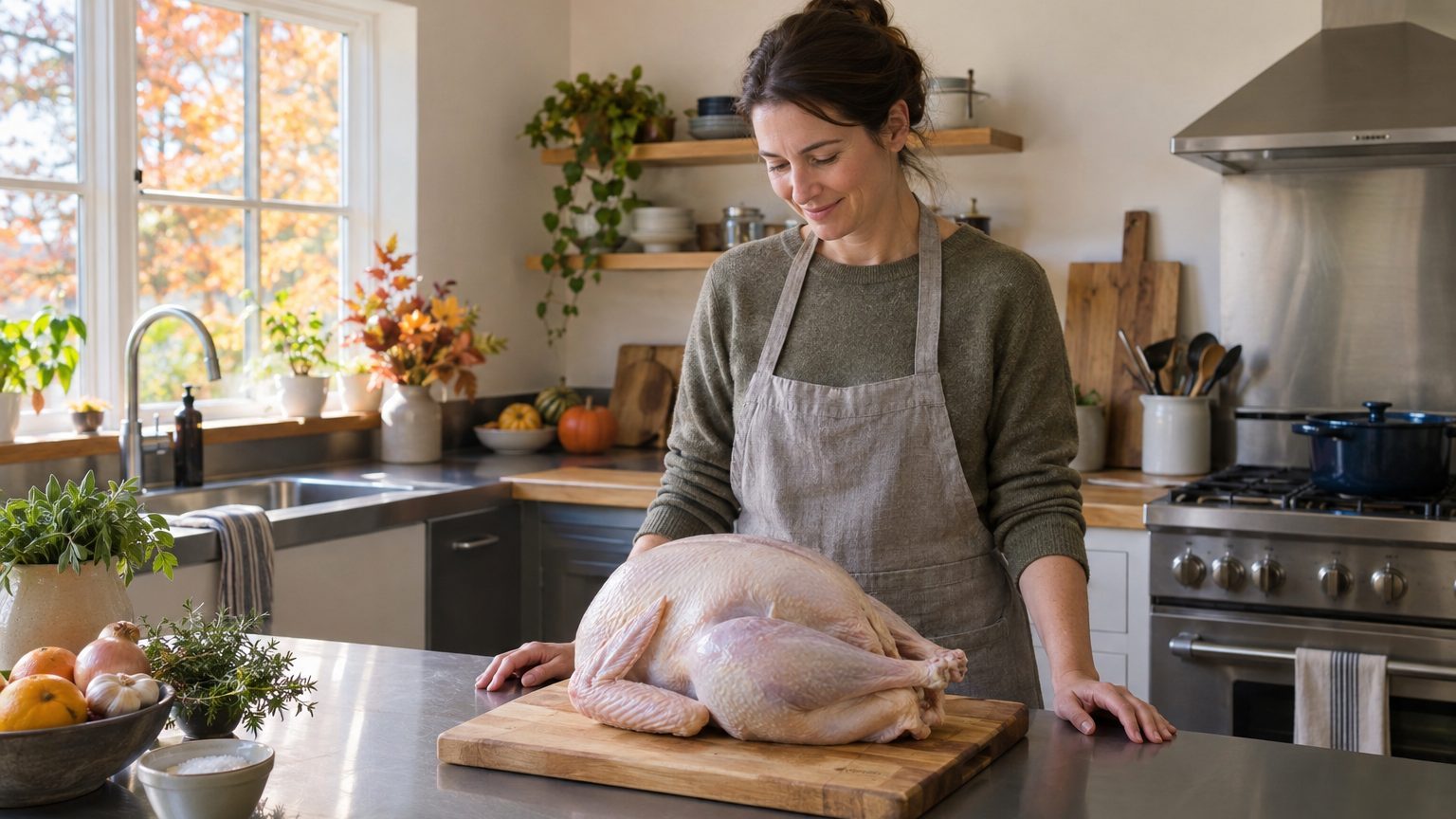
The USDA’s answer fits in one line: allow 1 pound of turkey per person, whether the bird is fresh or frozen. Ten guests means a 10-pound turkey, twelve means 12 pounds. Anyone asking “how big of a turkey do I need” for a real dinner table, with seconds and a plan for Friday’s sandwiches, will want to adjust that number.
That pound already covers bones, skin and the moisture lost in the oven.
- The USDA recommends one pound of turkey per person for fresh or frozen whole birds.
- Frozen pre-stuffed turkeys need 1¼ pounds per person because the stuffing adds weight.
- A pound of raw whole bird yields about eight ounces of usable raw meat.
- Plan 1½ pounds per person if you want leftovers.
The USDA math, and where it bends
The federal guidance in “Let’s Talk Turkey” is simple. One pound per person for fresh and for frozen whole birds, and 1¼ pounds per person for frozen pre-stuffed turkeys, because the stuffing takes up part of the weight. Eight guests, an 8-pound bird. Sixteen guests, 16 pounds.
The number looks stingy until you see what a raw turkey really holds. One chef puts it this way: a pound of raw whole bird gives roughly eight ounces of usable raw meat. Roasting then costs you another 20 to 30 percent, which leaves about five to six ounces of cooked meat per guest. A Rutgers extension bulletin, working from a range of 1 to 1½ pounds raw, estimates about 10 ounces of cooked meat at the top end. That is a comfortable dinner plate and not much more.
Children eat less, and planning guides commonly budget half a pound to three-quarters of a pound for each child. A table of six adults and four kids can therefore get by on a smaller bird than ten adults would need. Count heads by appetite, not just by chairs.
Leftovers rewrite the equation.
If cold turkey sandwiches, soup and a casserole are part of the plan, move to 1½ pounds per person. For six guests that is 9 pounds. For ten it is 15, and for twelve it is 18. Some chefs go all the way to 2 pounds per person as a ceiling, which makes sense only if the leftovers are the point of the exercise.
When the bird gets too big
Past 20 pounds, a single turkey becomes a logistics problem. It barely fits in many home ovens, the thickest part of the breast and the thighs finish at different times, and the carving takes forever. Two 12-pound birds will usually roast more evenly than one 24-pounder, and they leave you with four drumsticks instead of two. Most turkey planners recommend splitting the order once the total tops 20 pounds.
Smaller crowds have another option. University extension guidance lists a bone-in turkey breast at about three-quarters of a pound per person and a boneless breast at half a pound. For four or five people, a breast avoids the week of turkey that a whole bird forces on a small household.
Four guests? Skip the whole bird.
Shoppers sometimes round up out of anxiety, and the instinct is understandable. Nobody wants to run short of the main dish. But a surplus of five pounds means five pounds of raw turkey to store, and cooked turkey keeps only a few days in the refrigerator. Buy for the dinner you are actually hosting, plus a deliberate cushion of 2 or 3 pounds if you want one.
Buying and thawing: the schedule that follows the size
Weight decides the calendar as well as the budget. A fresh turkey should be bought only one to two days before cooking. A frozen one needs about 24 hours in the Refrigerator for every 4 to 5 pounds, so a 15-pound bird needs three to four days of thawing before roasting day.
A 20-pound bird needs four to five days. That detail catches people out every year. They buy the larger turkey on Monday, find it still rock hard on Wednesday, and end up improvising with a sink full of cold water. The cold-water method works (roughly 30 minutes per pound, with the water changed regularly), but it demands attention and an immediate trip to the oven afterward.
Read the label before you commit. Some birds are sold with an added solution, which affects both flavor and sodium, and the USDA advises against buying fresh pre-stuffed turkeys at all. Whatever size you choose, use a food thermometer and cook to 165°F; a pop-up indicator alone is not enough to trust.
Frozen pre-stuffed birds follow different rules: they should not be thawed, and they go into the oven straight from the freezer, following the package directions.
Sources : best-calculators.com | foodnetwork.com